Books worth understanding, not just finishing.
Explore 475 carefully structured nonfiction summaries. Start with the central argument, keep the useful ideas, then decide what deserves a full read.
All book summaries

Supercommunicators
Supercommunicators asks why some conversations create trust and understanding while others produce advice, defensiveness, or division. It presents communication as a learnable practice of matching practical, emotional, and social needs, then applies questions, listening, vulnerability, negotiation, conflict skills, and identity awareness to everyday and high-stakes dialogue.
Superintelligence
Superintelligence examines how machine intelligence might surpass humanity, how quickly that transition could unfold, and whether its goals can remain under human control. It connects technical pathways and strategic power to value specification, economic change, and the choices that could make a beneficial or catastrophic future more likely.
Surely You're Joking, Mr. Feynman!
An audio-first portrait of Richard Feynman’s curiosity, from childhood radios and social experiments through wartime engineering, teaching, physics, art, drumming, and scientific self-criticism. It asks how playful independence becomes reliable understanding—and how testing mechanisms, assumptions, and evidence keeps cleverness from becoming mere appearance.

Switch
Switch explains why people and organizations struggle to change and asks how direction, emotion, and environment can work together. Its Rider–Elephant–Path framework turns that question into practical choices: find what works, make progress visible, redesign routines, and sustain new behavior through identity and social support.
Talking to Strangers
Talking to Strangers examines why people and institutions misread unfamiliar others. Through deception, diplomacy, sexual consent, interrogation, suicide, crime, and Sandra Bland’s traffic stop, it asks how truth-default, assumptions about visible emotion, and neglected context distort judgment—and how humility, restraint, and safeguards can reduce the damage.

Tao Te Ching
Tao Te Ching asks how to live and govern when reality exceeds every fixed name. It explores whether yielding, humility, stillness, and enoughness can guide action more wisely than force, offering a framework for desire, leadership, conflict, and limits.
Team of Rivals
How did Abraham Lincoln defeat stronger rivals, turn them into a working cabinet, and lead a divided republic through civil war? Team of Rivals traces the relationships, political choices, military crises, emancipation debates, and reconstruction dilemmas that shaped his leadership, offering a study of judgment under pressure.

The 4-Hour Body
The 4-Hour Body asks how measurement, small interventions, and self-experimentation might reshape fat, muscle, performance, sleep, sex, and health. It offers practical protocols alongside skepticism about adherence limits, biological variation, imperfect evidence, and risk.

The 4-Hour Workweek
The 4-Hour Workweek asks how people can replace deferred retirement with a life organized around time, mobility, and chosen experiences. Ferriss’s DEAL framework—Definition, Elimination, Automation, and Liberation—connects dream-setting, selective productivity, automated cash flow, remote work, mini-retirements, learning, and service into a method for redesigning work and freedom.
The 48 Laws of Power
The book treats power as a social game beneath civilized appearances. This summary asks how influence is gained, protected, and read through hierarchy, reputation, concealment, dependence, emotional leverage, timing, and adaptation—and gives listeners a compact framework for recognizing the recurring mechanisms and tensions behind human relationships.

The 5 AM Club
Why do some people protect their best attention while others surrender it to distraction? The 5 AM Club presents an early-morning framework of movement, reflection, learning, habit formation, focused work, recovery, and service, asking how disciplined daily choices can turn potential into meaningful contribution.

The 5 Second Rule
The 5 Second Rule asks how to act before hesitation becomes excuses, fear, or avoidance. Mel Robbins presents a backward five-count followed by movement as a repeatable cue for changing habits, managing worry, practicing everyday courage, and pursuing more honest, purposeful action.
The 7 Habits of Highly Effective People
An adaptive outline for an audio-first summary of Stephen R. Covey’s framework for effectiveness. It asks how people can replace inherited or superficial approaches with principle-centered habits, then translate self-mastery into trust, mutual benefit, empathic communication, creative cooperation, and sustained renewal.

The Affluent Society
Galbraith asks what an affluent society should value once private goods are abundant but public needs remain neglected. He traces how scarcity-era economics, manufactured wants, debt, inflation, and investment priorities preserve production as the main test of progress, then argues for poverty relief, education, humane work, public services, and survival.
The Age of AI
The Age of AI examines how machines that learn, discover patterns, and act beyond explicit human rules could change knowledge, platforms, security, and human identity. It asks how people can remain responsible when AI expands capability while obscuring reasoning, and offers a framework for deciding when to partner with, oversee, or limit it.
The Age of Surveillance Capitalism
Shoshana Zuboff asks how digital systems turned everyday experience into a privately owned source of behavioral prediction and influence. This summary follows the model from Google’s extraction of behavioral surplus through smart environments and behavior modification, then examines its effects on autonomy, sanctuary, democracy, and collective resistance.

The Alchemist
An Andalusian shepherd follows a dream of treasure near the Egyptian pyramids, leaving routine for markets, work, desert, danger, and love. The story asks how destiny is recognized and pursued, and what setbacks, attention, courage, and reciprocal connection reveal about the value of a journey whose goal may lie closer than expected.
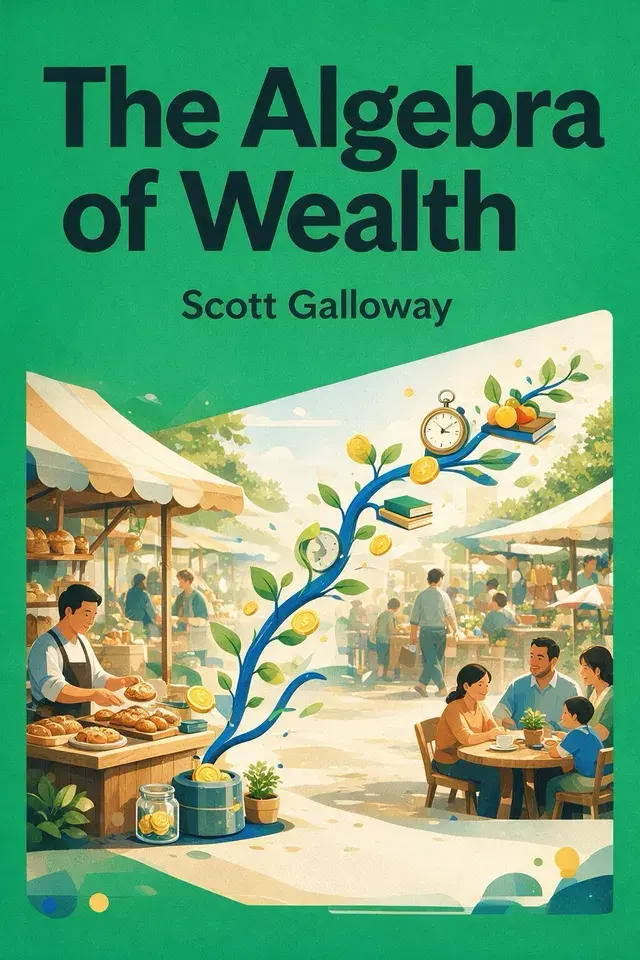
The Algebra of Wealth
Scott Galloway’s framework asks how people can turn work, restraint, time, and investment into economic security rather than endless consumption. It connects character, career fit, compounding, budgeting, diversification, and tax-aware choices, then returns to the purpose of wealth: preserving options and making more room for relationships and care.