What you'll learn
Key ideas from How To Be A Stoic
These ideas compress the book's argument without treating the author's view as settled fact. Use them as an orientation before reading the full work or listening in Wiseley.
Stoicism frames living well as a universal practical question answered through virtue, emotional awareness, social responsibility, and preparation for death.
Stoic freedom directs effort toward judgment, choice, preparation, and conduct while treating outcomes as influence rather than possession.
Virtue outranks external fortune lexicographically: externals may be exchanged among themselves, but never for compromised integrity.
Mistaken assent and cognitive dissonance help explain wrongdoing, while compassion supports correction without making harm acceptable.
Anger and anxiety are approached through reframing, preparation, practical action, and attention to character rather than control of outcomes.
Natural attachment becomes morally trustworthy only when reason trains it to express care, justice, and virtue.
Preparation, negative visualization, and deliberate pauses turn adversity into occasions for practical virtue rather than emotional suppression.
Nightly ethical review joins candid accountability with self-forgiveness, lessons, and openness to advice.
Inside How To Be A Stoic
Read the first chapter in full here. The other 8 continue in the Wiseley app.
Chapter 1 of 9 · 5 min · Audio & text
The Stoic Project
How To Be A Stoic, by Massimo Pigliucci.
How should a human being live? For Pigliucci, this is not an academic puzzle. It concerns how we handle adversity, treat other people, and prepare for death. Religions, philosophies, meditation, and science offer many answers, but their variety confirms the question’s reach. Stoicism enters as one proposed way of life, judged by whether it helps human beings live well.
Pigliucci identifies as a Stoic, but rejects the stiff upper lip often attached to the label. Stoic emotional discipline begins with recognizing feelings, examining their causes, and redirecting them constructively. Inner attention is not withdrawal from society. The philosophy links virtue to conduct, care for other people, and concern for humanity and Nature. Health, education, and wealth may be preferred, yet they do not determine moral worth. Death belongs to the same framework: it is unavoidable and natural, so learning to face it is connected with learning to live well.
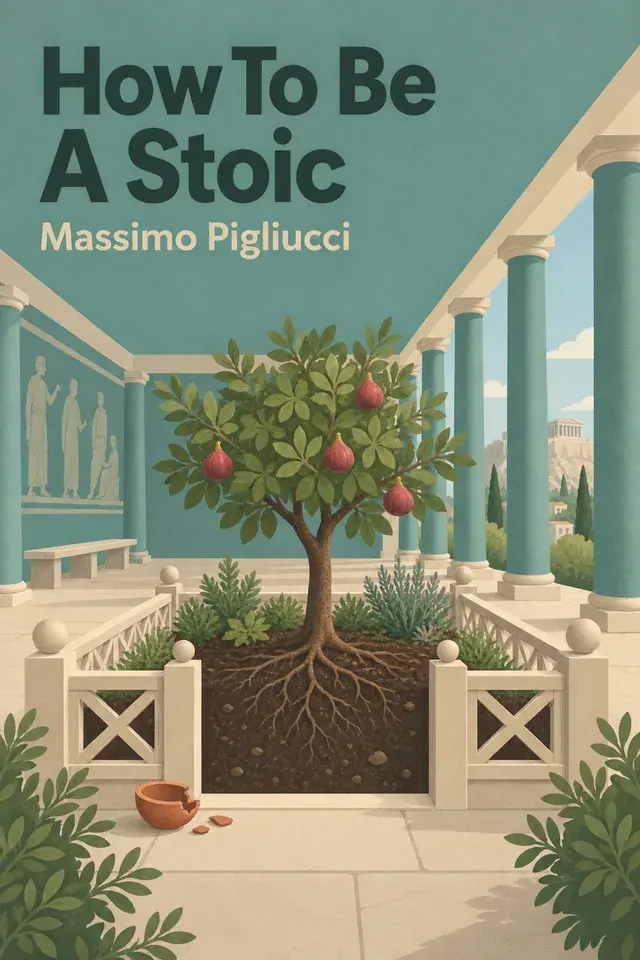
That framework becomes clearer through Stoicism’s history. The school began in Athens around 300 BCE, after Zeno, a merchant from Citium, turned to philosophy following a shipwreck, read Xenophon, and studied with Crates. Crates used a broken lentil-soup pot to expose Zeno’s shame over an event that had caused no real harm. Zeno later founded a public school at the Stoa Poikile, and Chrysippus gave the tradition much of its intellectual force. Stoicism grew through inheritance and argument with rival schools. Though those schools disagreed about virtue, pleasure, metaphysics, and knowledge, they shared the broad aim of eudaimonia, a flourishing human life. The tradition later moved into Roman culture and remained influential after antiquity.
Stoicism was practical, but not anti-theoretical. Its ethics depended on understanding the world and the ways human reasoning succeeds or fails. The ancient categories were broader than their modern labels: physics included nature, metaphysics, and theology; logic included reasoning, knowledge, rhetoric, and psychology; ethics concerned character and habits. Chrysippus’s garden captures the integration. Ethics is the fruit, physics the soil that nourishes it, and logic the fence that keeps destructive reasoning out. Theory matters because it supports a good life.
Epictetus organizes the practical side into three disciplines: desire, action, and assent. Desire concerns what we seek or avoid, guided by a clearer sense of what lies within our power. Action concerns conduct in the world and its obligations to others, especially through justice. Assent concerns the impressions that reach the mind; before accepting them as judgments, we test whether they are reasonable, using logic and practical wisdom. Together, the disciplines connect understanding, conduct, and response.
Modern Stoicism must remain revisable. Science and cognitive research challenge some ancient assumptions, including the idea that people control their thoughts perfectly. Pigliucci treats this as a reason for training, not abandoning the project. The Stoic Logos can mean God or Nature’s rational intelligibility, leaving room for different metaphysical commitments. Its influence on modern psychological therapies and the encouraging but tentative self-reports from Stoic Week suggest relevance, not universal proof. Philosophy also differs from therapy: therapy addresses a specific problem for a limited period, while a philosophy of life offers a broader account of meaning and conduct.
Pigliucci uses Epictetus as his guide, drawing on Arrian’s record of the Discourses while questioning ancient claims when needed. The book follows the same map: desire and control, action and character, assent and difficult emotions and relationships, then practical exercises. The Stoic project is an integrated, socially engaged, open-ended attempt to live by virtue. Its measure is neither numbness, withdrawal, nor worldly success, but the quality of judgment and conduct with which a person meets life.
Chapter 2 of 9 · 7 min · Audio & textIn the app
Freedom Within What Happens
Stoicism begins with a practical question: where should effort go when life refuses to cooperate? Its answer is to make the best use of what lies within our power and accept the rest as it occurs.
Chapter 3 of 9 · 6 min · Audio & textIn the app
Virtue Above External Fortune
Once circumstances are understood as things we do not command, a deeper Stoic question appears: how should we rank them? Stoicism answers with a strict moral hierarchy.
Chapter 4 of 9 · 7 min · Audio & textIn the app
Character, Error, and Moral Repair
Stoicism’s good life comes down to character: the durable core beneath occupations, titles, and social costumes. Epictetus asks us to notice the price at which we sell our will.
Chapter 5 of 9 · 6 min · Audio & textIn the app
Models for Agency Under Pressure
Stoicism becomes most revealing when circumstances strip away ordinary choices. Agency is not a claim that people control everything.
Chapter 6 of 9 · 8 min · Audio & textIn the app
Mortality and Difficult Emotions
Once Stoicism reaches the edge of life, its distinction between events and our judgments meets its hardest test. The author begins with his own fear of death: biological knowledge and optimism did not remove the disturbance caused by imagining consciousness ending.
Chapter 7 of 9 · 5 min · Audio & textIn the app
Love, Friendship, and Moral Loyalty
Stoicism does not begin its account of love by distrusting feeling. It asks whether feeling has been educated by judgment.
Chapter 8 of 9 · 7 min · Audio & textIn the app
Exercises for Attention and Resilience
Stoic practice begins in the small interval between what happens and what we make of it. Pigliucci treats Stoicism as a living philosophy, not a fixed catechism.
Chapter 9 of 9 · 7 min · Audio & textIn the app
Social Practice and Choosing a Philosophy
Stoic practice reaches its real test in company. Private exercises train attention, but a philosophy of life must also change how a person speaks, listens, chooses companions, responds to hostility, and evaluates the day.
Chapter 1 of 9 · 5 min · Audio & text: The Stoic Project
Wiseley supports reading and listening to summaries in the app.
Continue in WiseleyAbout Massimo Pigliucci

Massimo Pigliucci is a philosopher, biologist, and professor at the City College of New York. “How To Be A Stoic” explores how an ancient philosophy can guide modern life without denying emotion, uncertainty, or social responsibility.
Explore more books by Massimo Pigliucci