What you'll learn
Key ideas from How to Be an Epicurean
These ideas compress the book's argument without treating the author's view as settled fact. Use them as an orientation before reading the full work or listening in Wiseley.
Bodies and void form the basis of the Epicurean account of a world made from changing material arrangements.
Pleasure and pain are natural guides, but prudence weighs their likely effects across time.
Justice is a reciprocal human agreement for reducing harms that people cannot reliably prevent alone.
Accepting mortality supports preparation and relief of suffering without promising an afterlife or excusing preventable harm.
Empiricism supports careful revision while leaving room for accommodation when evidence cannot resolve a dispute.
Institutions are judged by their effects on suffering, security, freedom, and shared opportunity.
Modest needs, shared pleasures, cooperation, and evidence-informed choices can support well-being within ecological limits.
Inside How to Be an Epicurean
Read the first chapter in full here. The other 13 continue in the Wiseley app.
Chapter 1 of 14 · 5 min · Audio & text
A Material World in Motion
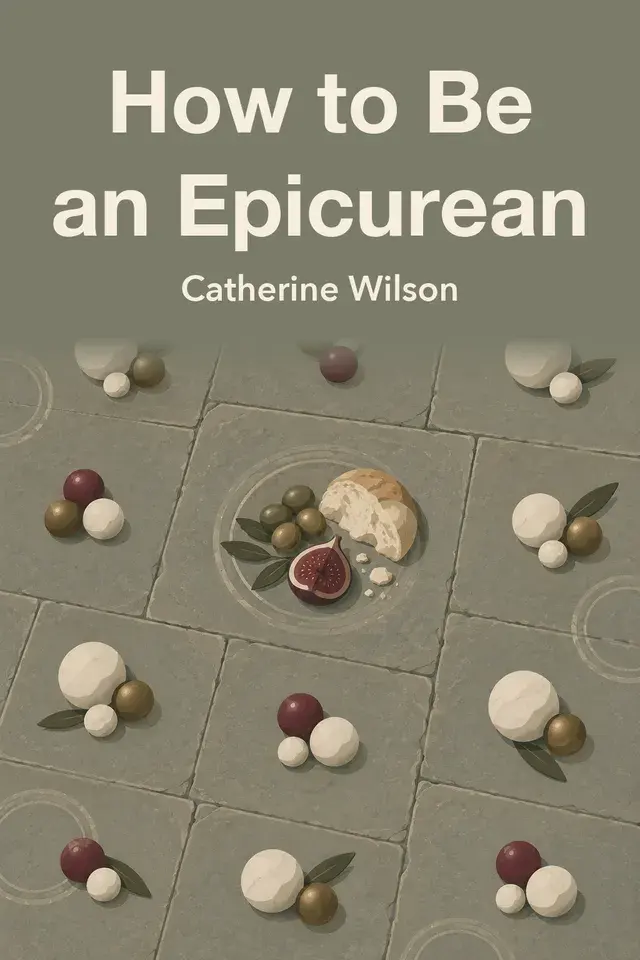
How to Be an Epicurean, by Catherine Wilson.
The book’s naturalistic framework begins with a simple picture: bodies move through empty space, or void. Some bodies are compounds, while others are the tiny, unchanging constituents from which compounds are made. The familiar world consists of these constituents arranged in different ways. Void matters because bodies need room to move and combine.
Ordinary wear offers a clue to this picture. A ring becomes thinner as it rubs against a finger. Water drops hollow stone, while the feet of a crowd wear stone pavements. We see the larger object changing, though we cannot watch each tiny piece leave it. The Epicurean inference is that visible things are made of smaller constituents. Their loss explains change without requiring matter itself to disappear.
The argument continues from change to permanence. The things we experience wear away or break apart, but they do not simply turn into nothing. If their material vanished, there would eventually be nothing from which anything new could form. Epicurus therefore proposed eternal, uncreated constituents beneath the temporary forms we encounter. This does not require an eternal maker. The basic elements have no intelligent creator or supervisor, and their combinations follow no master plan.
Epicurean atoms were conceived as too small to perceive directly. They had different sizes and shapes, but no color, taste, or scent in themselves. They moved, struck one another, rebounded, and sometimes caught together. Epicurus also proposed that atoms could swerve unpredictably. In this account, motion is not guided toward a goal; encounters and changing arrangements are enough for patterns to arise and persist for a time.
Those arrangements can produce qualities and powers missing from their separate parts. Letters provide a useful comparison. A letter alone may do little, yet letters arranged as a word or sentence can communicate, persuade, mislead, or prompt someone to act. The effects depend on how the pieces are put together. In the same way, matter arranged as a compound can have qualities that no isolated atom possesses. Complexity does not by itself point to a designer; it can emerge from the relations among simpler parts.
The same account applies to what we sense. Epicureans treated sights, sounds, tastes, and smells as material effects. They proposed that objects gave off thin films or particles that reached the senses. That particular account of vision is not accepted by modern science, but it shows their effort to explain perception through physical processes rather than supernatural ones.
Nor does an object’s appearance belong to it in quite the fixed way it may seem to. Color, taste, and scent depend on arrangements of matter, conditions such as light, and the perceiver’s sensory organs. The sea’s color, for instance, can look different as the light and viewing conditions change. The experience is real, but it is not simply a permanent color residing in the sea independently of every observer.
The observer is also a material arrangement, so perception partly depends on the body doing the perceiving. People share enough bodily features to perceive many everyday things in similar ways, but they can differ in their responses to foods, colors, and scents. Other animals, with differently organized senses, may experience aspects of the world that humans do not. This does not mean every perception is arbitrary. It means that appearances arise through an interaction between what is perceived and the perceiver.
Compounds differ in how long their arrangements last. Some resist change; others break down more readily. But everything we experience apart from the basic constituents is perishable. The material account makes this fragility part of nature itself: forms come together, persist for a while, and eventually disperse. Matter can be reorganized into new forms even as particular objects and structures wear out.
Ancient atomism therefore anticipates a material explanation of the world, but it is not modern physics in miniature. Epicurean atoms were imagined as indivisible; modern science recognizes that chemical atoms have smaller components. The ancient account of sensory films also differs from current explanations. Its lasting contribution here is the broader framework: a changing world can be understood through matter, motion, and arrangement, without appealing to divine design. That shared picture gives the book a natural foundation for its later discussions of life, society, and human choices.
Chapter 2 of 14 · 7 min · Audio & textIn the app
Life, Selection, and Mind
Once matter can form stable arrangements, the question turns to living organization and mind. The naturalistic account begins not with a finished animal, but with simpler structures that combine, copy, vary, and persist.
Chapter 3 of 14 · 6 min · Audio & textIn the app
From Nature to Civilization
The story now shifts from nature to human institutions. Lucretius begins with adults living as solitary foragers, presumably carrying or followed by their children.
Chapter 4 of 14 · 8 min · Audio & textIn the app
Pleasure as Practical Judgment
Epicurean ethics starts from a simple observation: pleasure feels good, and pain feels bad. These are natural guides to what matters in a life, not commands from outside it.
Chapter 5 of 14 · 7 min · Audio & textIn the app
Justice as Human Agreement
If pleasure and pain are everyone’s natural stakes, a further question follows: how can people share a world when one person’s advantage may burden another? A lie may avert accusation; theft may answer hunger or acquisitiveness; exploitation and violence can also reward their users.
Chapter 6 of 14 · 6 min · Audio & textIn the app
Love, Sex, and Foreseeable Harm
Romantic and sexual relationships make the effects of desire unusually vivid. Attraction can bring intense pleasure, but intimate choices also expose other people to vulnerability.
Chapter 7 of 14 · 8 min · Audio & textIn the app
Mortality Without Consolation
Epicurean thought begins with a stark claim: when the body dies, the mind ends with it. Death is not a condition in which someone lies awake in darkness, suffers, or enjoys peaceful rest.
Chapter 8 of 14 · 6 min · Audio & textIn the app
What Counts as Real
When we ask whether something is real, we can be asking different questions. Does it exist in nature?
Chapter 9 of 14 · 5 min · Audio & textIn the app
Experience and Disagreement
Inquiry begins in lived experience. We learn about the world by seeing, hearing, tasting, touching, and noticing what happens to us.
Chapter 10 of 14 · 6 min · Audio & textIn the app
Science Without Certainty
Scientific inquiry begins with experience, but it cannot stop at what someone can see or feel at once. Many causes are hidden in microscopic processes or complex systems, so researchers extend observation with instruments and compare evidence across cases.
Chapter 11 of 14 · 7 min · Audio & textIn the app
Justice in Public Life
Justice reaches beyond how one person treats another. It also asks what political and economic arrangements make possible, and who bears their costs.
Chapter 12 of 14 · 7 min · Audio & textIn the app
Religion, Wonder, and Harm
Epicurean criticism of religion begins by separating wonder from stories about gods. Greek deities were often imagined as emotional powers who intervened in wars and brought plagues.
Chapter 13 of 14 · 5 min · Audio & textIn the app
Meaning Within Limits
A meaningful life need not be famous, wealthy, or devoted to a grand cause. The book considers two familiar accounts of meaning: achievement that earns recognition, and service that improves other people’s lives.
Chapter 14 of 14 · 5 min · Audio & textIn the app
Feeling, Stoicism, and Limits
At the close, Wilson places Epicureanism beside Stoicism as two full accounts of how to live, not merely collections of advice. Both connect views of nature, knowledge, politics, and ethics, and both seek a life less ruled by disturbance.
Chapter 1 of 14 · 5 min · Audio & text: A Material World in Motion
Wiseley supports reading and listening to summaries in the app.
Continue in WiseleyAbout Catherine Wilson

Catherine Wilson is a philosopher and historian of early modern thought. “How to Be an Epicurean” explores how a naturalistic philosophy can guide a good life without divine design or an afterlife.
Explore more books by Catherine Wilson