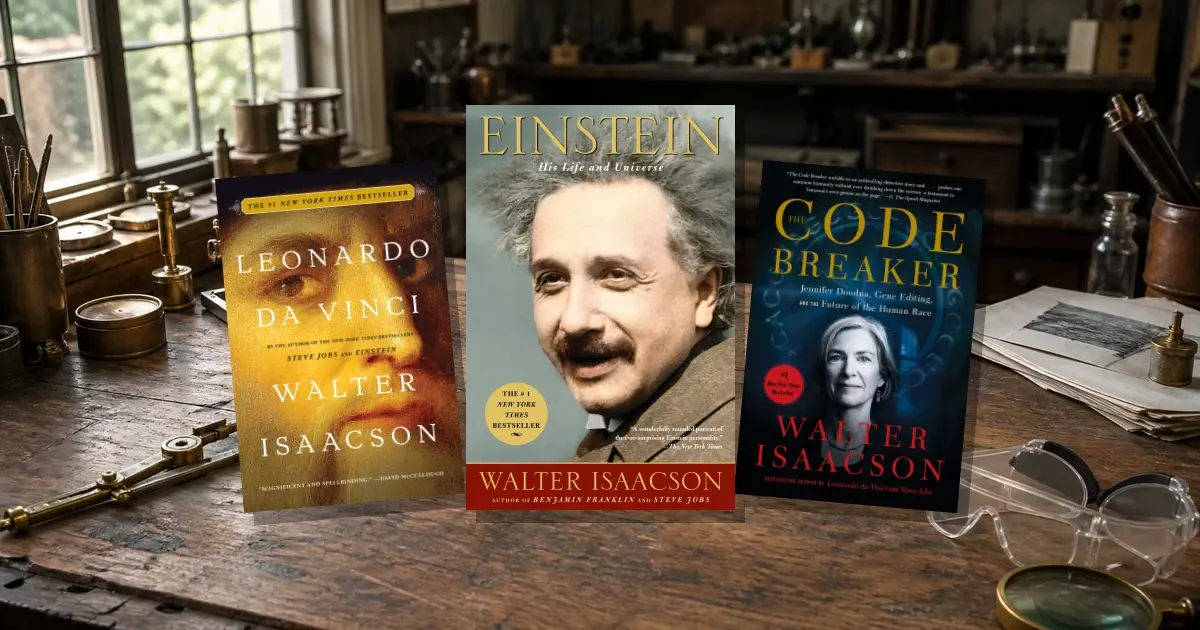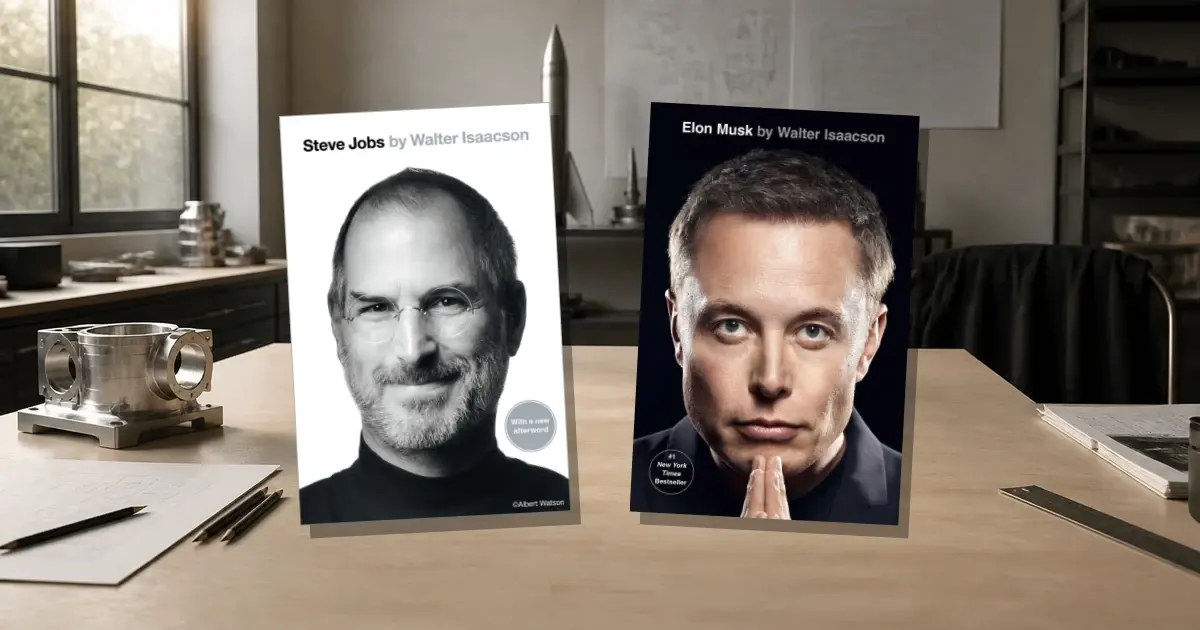

Ask what the writer could know
Biography combines traces: documents, testimony, objects, public acts, and gaps. An author must choose how to connect them. Instead of reading every life as a lesson in greatness, ask which evidence supports the portrait and whose experience complicates it.
Four subjects that resist the same success story
These books earn their place because they expose different relationships between a life and its record. The reading task shifts from notebooks to witnesses, from public leadership to the ethics of scientific institutions.
A mind encountered through its working pages
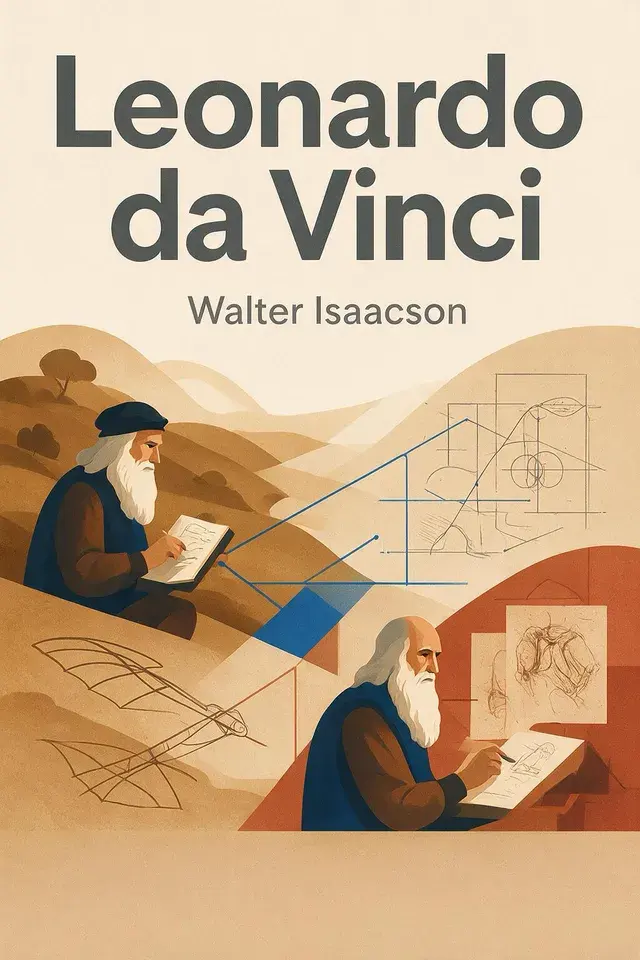
Leonardo da Vinci · Walter Isaacson
Walter Isaacson follows Leonardo’s art, investigation, and notebooks, attending to the connections between close observation and restless curiosity. Unfinished projects matter alongside finished work; they complicate the image of effortless genius.
- Read it for
- A creative life understood through observation and surviving work.
- Keep in mind
- The surviving record is uneven, and curiosity alone does not explain every achievement.

Place the public voice back inside the life
King: A Life · Jonathan Eig
Jonathan Eig’s portrait of Martin Luther King Jr. brings personal pressures and relationships into the story of public leadership. Read for the distance between a memorialized symbol and a person acting within a movement under sustained threat.
- Read it for
- Civil-rights leadership with personal and institutional context.
- Keep in mind
- A biography of King cannot replace histories of the many organizers around him.

Follow the family as well as the scientific story
The Immortal Life of Henrietta Lacks · Rebecca Skloot
Rebecca Skloot connects Henrietta Lacks’s life and family with the history of HeLa cells. The book’s structure resists letting scientific usefulness finish the ethical discussion. Questions of consent, knowledge, and recognition remain central to how the story is told.
- Read it for
- The human relationships behind a celebrated scientific resource.
- Keep in mind
- Its historical account should not be treated as a guide to current consent law.

Keep the costs inside the portrait
Steve Jobs · Walter Isaacson
Isaacson’s biography connects Jobs’s product ambitions with his working relationships and personal contradictions. Admiring an outcome does not require accepting every behavior associated with it. Notice which achievements were collaborative even when the narrative follows one dominant figure.
- Read it for
- The tensions between design judgment, organizational power, and relationships.
- Keep in mind
- A successful company does not prove that its leader’s conduct is a transferable management method.
Read against the central character
For each turning point, write down who supplied the evidence and who else made the event possible. Where a biography describes someone’s motive, look for the difference between a documented statement and the writer’s interpretation. That habit makes admiration and criticism less dependent on a compelling scene.
Sources and scope
Book ideas are attributed to their authors. External evidence is linked directly when a claim needs more than the source book.
- Leonardo da Vinci: Walter Isaacson follows Leonardo’s art, investigation, and notebooks, attending to the connections between close observation and restless curiosity. Unfinished projects matter alongside finished work; they complicate the image of effortless genius. Scope: The surviving record is uneven, and curiosity alone does not explain every achievement.
- King: A Life: Jonathan Eig’s portrait of Martin Luther King Jr. brings personal pressures and relationships into the story of public leadership. Read for the distance between a memorialized symbol and a person acting within a movement under sustained threat. Scope: A biography of King cannot replace histories of the many organizers around him.
- The Immortal Life of Henrietta Lacks: Rebecca Skloot connects Henrietta Lacks’s life and family with the history of HeLa cells. The book’s structure resists letting scientific usefulness finish the ethical discussion. Questions of consent, knowledge, and recognition remain central to how the story is told. Scope: Its historical account should not be treated as a guide to current consent law.
- Steve Jobs: Isaacson’s biography connects Jobs’s product ambitions with his working relationships and personal contradictions. Admiring an outcome does not require accepting every behavior associated with it. Notice which achievements were collaborative even when the narrative follows one dominant figure. Scope: A successful company does not prove that its leader’s conduct is a transferable management method.
To report a factual, attribution, rights, or accessibility concern, email hello@wiseley.app.