What you'll learn
Key ideas from How to Avoid a Climate Disaster
These ideas compress the book's argument without treating the author's view as settled fact. Use them as an orientation before reading the full work or listening in Wiseley.
Near net zero means reducing gross emissions as far as possible and balancing residual emissions with removals; it does not mean every emission disappears.
A credible climate solution must make a meaningful, scalable contribution toward eliminating the roughly 51 billion tons of annual emissions and remain affordable worldwide.
A reliable zero-emissions grid combines firm generation, variable renewables, storage, efficiency, and responsive demand because each addresses a different reliability constraint.
Steel, cement, and plastics need different routes: electrolysis, altered chemistry or capture, and cleaner carbon feedstocks with long-term storage.
Population growth, rising incomes, and meat-heavy diets can increase food demand faster than population, making higher yields central to protecting forests.
Transport decarbonization proceeds from avoiding movement to efficiency, suitable electrification, and cleaner fuels for battery-constrained modes.
Adaptation complements mitigation by reducing exposure, preparing for emergencies, responding effectively, and rebuilding more safely.
Zero-emissions progress depends on a linked sequence from public research and commercial proof to infrastructure and dependable demand.
Inside How to Avoid a Climate Disaster
Read the first chapter in full here. The other 10 continue in the Wiseley app.
Chapter 1 of 11 · 9 min · Audio & text
Why the Destination Is Zero
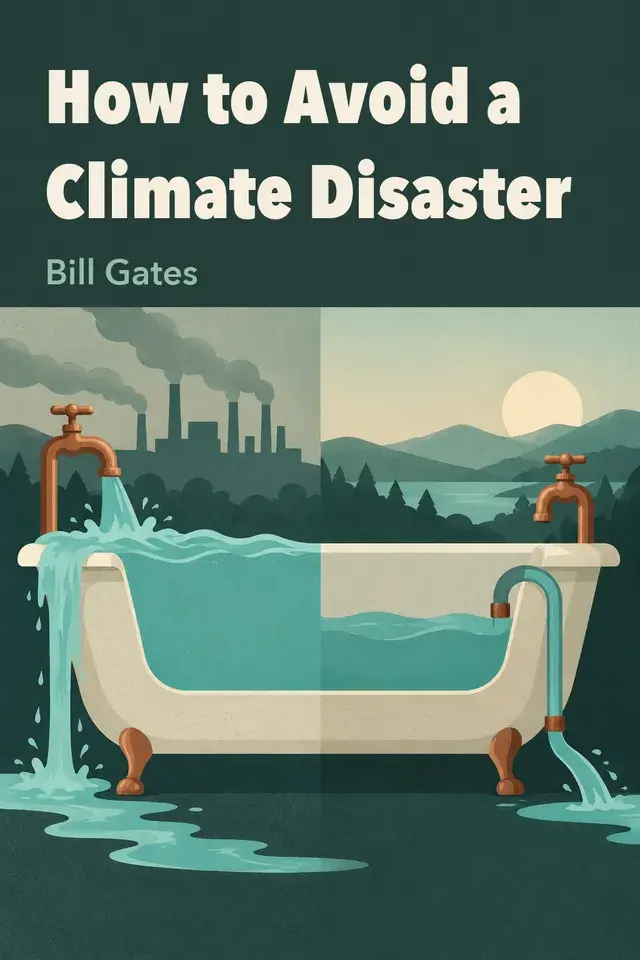
How to Avoid a Climate Disaster, by Bill Gates.
Climate safety has a destination: near net zero. The book starts from a working estimate of roughly 51 billion tons of greenhouse gases added to the atmosphere each year. The total matters because these gases accumulate. Continuing to add them keeps increasing the amount of heat the climate system must retain. At the same time, billions of people need more dependable energy, better housing, transport, food production, and opportunities to improve their lives. The challenge is therefore not to make the world use less energy in general. It is to provide more energy services without adding greenhouse gases.
The physical reason begins with radiation. Sunlight mostly passes through greenhouse gases and warms Earth’s surface. The warmed planet then sends energy back outward as radiation. Some of those wavelengths are absorbed by molecules such as carbon dioxide and methane. Their vibrations transfer energy to the atmosphere, strengthening the natural greenhouse effect. That natural effect makes Earth habitable; the problem is that human activity has added more heat-trapping gases and pushed the effect further. The atmosphere must warm before it can release enough energy to restore balance.
This distinction explains why annual emissions and atmospheric accumulation are different. Annual emissions are the inflow, while the gases already in the atmosphere are the water in a bathtub. Slowing the faucet makes the tub fill more slowly, but it does not lower the water level. A partial emissions cut can postpone the worst outcomes without stopping the buildup. The book combines different gases in carbon dioxide equivalents, or CO2e, so that carbon dioxide, methane, and nitrous oxide can be counted in one broad measure. That accounting is useful, but imperfect: gases differ in warming strength, persistence, and timing, so CO2e does not capture every aspect of temperature or harm.
Near net zero does not mean eliminating every gross emission. Some activities, including parts of cement and fertilizer production or methane leakage, may continue to emit. The aim is to reduce emissions as far as possible and balance the residual amount with removals from the atmosphere. To avoid the worst climate scenarios, the book says the world will eventually need to remove some of the greenhouse gases it has already emitted and take more greenhouse gases out of the atmosphere than it puts in. The essential destination, however, is to stop adding to the atmospheric burden. Reaching it would not immediately make the planet cool, because greenhouse gases remain for a long time. It would stop the problem from getting worse in the same way.
A small change in global average temperature can therefore have large consequences. The last ice age was about six degrees Celsius colder than the present, while the dinosaur era may have been about four degrees warmer. Against that planetary range, one or two degrees can sound modest, but it represents a major shift in the conditions under which societies and ecosystems developed. Global averages also conceal uneven regional changes. Some areas have already warmed by more than two degrees. Models cannot specify every local outcome or the exact timing of the most damaging effects, and no individual heat wave or storm can always be attributed to climate change alone. But uncertainty about details does not remove confidence about the direction of risk.
Development needs make the equity problem concrete. In Lagos, unreliable electricity leaves streets dark and children doing homework by candlelight or other makeshift light. In remote villages, women and girls may spend hours collecting firewood for cooking. A clinic without reliable refrigeration cannot safely keep vaccines cold. Electricity also supports education, industry, jobs, and the basic services that make economic development possible. Asking communities in this position to consume less energy is not a climate solution. The energy they need must become affordable, reliable, and clean.
The book uses a hypothetical prosperous farmer in Nebraska to show how climate damage can compound. By 2050, hotter days and less dependable rain might reduce the farm’s productivity and put stress on crops and livestock. A flood could then damage fields, crops, and feed. If transport links became unusable, the farmer might be unable to receive supplies or move a harvest to market. Measures that reduce routine heat stress would not necessarily prevent this chain of crop, livestock, infrastructure, and logistics failures. The family farm could be threatened by the interaction among several pressures, not by one isolated event. This is a thought experiment, not a prediction for every Nebraska farm, and the likelihood and severity of each local outcome remain uncertain.
Subsistence farmers have less room to absorb a comparable shock. For a rural Indian family, extreme heat, pests, reduced rainfall, and water scarcity can affect food, income, and the possibility of remaining on the land at the same time. Hunger, migration, or family separation may follow. A prosperous farmer may lose assets; a subsistence farmer may lose the means to survive the next season. Climate pressures can contribute to displacement and instability, but they are not a single explanation for any conflict. The important point is the unequal capacity to prepare, endure losses, and recover.
That difference separates mitigation from adaptation. Adaptation reduces harm from changes already underway or expected, such as developing crops that tolerate drought or flooding. Mitigation stops additional greenhouse gases from entering the atmosphere. Both are necessary. Even successful adaptation cannot remove the accumulated gases, and mitigation cannot prevent every near-term effect because the climate will remain warm for a long time. Detailed resilience measures belong later, but the principle is already clear: protecting vulnerable people must accompany the drive toward net zero.
The pandemic offers a final caution. In 2020, the shutdown of ordinary economic activity produced a likely emissions decline of about five percent compared with the previous year, yet it came with roughly a million deaths and tens of millions of lost jobs. A reduction achieved through people staying home, driving less, and flying less was both too small and too socially destructive to provide a route to zero. The comparison does not make efficiency or cleaner transport unimportant. It shows that the complete solution must change the energy, industrial, agricultural, building, and transport systems themselves.
The destination is therefore not a poorer world with less energy. It is a world where development can continue on a clean foundation. Near net zero defines the physical requirement, while Lagos, Nebraska, and subsistence farming define the human test. Every later solution must help replace emissions at scale, preserve reliable energy access, and reduce the unequal burden on people least able to withstand warming.
Chapter 2 of 11 · 9 min · Audio & textIn the app
A Framework for Judging Solutions
Once the destination is near zero emissions, the practical question is not whether a clean invention sounds promising. It is whether it can replace a carbon-emitting service at the scale people need and at a price the world can bear.
Chapter 3 of 11 · 10 min · Audio & textIn the app
The Grid Must Always Work
Electricity is the hinge of a clean economy. It can eliminate emissions from power generation and provide the energy needed for cleaner cars, steelmaking, heating, and other activities.
Chapter 4 of 11 · 8 min · Audio & textIn the app
Building a Clean Electricity Portfolio
Chapter 3 established that a grid must deliver electricity when needed, not merely generate clean power at favorable hours. Gates's answer is a portfolio: firm generation for long gaps, renewables where resources are strong, storage to move electricity through time, and efficiency or flexible demand to reduce the load.
Chapter 5 of 11 · 9 min · Audio & textIn the app
Remaking the Materials Around Us
Modern life relies on materials so ordinary that we stop noticing them. Buildings, roads, bridges, cars, phones, and household goods depend on cement, steel, plastics, and other manufactured inputs.
Chapter 6 of 11 · 13 min · Audio & textIn the app
Feeding People While Preserving Forests
Food is not a separate climate problem. It connects population, income, diets, livestock, crops, fertilizer, and land.
Chapter 7 of 11 · 9 min · Audio & textIn the app
Matching Transport to Clean Energy
Transport is not one machine with one replacement. Mobility supports personal freedom, access to markets, international connection, and food distribution, so decarbonization has to preserve its service.
Chapter 8 of 11 · 6 min · Audio & textIn the app
Comfort Without Warming the Planet
Cooling has become infrastructure, but access is uneven. The source describes about 1.6 billion air-conditioning units worldwide, while fewer than one in ten households in the hottest countries has cooling.
Chapter 9 of 11 · 10 min · Audio & textIn the app
Protecting Lives During the Transition
Reaching zero emissions remains essential, but the technologies and systems needed to get there will take decades to develop and spread. During that transition, nearly everyone alive will need some form of adaptation.
Chapter 10 of 11 · 12 min · Audio & textIn the app
Turning Invention Into Mass Adoption
Reaching zero emissions is not a matter of waiting for one miraculous machine. Gates’s argument turns the transition into a sequence: research, demonstration, commercial proof, infrastructure, and widespread adoption.
Chapter 11 of 11 · 7 min · Audio & textIn the app
Choosing Actions That Change Systems
The book’s institutional program becomes practical when we ask what a person can do from a particular position. Gates’s starting point is that most emissions are produced by the systems supplying ordinary goods and services, not by isolated personal decisions.
Chapter 1 of 11 · 9 min · Audio & text: Why the Destination Is Zero
Wiseley supports reading and listening to summaries in the app.
Continue in WiseleyAbout Bill Gates
Bill Gates is an American businessman and philanthropist. “How to Avoid a Climate Disaster” explores how the world can reach net-zero emissions while expanding access to affordable energy.
Explore more books by Bill Gates