
You do not need the same doorway into every subject
Mathematics can appear as a formal system, a way to describe changing systems, or a discipline for reasoning about uncertainty. These three books are a deliberately small reading route through those differences. They are not a mathematics curriculum, and their subjects should not be collapsed into a single idea of complexity.
Three distinct kinds of difficulty
Choose according to the question that holds your attention. A book can be accessible in its prose while asking for substantial concentration in its examples.

Follow the pattern into a formal system
Gödel, Escher, Bach · Douglas R. Hofstadter
Douglas Hofstadter connects logic, music, art, recursion, and questions of mind. The pleasure comes partly from working through constructions rather than receiving their conclusions. Its dialogues and formal examples make slow reading a feature, not a failure.
- Read it for
- Self-reference and the relationship between formal systems and meaning.
- Keep in mind
- The connections are ambitious; a summary cannot reproduce the experience of working through the book’s examples.

Watch simple rules become hard to predict
Chaos · James Gleick
James Gleick tells the story of research into nonlinear systems and sensitive dependence on initial conditions. Read for how a scientific field develops through people, problems, and changing ways of seeing. Mathematical chaos is not simply randomness or disorder.
- Read it for
- A narrative entrance into nonlinear dynamics and its scientific history.
- Keep in mind
- This is a history and explanation of ideas, not a substitute for the mathematics needed to model a system.
Ask how much of the pattern could be chance
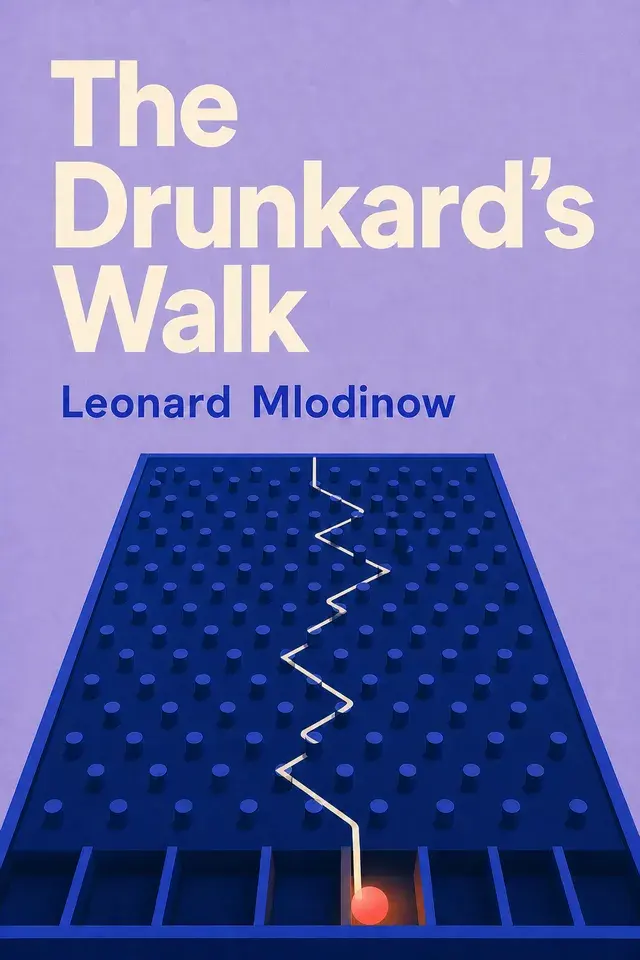
The Drunkard's Walk · Leonard Mlodinow
Leonard Mlodinow uses probability and statistics to challenge confident stories about streaks, success, and apparent skill. Its everyday examples make uncertainty visible where an outcome first looks obvious. Keep the distinction between changing the odds and determining the result.
- Read it for
- A reader-friendly examination of probability in ordinary judgments.
- Keep in mind
- Chance is not the only explanation; the task is to assess evidence rather than dismiss skill or effort.
Take the practical entrance or the formal one
Begin with Mlodinow if everyday decisions motivate you. Follow with Gleick to separate randomness from deterministic systems that are hard to predict. Save Hofstadter for a period when you can pause over a construction rather than rush to its takeaway.
- Everyday judgments
Chance and evidence
Start with a familiar outcome and ask what other outcomes the same process could produce.
Explore The Drunkard's Walk - Changing systems
Prediction has conditions
Notice why sensitivity to starting conditions is different from an absence of rules.
Explore Chaos - Formal patterns
Work through the construction
Keep a notebook for the examples that make self-reference concrete.
Explore Gödel, Escher, Bach
Sources and scope
Book ideas are attributed to their authors. External evidence is linked directly when a claim needs more than the source book.
- Gödel, Escher, Bach: Douglas Hofstadter connects logic, music, art, recursion, and questions of mind. The pleasure comes partly from working through constructions rather than receiving their conclusions. Its dialogues and formal examples make slow reading a feature, not a failure. Scope: The connections are ambitious; a summary cannot reproduce the experience of working through the book’s examples.
- Chaos: James Gleick tells the story of research into nonlinear systems and sensitive dependence on initial conditions. Read for how a scientific field develops through people, problems, and changing ways of seeing. Mathematical chaos is not simply randomness or disorder. Scope: This is a history and explanation of ideas, not a substitute for the mathematics needed to model a system.
- The Drunkard's Walk: Leonard Mlodinow uses probability and statistics to challenge confident stories about streaks, success, and apparent skill. Its everyday examples make uncertainty visible where an outcome first looks obvious. Keep the distinction between changing the odds and determining the result. Scope: Chance is not the only explanation; the task is to assess evidence rather than dismiss skill or effort.
To report a factual, attribution, rights, or accessibility concern, email hello@wiseley.app.