The quick answer
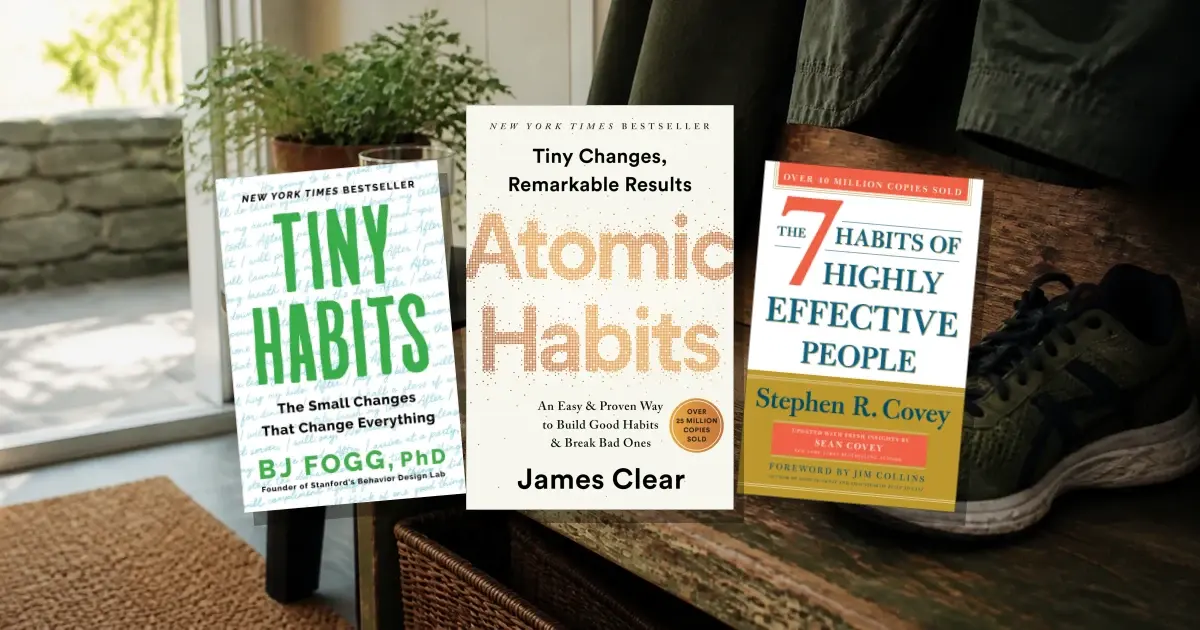
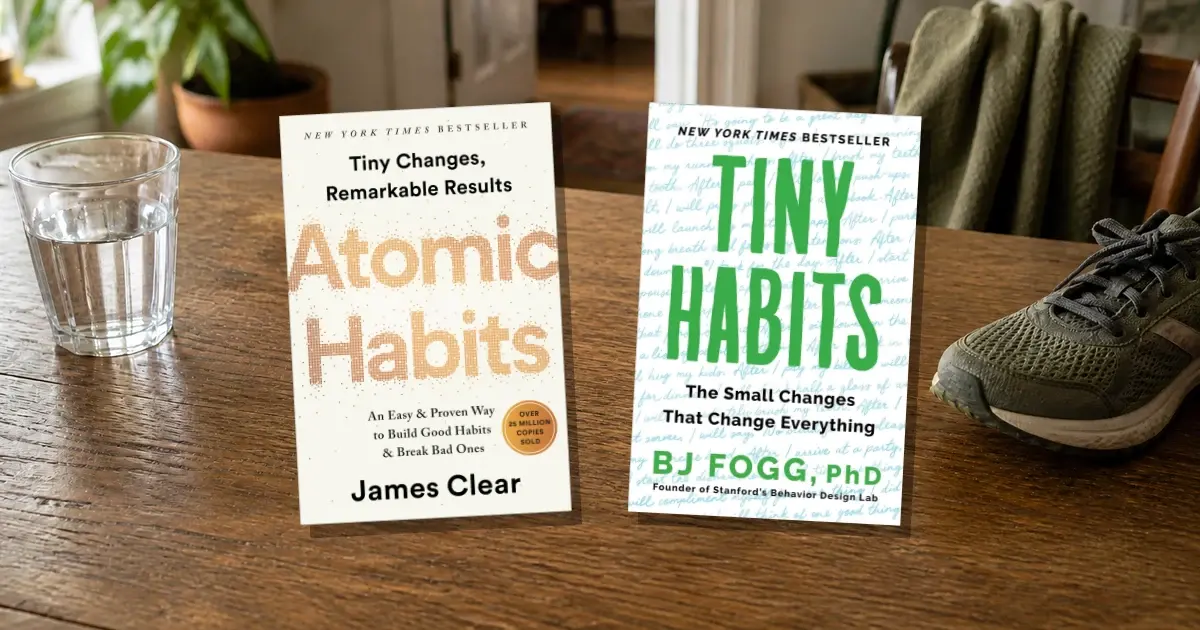
Choose Atomic Habits when you want to redesign a whole system: identity, cues, environment, friction, rewards, and review. Choose Tiny Habits when starting is the main problem and you need a behavior so small that it can happen even on a difficult day. The books overlap, but their center of gravity is different: James Clear emphasizes the architecture around repeated behavior, while BJ Fogg emphasizes making the first version easy enough to perform.
- System feels chaotic: start with Atomic Habits.
- Motivation keeps disappearing: start with Tiny Habits.
- You already start but do not stay consistent: use Atomic Habits for environment and tracking, then Tiny Habits to shrink the weakest step.
How the methods differ
Atomic Habits asks what kind of person a repeated action supports and how the surrounding system can make that action obvious, attractive, easy, and satisfying. Tiny Habits begins closer to the moment of action: identify a behavior, attach a very small version to an existing prompt, and mark the success immediately. One is especially good for auditing a routine; the other is especially good for lowering the emotional cost of beginning.
- Identity versus ability: Clear gives identity a central role; Fogg starts with whether the behavior is easy enough right now.
- Environment versus anchor: Clear broadens the context; Fogg gives the new action a precise place after an existing routine.
- Tracking versus celebration: Clear uses visible progress and review; Fogg uses an immediate positive feeling to reinforce completion.
A simple way to choose
Write the habit you want and the sentence that usually explains failure. If the sentence is “I forget,” “my space works against me,” or “I lose the streak,” begin with Atomic Habits. If it is “the task feels too big,” “I can only do it when inspired,” or “missing once makes me avoid it,” begin with Tiny Habits. After one week, borrow the other book’s strongest tool instead of treating either framework as a complete law of behavior.
- Define a version that takes less than two minutes.
- Give it an unmistakable cue or anchor.
- Review whether the obstacle was memory, ability, environment, or reward before making the habit larger.
Sources and scope
Book ideas are attributed to their authors. External evidence is linked directly when a claim needs more than the source book.
- Atomic Habits: Primary source for the identity, environment, friction, and review framework discussed here.
- Tiny Habits: Primary source for the anchor, ability, tiny behavior, and celebration framework discussed here.
To report a factual, attribution, rights, or accessibility concern, email hello@wiseley.app.
Questions readers ask
Do I need to read both books?
No. Start with the book that addresses your present bottleneck. Read the second only when you can name a gap the first framework did not solve.
Which book is better for someone who repeatedly quits?
Tiny Habits is often the cleaner starting point because it reduces the behavior before asking for consistency. Atomic Habits becomes useful once the action exists and its wider system needs reinforcement.