

A meditation book and a book about presence are different
The titles on this shelf use overlapping words but do different work. Some connect meditation to ethics and community; others describe a relationship to thought or a broader ideal of stillness. This is a guide to reading those approaches, not a clinical assessment of their effects or a prescribed practice program.
Read the frame around the practice
The selection makes the distinction visible rather than presenting every reflective book as a step-by-step course.
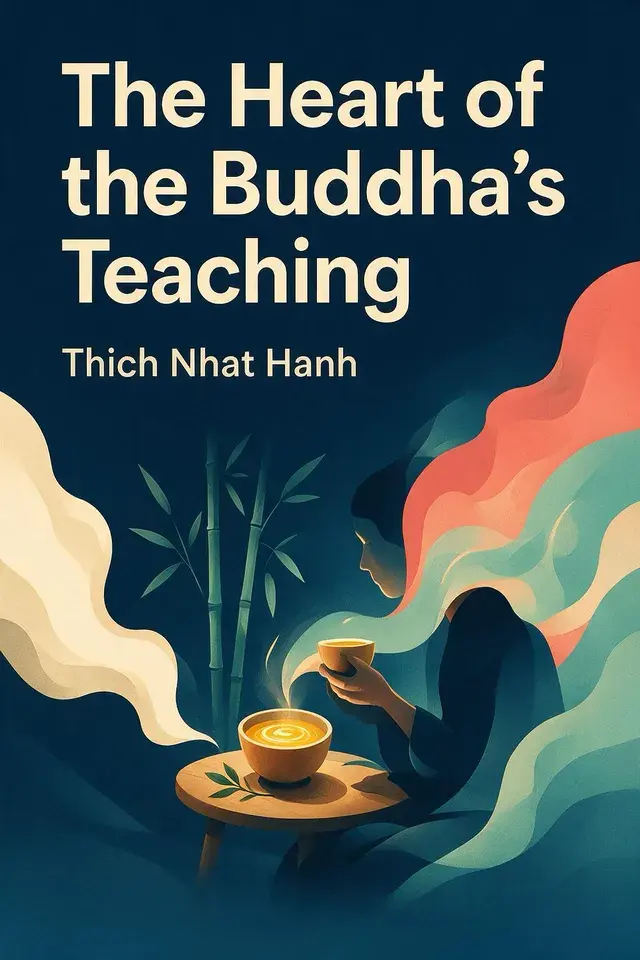
Practice within a connected teaching
The Heart of the Buddha's Teaching · Thich Nhat Hanh
Thich Nhat Hanh places mindfulness and meditation inside a Buddhist account of suffering, ethical action, compassion, and interdependence. Readers who want a framework around practice can follow those connections instead of extracting attention as a productivity tool.
- Read it for
- The relationship between Buddhist teaching, meditation, and ordinary conduct.
- Keep in mind
- The book presents one teacher’s approach and is not individualized instruction.

Read presence as a spiritual argument
The Power of Now · Eckhart Tolle
Eckhart Tolle asks readers to reconsider identification with thought and psychological time. Its central language concerns presence and being. Read it as a spiritual account with its own assumptions, rather than translating every statement into a claim about neuroscience.
- Read it for
- An influential spiritual interpretation of thought and present-moment awareness.
- Keep in mind
- Its metaphysical claims should not be presented as established medical or psychological findings.

Notice the observer in the argument
The Untethered Soul · Michael A. Singer
Michael A. Singer develops a distinction between awareness and the changing thoughts and emotions it notices. The book’s questions can orient a reflective reading, while its spiritual vocabulary deserves to remain explicit.
- Read it for
- A sustained inquiry into the relationship between awareness and inner experience.
- Keep in mind
- Observing an experience is not equivalent to resolving the conditions that produced it.

Move from a cushion to a whole day
Stillness Is the Key · Ryan Holiday
Ryan Holiday gathers stories and ideas about stillness across mental, spiritual, and physical life. It can interest readers who want a broader reflection on pace and attention. It is less suitable for someone specifically seeking a detailed meditation curriculum.
- Read it for
- A cross-tradition collection of reflections on stillness in daily life.
- Keep in mind
- A synthesis can blur differences between traditions; follow a cited source when a distinction matters.
Choose the kind of book you actually need
Start with Thich Nhat Hanh for a connected Buddhist teaching, Tolle or Singer for contemporary spiritual accounts, and Holiday for a wider collection of examples. A summary can help make that choice; it cannot reproduce the pacing, interpretation, or guidance involved in a sustained practice.
Sources and scope
Book ideas are attributed to their authors. External evidence is linked directly when a claim needs more than the source book.
- The Heart of the Buddha's Teaching: Thich Nhat Hanh places mindfulness and meditation inside a Buddhist account of suffering, ethical action, compassion, and interdependence. Readers who want a framework around practice can follow those connections instead of extracting attention as a productivity tool. Scope: The book presents one teacher’s approach and is not individualized instruction.
- The Power of Now: Eckhart Tolle asks readers to reconsider identification with thought and psychological time. Its central language concerns presence and being. Read it as a spiritual account with its own assumptions, rather than translating every statement into a claim about neuroscience. Scope: Its metaphysical claims should not be presented as established medical or psychological findings.
- The Untethered Soul: Michael A. Singer develops a distinction between awareness and the changing thoughts and emotions it notices. The book’s questions can orient a reflective reading, while its spiritual vocabulary deserves to remain explicit. Scope: Observing an experience is not equivalent to resolving the conditions that produced it.
- Stillness Is the Key: Ryan Holiday gathers stories and ideas about stillness across mental, spiritual, and physical life. It can interest readers who want a broader reflection on pace and attention. It is less suitable for someone specifically seeking a detailed meditation curriculum. Scope: A synthesis can blur differences between traditions; follow a cited source when a distinction matters.
To report a factual, attribution, rights, or accessibility concern, email hello@wiseley.app.