The core difference
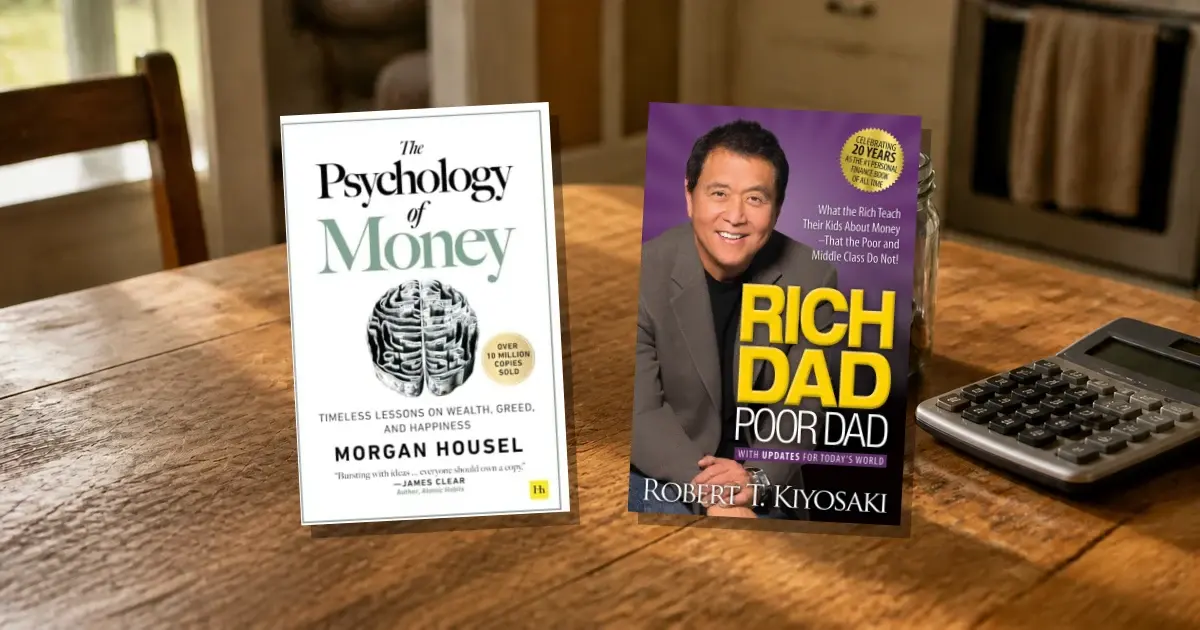
The Psychology of Money explains why reasonable people make different financial choices: experience is narrow, outcomes are uncertain, compounding needs time, and survival matters more than looking optimal. Rich Dad Poor Dad is a motivational narrative built around contrasting lessons about wages, assets, liabilities, ownership, and financial education. Morgan Housel is mainly trying to improve judgment. Robert Kiyosaki is mainly trying to alter the reader’s sense of what is possible and what counts as an asset.
- For uncertainty, patience, and behavior: The Psychology of Money.
- For a forceful challenge to an employee-only mindset: Rich Dad Poor Dad.
- For products, tax choices, or investment selection: neither is a substitute for current qualified guidance.
Where critical reading matters
Both books simplify in order to teach. Housel’s compact stories can make a principle memorable without proving that it applies identically to every household. Kiyosaki’s categories can energize a reader while obscuring differences in risk, liquidity, debt, jurisdiction, and starting resources. Keep the useful question—what behavior or balance-sheet pattern is this idea drawing attention to—while refusing to turn a memorable sentence into a universal rule.
- Separate a concept from a recommended transaction.
- Ask what assumptions the example makes about income stability, time, and downside risk.
- Verify any current tax, product, or regulatory claim outside the book before acting.
A useful reading order
Start with The Psychology of Money if you want a durable vocabulary for enough, risk, luck, time, and room for error. Start with Rich Dad Poor Dad if your immediate obstacle is not technical knowledge but the belief that earning and owning are the same activity. Then write two columns: principles worth testing and claims that require verification. That single distinction turns inspiration into a safer learning process.
- Keep: a principle that remains useful across several scenarios.
- Test: a behavior you can try without large irreversible risk.
- Verify: any claim tied to a market, product, law, or personal recommendation.
Sources and scope
Book ideas are attributed to their authors. External evidence is linked directly when a claim needs more than the source book.
- The Psychology of Money: Primary source for the behavior, uncertainty, compounding, enough, and room-for-error ideas.
- Rich Dad Poor Dad: Primary source for the narrative contrast around assets, liabilities, work, ownership, and financial education.
To report a factual, attribution, rights, or accessibility concern, email hello@wiseley.app.
Questions readers ask
Which book is better for a complete beginner?
The Psychology of Money is usually the steadier foundation because it begins with behavior and uncertainty. Rich Dad Poor Dad may be useful as a challenge to assumptions, provided its claims are treated as prompts rather than instructions.
Will either book tell me exactly what to invest in?
That is not the useful role of either title. Use them to improve questions and habits, then evaluate any real decision with current information and advice appropriate to your situation.