What The Psychology of Money is about
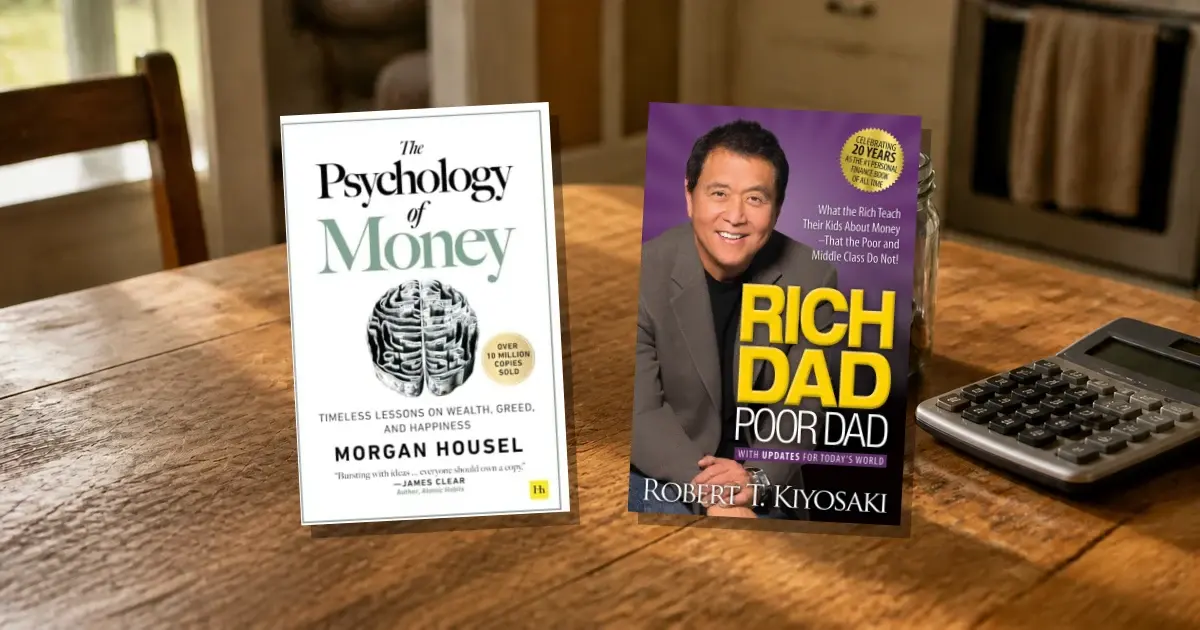
The Psychology of Money is Morgan Housel’s argument that doing well with money depends less on what you know than on how you behave. Across short essays he examines luck and risk, compounding, saving, control over your own time, and the difference between getting wealthy and staying wealthy. Wiseley’s summary follows those essays in order, ending with his account of how modern consumer expectations were formed.
Housel’s premise is that finance is taught as a mathematical subject and lived as a behavioral one. People build money beliefs from the economies and hardships they personally experienced, so choices that look irrational from outside can be coherent from inside. Because luck and risk shape individual results, he argues, a single financial biography is weak evidence of skill, which is why he prefers broad patterns to imitating extreme success.
The practical core is endurance. Compounding needs time more than it needs a spectacular annual return, so the decisive skill is surviving long enough to let it work: a savings rate you control, a margin of safety, liquidity that looks inefficient in good years, and a plan reasonable enough that you can actually stay in it. Housel defines wealth as the income you did not spend, and describes control over your own time as the highest dividend money pays.
What you'll learn
Key ideas from The Psychology of Money
These ideas compress the book's argument without treating the author's view as settled fact. Use them as an orientation before reading the full work or listening in Wiseley.
Financial outcomes depend on emotional habits and self-control as well as intelligence, knowledge, and effort.
Luck and risk make individual financial outcomes poor evidence of pure skill or character.
Enough is a boundary that protects needed wealth, freedom, reputation, and relationships from unnecessary risk.
Time can matter more than annual return when good performance lasts longer than spectacular performance started later.
Financial success depends on surviving long enough for compounding, with no edge useful if debt or forced selling ends participation.
Financial plans are evaluated by persistence as well as mathematical optimization, because a strategy must be livable.
Margin of safety creates a gap between expected and survivable outcomes, allowing continuation after unfavorable odds produce losses.
Financial success is framed as independence and control over time, not maximum wealth, luxury, or returns.
A Wiseley example: a one-page note on what counts as enough
Wiseley editors wrote this example to show one way to use Morgan Housel’s argument. It is not taken from the book.
Take one page. On the first half, write what the money is for in plain terms: the bills it must cover, the months of expenses you want held in cash, and the freedom you want it to buy, whether that is an afternoon, a shorter week or a job you could leave. On the second half, write the two things you will not risk in order to get more, usually the emergency cash and the plan you can stay in when prices fall.
Date the page and read it before any decision that would change either half. The page is not the point. Having your own definition of enough written down, before a market or a colleague or a comparison supplies one, is the point.
How The Psychology of Money builds its case
Follow how the book develops its argument. Each note is a brief orientation, not a replacement for the chapter.
Money Is Personal Behavior
Money is often treated as a technical subject involving income, expenses, rates, probabilities, and formulas. But the book’s central lens is behavioral.
Luck, Risk, and Enough
Financial outcomes are easy to read as verdicts on character. Someone gets rich, and we call them brilliant; someone loses money, and we call them foolish.
Compounding Requires Time
Compounding is one of money’s most important forces, and one of its least intuitive. It starts with a base, earns a return, and lets that result become part of the base for the next return.
Staying Rich Means Surviving
Building wealth and keeping it are not the same achievement. The first may reward optimism, risk-taking, and exposure to opportunity.
The Few Outcomes That Matter
One of the hardest things about judging success is that results are rarely distributed evenly. The same shape appears in portfolios, businesses, careers, and market returns.
Wealth Buys Control of Time
Money matters most not when it becomes impressive, but when it gives a person control over life. The author calls control over time money’s highest dividend: deciding what to do, when to work, and whom to be with.
Reasonable Beats Mathematically Rational
Financial decisions are often treated as if the best answer were the one that wins on a spreadsheet. Housel argues that this misses a central condition: a plan must be livable.
History Is Not a Forecast
History is useful in money, but it is a poor substitute for imagination. It can calibrate expectations, expose common mistakes, and show how people behave under greed, fear, stress, and incentives.
Change, Cost, and Your Game
Long-term financial plans face two kinds of change. Markets bring volatility, and the person making the plan may become someone else.
Optimism Against Seductive Pessimism
Pessimism often sounds more intelligent than optimism, especially when money is involved. It names a threat, points to evidence, and seems to protect us from complacency.
Independence as the Financial Goal
After the book’s lessons about behavior, uncertainty, and competing financial games, its conclusion is personal: the point of money is independence. That means controlling what you do, when you do it, and with whom, for as long as you choose.
How Consumer Expectations Changed
To understand modern money behavior, Housel widens the lens beyond individual choices. He traces a selective history of how a “normal” American life was created after World War II, then shows how that expectation survived after the economy changed.
Read it with these limits in mind
- This is not a financial plan. Housel offers dispositions and mental models, not allocations, products or tax treatment, and nothing here is financial advice.
- The historical material is largely American, from postwar credit to United States markets and consumer expectations. Transfer the specifics elsewhere with care.
- The essays argue through stories and selected cases. They are persuasive rather than empirical, and Housel is explicit that history calibrates expectations without forecasting them.
- Advice to save more and hold a margin of safety assumes income above subsistence. The book does not address financial behavior when there is nothing left to save.
Who it helps, and when to read the whole book
The Psychology of Money tends to be most useful to:
- Readers who understand the arithmetic of saving and still make decisions they later regret.
- New investors who want a temperament before they choose a strategy.
- Anyone deciding how much risk a household can carry without being forced to sell.
Read the complete book when:
- You want the full essays, each of which builds its case through a story a summary has to compress.
- You want the closing chapters on Housel’s own finances and the postwar history behind current expectations.
- You want the historical examples in the author’s telling rather than in outline.