What you'll learn
Key ideas from How to Day Trade for a Living
These ideas compress the book's argument without treating the author's view as settled fact. Use them as an orientation before reading the full work or listening in Wiseley.
Retail traders’ freedom to wait supports selective participation, while algorithmic competition and changing conditions require adaptation.
A technical stop defines where a trade idea has failed; its distance from entry sets the risk per share.
Position size follows from dividing the chosen dollar loss limit by the stop distance per share; traders may risk less or pass.
A catalyst, sufficient liquidity, and readable price movement help distinguish a useful candidate from a stock that is merely active.
Live trade management means treating price after entry as evidence and adding only when it confirms the setup.
Volume, an extreme RSI reading, and a reversal candle can strengthen the case; several aligned clues matter more than any one signal.
A personal strategy fits a trader’s experience, account size, time, and risk tolerance, and needs written rules and testing before live use.
A complete trade connects stock selection, a conditional plan, execution, position management, and review.
Inside How to Day Trade for a Living
Read the first chapter in full here. The other 12 continue in the Wiseley app.
Chapter 1 of 13 · 7 min · Audio & text
Treat Trading as a Business
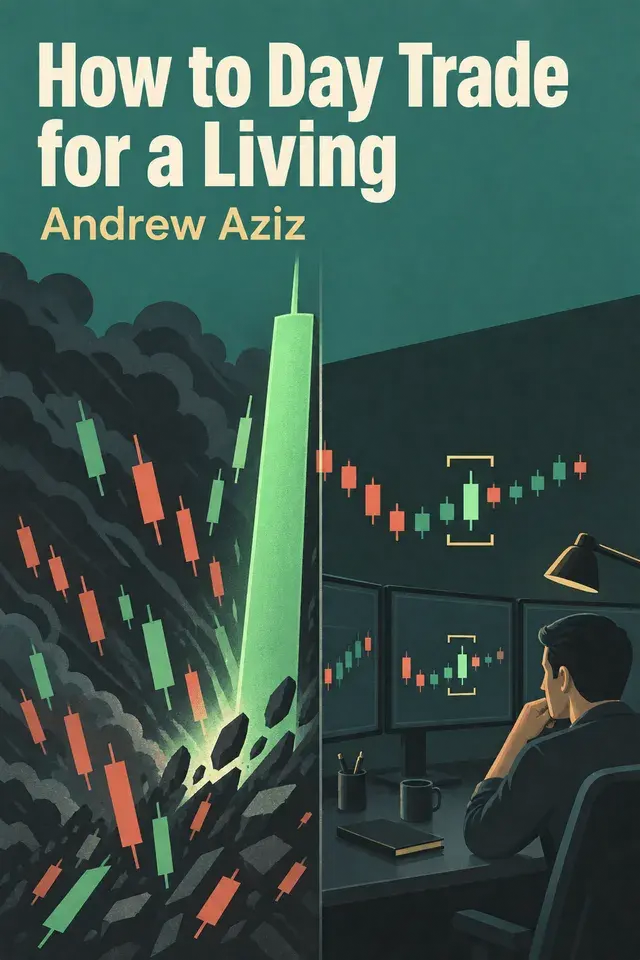
How to Day Trade for a Living, by Andrew Aziz.
Day trading can look like a simple route to easy money: buy a stock, wait for a rise, then sell. Aziz argues that this surface simplicity hides a demanding profession. Decisions must be made while prices and information move quickly, amid competition from experienced traders and institutions. Preparation and discipline matter because no profitable outcome is assured. Trading therefore calls for patience and practice, not the expectation that one lucky trade proves a reliable income.
His early experience with Aquinox made that risk concrete. Positive drug news had helped push its shares from one dollar to above fifty-five dollars in two days. Aziz bought one thousand shares at four dollars and sold above ten, making more than six thousand dollars in minutes. He later lost that gain in other trades within weeks. He says the initial win came from luck, not skill: he did not understand why Aquinox was moving or have repeatable expertise. The episode shows why a favorable outcome alone cannot establish that a trader has an edge.
Day trading has a short horizon. The trader seeks to benefit from a stock’s movement during the day, often over seconds or minutes and rarely for more than a few hours. Positions are closed before the market closes. Holding a stock overnight changes the trade into swing trading, which may last from a day to several weeks and calls for different tools and strategies. Aziz treats the two approaches as separate businesses. A stock that seems suitable for a brief trade may be too risky to hold overnight. And a day trader does not need to predict where a company or the market will be months or years from now. The question is what the day’s setup offers.
A trader can act on either a rising or falling price. Buying long means purchasing shares with the aim of selling them later at a higher price. Selling short means borrowing shares, selling them, then hoping to buy them back at a lower price and return them to the broker. Aziz illustrates the short position with one hundred Apple shares sold at one hundred dollars each. If the trader buys them back at ninety dollars, the ten-dollar drop per share produces a one-thousand-dollar gain. If Apple instead rises to one hundred ten dollars, buying back the shares costs one thousand dollars more. The risk differs from a long position: its maximum loss is the purchase amount, while a short position has no fixed loss ceiling if the price keeps rising. Aziz says he chooses long or short based on the day’s setup, while taking extra care with shorts.
The market’s structure helps explain why he urges retail traders to be selective. Individuals account for only a small share of trading volume, while institutions include banks, trading firms, mutual funds, and hedge funds. According to Aziz, institutions rely heavily on algorithms and high-frequency trading, with substantial capital behind them. A retail trader cannot match that scale or win every contest with a computer. The individual’s advantage, in his account, is the freedom to wait, choose whether to trade, and exit a position promptly. Large institutions may need time to unwind much bigger positions. That freedom is useful only when a trader is patient; frequent trades driven by greed can squander it. Aziz favors familiar, recognizable patterns over attempts to capture every dramatic move.
He also argues that algorithms do not control every outcome. Markets change, and a program cannot anticipate every condition, so a trained trader may sometimes notice a useful moment in real time. But that possibility is not a promise of success. Aziz describes a failed attempt to squeeze short sellers in September 2008. A “Buy the New Low” program bought shares when they reached new intraday lows, hoping short sellers would have to buy shares back and drive prices upward. In distressed stocks including LEH and FRE, continued selling from institutions and day traders overwhelmed that buying. The prices did not rise as the program intended. Aziz says the programs and their developers were left holding worthless shares. The example shows that even a computer-driven strategy can fail when the market’s selling pressure runs against it.
Selectivity also means adapting as conditions change. Aziz favors looking for moments when a stock has a distinct reason to move, rather than assuming every stock will behave alike. He calls stocks with company-specific catalysts that may move apart from the broader market “Stocks in Play.” This introduces the logic of choosing opportunities without requiring every reader to use the same names or trade every move. Kem, a trader with more than twenty years of experience, had relied on a familiar basket of stocks. As technology and market conditions changed, she reconsidered that approach and considered trading unfamiliar active stocks, provided she had a solid plan and hard rules. Her example presents adaptation as a considered response, not constant strategy switching.
The 2020 edition places that need for adaptation in a changing market. Aziz describes the transition from bull-market conditions to a pandemic-era sell-off, amid recession news and lockdowns. The sharp shift brought new traders and new questions about whether familiar tools and strategies still worked in volatile conditions. That renewed interest explains why market conditions matter to the discussion; it does not demonstrate that newcomers had found a trading edge. The chapter’s premise is more measured: day trading offers no shortcut around uncertainty. Retail traders can pursue selected intraday opportunities, but they need to understand their position, respect the limits of their tools, and be ready to adjust as the market changes.
Chapter 2 of 13 · 7 min · Audio & textIn the app
Protect Capital Before Seeking Gains
Before considering what a trade might earn, Aziz asks how much it could lose and where the trade idea would be proved wrong. That makes risk management an entry decision.
Chapter 3 of 13 · 6 min · Audio & textIn the app
Find the Stocks Worth Watching
Finding a stock to watch starts with asking whether its movement is unusual, understandable, and potentially useful. Andrew Aziz calls these candidates Stocks in Play.
Chapter 4 of 13 · 9 min · Audio & textIn the app
Build a Reliable Execution Setup
Day trading depends on more than recognizing a setup. An order must reach the market promptly and return a usable fill.
Chapter 5 of 13 · 5 min · Audio & textIn the app
Read Candles as Price Action
A candlestick compresses four prices from one chosen period: the open, high, low, and close. Its body connects the opening price with the closing price.
Chapter 6 of 13 · 7 min · Audio & textIn the app
Manage Risk Through Momentum Setups
A trade does not end when an order fills. After entry, each new move gives evidence about whether the original idea is still working.
Chapter 7 of 13 · 7 min · Audio & textIn the app
Trade Reversals With Confirmation
A reversal trade begins with an extreme move, but the move itself is not the signal. Buying only because a stock has fallen, or shorting only because it has climbed, is a guess about what must happen next.
Chapter 8 of 13 · 6 min · Audio & textIn the app
Use Trend and VWAP Structure
Trend trading follows a move that has already developed and lasts as price respects a moving reference. Aziz presents it as a way to participate in sustained intraday direction, alongside the book’s shorter momentum and reversal approaches.
Chapter 9 of 13 · 6 min · Audio & textIn the app
Trade Levels and Prior Closes
Support and resistance begins with a judgment about what to draw. Aziz favors horizontal levels from past prices over diagonal trend lines, whose slope can vary from one trader’s chart to another.
Chapter 10 of 13 · 10 min · Audio & textIn the app
Build a Strategy Around the Open
The opening-range breakout, or ORB, is a way to trade a move that takes shape after the market opens. It marks the high and low of an initial period, then treats a break beyond that range as a possible directional entry.
Chapter 11 of 13 · 6 min · Audio & textIn the app
Turn Preparation Into a Complete Trade
A trade begins before an order is placed. The author presents it as a sequence: prepare a watchlist, identify a setup, plan the possible trade, wait for its signal, manage the position, and review what happened.
Chapter 12 of 13 · 5 min · Audio & textIn the app
Learn From One Trader’s Rebuild
Andrew Aziz uses John Hiltz’s experience to show how a trader can mistake early success for readiness. John had watched market patterns for years and read extensively before he began trading.
Chapter 13 of 13 · 10 min · Audio & textIn the app
Make Practice a Trading Business
Aziz brings training, preparation, patience, discipline, and review together as one operating process. The aim is to develop a method that can be explained and evaluated, not to find a reason to trade constantly or judge each day by its profit.
Chapter 1 of 13 · 7 min · Audio & text: Treat Trading as a Business
Wiseley supports reading and listening to summaries in the app.
Continue in WiseleyAbout Andrew Aziz

Andrew Aziz is a Canadian trader, investor, and author. “How to Day Trade for a Living” explores how a retail trader can find intraday opportunities, plan risk, and trade with discipline.
Explore more books by Andrew Aziz