What you'll learn
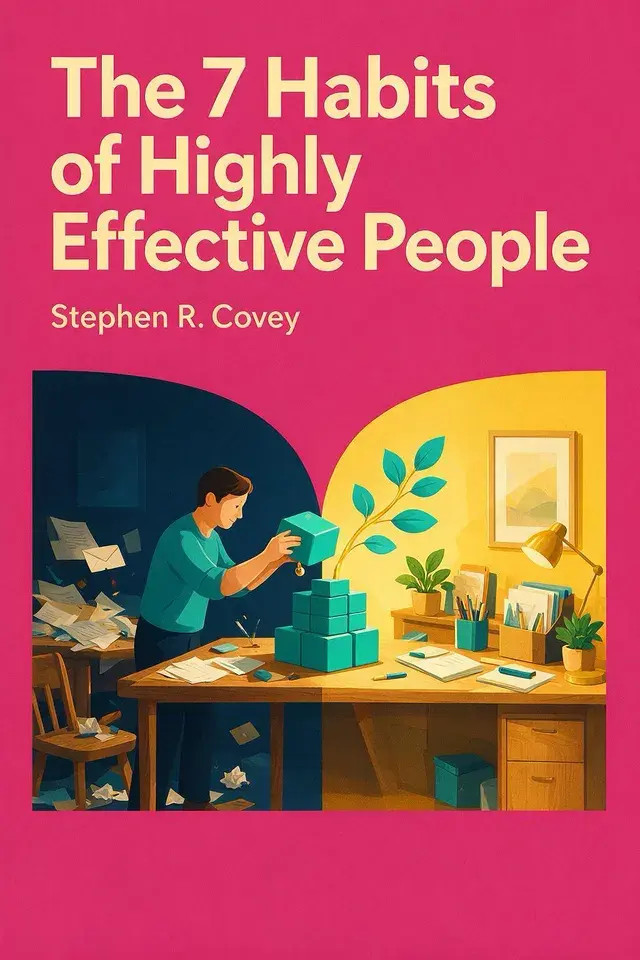
Key ideas from The 7 Habits of Highly Effective People
These ideas compress the book's argument without treating the author's view as settled fact. Use them as an orientation before reading the full work or listening in Wiseley.
Paradigms shape interpretation and conduct, so major change requires examining the mental map as well as the situation it describes.
Habit 1 locates freedom in the space between events and responses, where self-awareness and values make responsible choice possible.
Habit Two defines life as a first creation: a chosen destination and identity precede the details of execution.
Habit 3 converts mission and values into daily execution through independent will, integrity, and putting first things first.
Win/Win balances courage to pursue legitimate results with consideration for the other party’s needs, feelings, and long-term welfare.
Empathic listening develops from repeating content to understanding both the speaker’s meaning and feeling.
Synergy turns trusted, empathic difference into a third alternative better than either starting position.
Habit 7 treats balanced physical, spiritual, mental, and social/emotional renewal as the Quadrant II foundation that preserves effectiveness.
How The 7 Habits of Highly Effective People builds its case
Follow how the book develops its argument. Each note is a brief orientation, not a replacement for the chapter.
The Inside-Out Foundation
People can look successful and still feel hungry, disconnected, overextended, or unable to keep promises to themselves. Covey begins with that tension because durable effectiveness cannot be judged by appearance alone.
Choose Your Response
Habit 1 begins with a distinction that changes responsibility: an event and a response are not the same. Covey uses Frankl’s imprisonment to illustrate it.
Design the Life You Mean
Once a person recognizes the ability to choose a response, a question appears: what direction should those choices serve? Habit Two, beginning with the end in mind, answers by making the person the first creator of life.
Make Priorities Real
Once a person has chosen a direction, the next challenge is making it visible in ordinary choices. Covey calls this Habit 3, the practical, physical creation that fulfills the first two habits.
Make Trust Mutual
With Private Victory established, Covey turns to Public Victory: the work of achieving results with other people. The transition is not a shortcut to interpersonal technique.
Practice Mutual Benefit
Once people depend on one another, effectiveness cannot rest on private wins alone. Habit 4 asks what kind of result an interaction is designed to produce.
Understand Before Influencing
Effective influence begins with diagnosis, not advice. Covey opens Habit 5 with an optometrist analogy: a prescription offered before the problem is understood may sound professional, but it cannot be trusted.
Turn Difference into Synergy
Synergy is the creative culmination of the public-victory habits. When trust, empathic understanding, and a Win/Win intention make people secure enough to be open, differences can produce a result better than either starting position.
Renew, Learn, and Pass It On
After the book reaches creative cooperation, Covey asks what keeps it possible. Synergy is not a permanent achievement.