What you'll learn
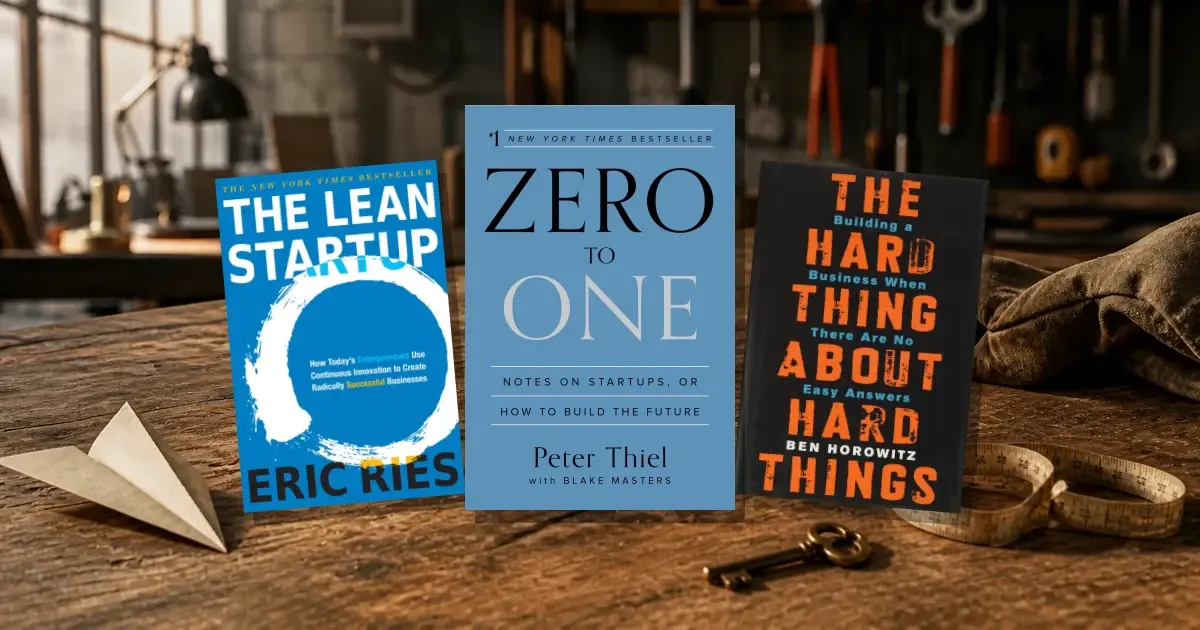
Key ideas from Zero to One
These ideas compress the book's argument without treating the author's view as settled fact. Use them as an orientation before reading the full work or listening in Wiseley.
Zero-to-one progress creates a new way of doing something; one-to-n progress spreads a known solution.
A valuable product becomes a durable business only when it captures enough of the value it creates through meaningful differentiation.
A startup becomes an instrument of agency when deliberate design and a bold goal give iteration a direction.
Power-law returns mean a small minority of investments and companies can account for most of the value.
Important unknowns are secrets when they are hard but achievable, whereas mysteries may be impossible to resolve.
Distribution belongs in product design because adoption depends on a viable channel, not product quality alone.
Human-computer complementarity pairs machine-scale data processing with human planning, judgment, and adaptation.
A socially important sector does not create a durable company without strong answers to engineering, timing, monopoly, people, distribution, durability, and secrets.
How Zero to One builds its case
Follow how the book develops its argument. Each note is a brief orientation, not a replacement for the chapter.
Create the Future Deliberately
Zero to One opens with a distinction that organizes the book. Creating something genuinely new moves from zero to one.
From Bubble to Lasting Value
The dot-com crash is easy to misread. In the late 1990s, Mosaic and Netscape made the web accessible, and internet companies drew public offerings and spectacular valuations before they were profitable.
Design a Durable Monopoly
After establishing why durability matters, Thiel asks how a company can make its advantage last. His answer is a design problem, not a race for publicity.
Choose a Definite Future
Thiel opens this part of the argument by asking whether success is mainly luck or skill. Successful people may point to timing, context, networks, wealth, or innate ability, and the author acknowledges that these advantages matter.
Concentrate on Power-Law Bets
Once the future is treated as something that can be shaped, the next problem is allocation. Which opportunity deserves scarce time, money, attention, and years?
Search for Valuable Secrets
After examining why a few opportunities can matter so much, Thiel asks whether important opportunities still remain unknown. Conventional knowledge may be useful for education, but it gives no special advantage once everyone knows it.
Set the Foundation Early
At the beginning of a startup, some choices matter more than their apparent size. Peter Thiel calls this the foundation problem: a flawed foundation cannot be repaired by later effort, because decisions made at the founding can establish structures that later generations find difficult to change.
Build a Mission-Driven Team
A startup’s culture is easy to confuse with its atmosphere. Thiel argues that open offices, massages, sushi, yoga, pets, and similar perks cannot substitute for meaningful work, a mission, or a functioning team.
Distribution Is Part of Product
A strong product can still go nowhere. Thiel calls the belief that customers will arrive automatically the “Field of Dreams” fallacy.
Make Humans and Computers Complementary
Computers now perform tasks once considered uniquely human. Deep Blue defeated Garry Kasparov at chess, Watson defeated Ken Jennings at trivia, and Google built self-driving cars.
Seven Questions for Durable Technology
Cleantech is where the book’s framework becomes a practical test. The sector began with serious environmental and energy concerns, attracted thousands of startups, and drew more than fifty billion dollars in investment.
Founders, Myths, and Possible Futures
At the end of Zero to One, Thiel returns to founders. His claim is double-edged.