What you'll learn
Key ideas from How to be Love(d)
These ideas compress the book's argument without treating the author's view as settled fact. Use them as an orientation before reading the full work or listening in Wiseley.
Love is framed as a continuing practice and path, not a reward, possession, or permanent romantic destination.
Self-respect becomes steadier when sincere effort and chosen values guide action without becoming new conditions for love.
Clear limits make personal needs and values visible, turning self-prioritization into a practice of self-respect.
Relationship selection becomes clearer when observed behavior, stated needs, current compatibility, and hoped-for changes are reviewed separately.
Healthy interdependence combines mutual reliance with distinct identities, self-responsibility, and freedom from control.
Shared experiences, direct requests, appreciation, stated intentions, an evolving sex life, and forgiveness form a practical maintenance pattern.
Constructive disagreement uses a defined return, ownership of one’s part, specific behavioral complaints, and respectful tone.
An isolated mistake can invite remorse and repair, while repeated self-loss can make leaving an act of care.
Inside How to be Love(d)
Read the first chapter in full here. The other 9 continue in the Wiseley app.
Chapter 1 of 10 · 8 min · Audio & text
Love as a Daily Practice
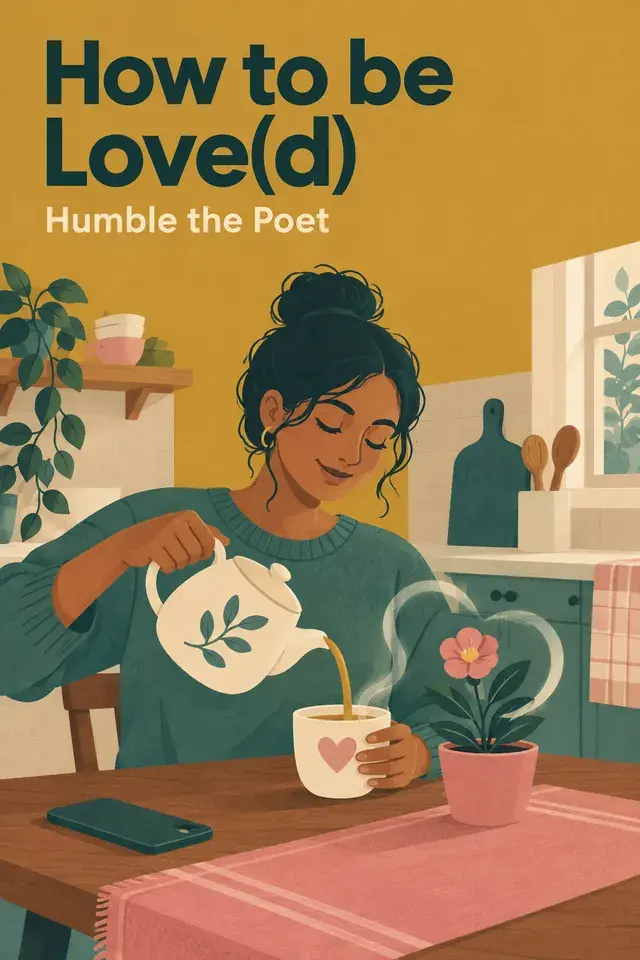
How to be Love(d), by Humble the Poet.
What changes when love is something we practice rather than something another person awards us? Humble the Poet begins with a personal contradiction. His fiancée loved him, yet he struggled to receive and honor that devotion. He had considered ending the relationship, and when he spoke, she met his uncertainty with pain but also kindness. Her commitment had become a kind of permission for his irresponsible behavior. The lesson is not that her love was insufficient. Being loved does not automatically make us open, honest, or loving. He must change so he can live with himself, not merely preserve a relationship.
This failure gives the book its starting vocabulary. The author distinguishes Big L love from Small L love. Small L is the quick external hit: attention, validation, admiration, pleasure, an award, a wedding, flowers, or approval online. The problem begins when these become the whole of love, or when we chase the next hit because the last one fades. Big L, by contrast, is the author's framework for deeper internal abundance: peace, compassion, empathy, and connection. He describes it through a field or source metaphor, not as an established scientific mechanism. It is recognized and allowed, rather than earned by becoming enough, worthy, or deserving.
That distinction also changes love from a possession into a path. Romantic stories often train us to expect a final milestone, after which happiness is secure. The author calls this destination thinking. His alternative is to treat love as a verb, a way of living: something we do, share, receive, and return to. Practice matters because a single insight does not permanently change behavior. He compares loving capacity to a muscle strengthened through use. A partner, child, or audience may give us opportunities, but none is required to begin. Nor does this path promise a soulmate or a permanent romantic ending.
People, then, are access points rather than owners of love. Someone may awaken love in us, reveal where it is already present, or show us where fear and self-dislike still block it. Relationships can form strong pathways, but a closed door or a lost person does not remove the capacity itself. The author extends the same idea beyond romance: play, ritual, work, community, art, family, friendship, animals, nature, movement, and creative activity can all become routes into connection. In this framework, the task is to notice, explore, share, and embody those routes. The claim is interpretive and practical: changing what we attend to and how we act can open more room for love.
Fear often closes that room before reality has spoken. The author describes anticipatory anxiety as feeling the emotion of an event that has not happened. Before asking someone for a favor, you may already feel rejected, so you avoid the request or behave as if the answer is settled. The same pattern can inhibit studying or beginning. He distinguishes everyday anticipation from distress connected with death, trauma, or abuse, which he says requires attention to healing. For ordinary anxiety, he recommends starting rather than stopping: envisioning an awesome future, intentionally feeling wonderful, and starting to love to paint over fear, pain, suffering, and anxiety. This is gradual, never-ending practice rather than a short-term guarantee of a soulmate. We cannot control every outcome; we can choose whether fear or love guides the next action.
The author gives the ego a related role. It is not merely arrogance, but a defended identity built around what we are not: the image we protect, status we seek, and differences that separate us. Ego depends on outside validation and turns people into competitors. Love, in his account, softens that border and makes service, authenticity, and connection more possible. The aim is not to destroy ego; even appearing humble can feed it. Instead, examine the choice: does it open a pathway of love, or mainly feed visibility, admiration, control, or a need to win? Quiet care supplies the contrast: cleaning a neighborhood without recording it, or caring for a sick child without expecting applause. Judgment creates another barrier. Insecurity can drive judgment of others and imprison our own authentic self. Practicing curiosity and less judgment outwardly can make more acceptance possible inwardly.
A story about his father shows why love must be read in behavior, not only in emotional language. During a dispute over an eight-hundred-dollar car repair his father had authorized without consent, the author felt unheard and chose being right over peace. The argument escalated; he left home. After he returned, his father largely avoided speaking to him for the better part of a year. Eventually their relationship returned to normal, but they never discussed the fight. Later, he learned his father had given his sister a blank check to help him if he called. The gesture did not erase the conflict or the silence. It revealed practical concern: a father with limited emotional vocabulary still acting to protect his child’s well-being. Care can be imperfectly expressed and still be care.
That is the daily test this chapter leaves us. When a choice feels urgent, ask what it is trying to secure. Is it connection, honesty, care, or a more authentic way of participating? Or is it mainly admiration, approval, pleasure, or proof that we matter? The second group is not forbidden; Small L pleasures can be part of an ordinary life. The point is to recognize their limits and not mistake a gratifying reaction for a permanent source of love. Then ask what action is available now, even if no one notices and no one gives anything back. Loving action cannot guarantee reciprocity. It does, in the author's framework, make love something we practice rather than something we wait to be awarded. That is why the book turns from the idea of being loved toward self-knowledge and daily behavior.
Chapter 2 of 10 · 7 min · Audio & textIn the app
From Approval to Inner Worth
The wish to belong is not itself a problem. The author treats validation as a reasonable human need in an interdependent life.
Chapter 3 of 10 · 10 min · Audio & textIn the app
Becoming Your Own Nurturing Presence
Self-love, in the author’s account, is not a reward for becoming easier to admire. It is a relationship we build with ourselves: friendship, nurturing, honest correction, and acceptance at the same time.
Chapter 4 of 10 · 9 min · Audio & textIn the app
Feeling Pain Without Losing Direction
Pain becomes harder to understand when we refuse to feel it. The author treats suppression as short-term shelter that can become a long-term barrier.
Chapter 5 of 10 · 6 min · Audio & textIn the app
Boundaries That Build Self-Trust
Self-respect becomes trustworthy when it is visible in behavior. Saying you matter is easy; letting that belief change a plan, a conversation, or a promise is harder.
Chapter 6 of 10 · 7 min · Audio & textIn the app
Choosing People as They Are
Choosing a relationship begins with seeing the person in front of you, not the story you hope the relationship will complete. The author argues that Disney, romantic comedies, and other cultural scripts can make love look like dramatic arrival, effortless compatibility, or proof that someone is finally worthy.
Chapter 7 of 10 · 9 min · Audio & textIn the app
Closeness Without Losing Yourself
Closeness is not the same as merging. The romantic phrase “You complete me” can conceal the belief that one person is incomplete without another.
Chapter 8 of 10 · 8 min · Audio & textIn the app
Building Love Through Everyday Attention
Love can motivate relationship work, but it cannot hold people together by itself. The author makes this distinction through Kyle and Stu.
Chapter 9 of 10 · 10 min · Audio & textIn the app
Conflict Without Control or Concealment
Love is not proved by never disagreeing. It is tested by what disagreement is made to do.
Chapter 10 of 10 · 6 min · Audio & textIn the app
Leaving While Keeping Love Possible
At the end of a relationship, the author’s central question is not simply whether love is present. It is what the relationship does to your relationship with yourself.
Chapter 1 of 10 · 8 min · Audio & text: Love as a Daily Practice
Wiseley supports reading and listening to summaries in the app.
Continue in WiseleyAbout Humble the Poet

Humble the Poet is a Canadian writer and spoken-word artist. “How to be Love(d)” explores how to give and receive love without making approval or a relationship the measure of personal worth.
Explore more books by Humble the Poet