What you'll learn
Key ideas from How to Be Your Own Therapist
These ideas compress the book's argument without treating the author's view as settled fact. Use them as an orientation before reading the full work or listening in Wiseley.
A focused timeline brings personally meaningful positive and difficult events into view without requiring an exhaustive biography.
Recording triggers, thoughts, feelings, and behavior creates a map before attempts to change the pattern.
A personally chosen future can include practical aims and inner needs, while distinguishing authentic wishes from inherited expectations.
Distressing thoughts can be examined for evidence and context rather than accepted as facts or treated as definitions of the self.
The morning scan of emotion, body, and mind provides information for deciding what care may be needed.
The midday review creates a pause to examine an event, the story attached to it, and the reaction that followed.
A brief written review separates an event, its interpretation, its immediate effects, and a helpful alternative.
If trauma, anxiety, or low mood do not improve after about two to three months of consistent self-therapy and behavior changes, O’Kane recommends professional support.
Inside How to Be Your Own Therapist
Read the first chapter in full here. The other 9 continue in the Wiseley app.
Chapter 1 of 10 · 7 min · Audio & text
Therapy as Active Practice
How to Be Your Own Therapist, by Owen O'Kane.
Owen O’Kane presents therapy as a way to understand yourself and prepare for life’s harder stretches, not only as help to seek in a crisis. He argues that knowing what supports your happiness can help you recognize and return to it when life becomes difficult. Yet shame and fear of judgment can make reaching out feel uncomfortable. O’Kane recalls feeling ashamed before his own first therapy appointment, partly because he believed he should manage alone. Public attitudes have become more positive, he says, but stigma remains.
His approach is practical and deliberately plain-spoken. Drawing on several therapeutic traditions and his own clinical and personal experience, he offers one way to think about therapy, not a universal template. He describes it as collaborative work: a therapist helps someone examine their experiences and patterns, while the person takes part in finding and practicing changes. Therapy, in this view, is more than a weekly conversation or a chance to gain insight. What happens between sessions matters too.
O’Kane observes that people can respond very differently to negative experiences. In his clinical experience, the way a person responds can sometimes affect their distress more than the event itself. That does not mean people choose to suffer. Responses and coping strategies may be learned early and carried into adulthood, even when they no longer help. Understanding where a pattern came from can replace some self-blame with curiosity about how it works.
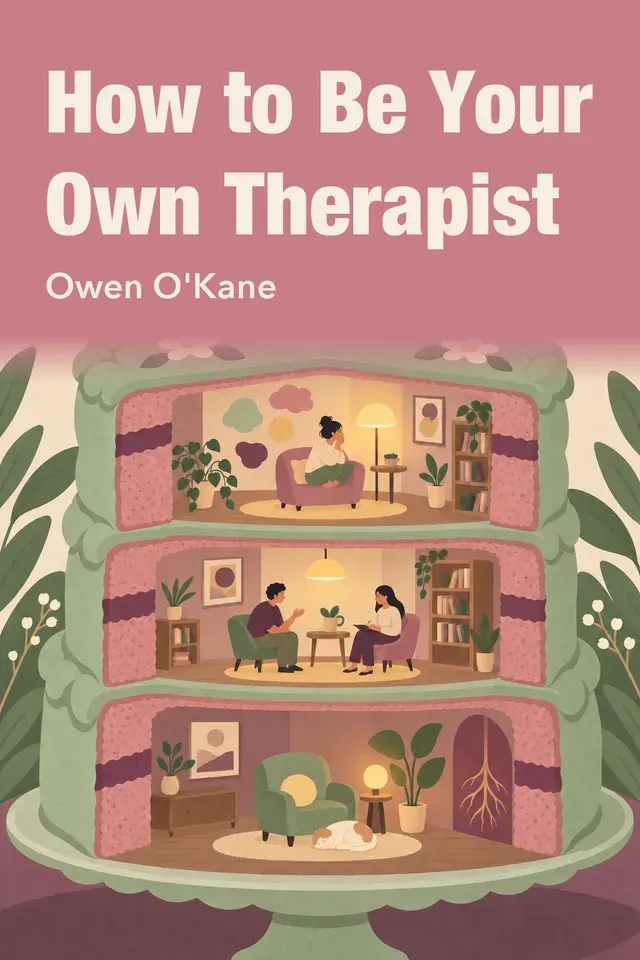
To explain those patterns, O’Kane uses a three-layer cake. The top layer holds thoughts and feelings. They are distinct, but they affect one another: a thought can bring on an emotion, and an emotion can make certain thoughts more likely. Some thoughts arrive automatically, like a running account of what an event means; feelings can also arise without a person choosing them.
For example, repeated criticism in childhood may teach someone to expect the worst of themselves. Later, a situation that resembles earlier criticism can prompt self-critical thoughts and difficult feelings before the person has had time to consider what is happening. If anger, fear, or vulnerability was treated as unacceptable, those feelings may also become hard to recognize or manage. These responses can be learned; they are not proof that something is wrong with the person.
The cake’s middle layer consists of rules and beliefs about how someone ought to live. These may come from family, culture, religion, gender expectations, or formative experiences. They can support daily life, but rigid demands can become punishing: always be perfect, reliable, selfless, in control, or emotionally strong; never appear needy or vulnerable. If a result falls short of perfection, a rigid rule may turn a manageable disappointment into self-criticism. A more flexible belief can leave room to learn and respond with compassion. The problem, O’Kane emphasizes, is not having standards; it is treating every standard as an inflexible requirement.
At the cake’s foundation are deeper beliefs about safety, being lovable, self-worth, and hope. O’Kane uses these broad themes to show how underlying beliefs can shape the rules a person follows and the thoughts and feelings that surface day to day. Someone who did not feel safe or loved may learn to avoid risks, plan for certainty, please others to prevent rejection, or hide vulnerability for fear of abandonment. In turn, the person may experience negative or critical thought patterns and find managing emotions challenging. The layers influence one another, so focusing only on a thought or feeling may bring some short-term relief while leaving a deeper pattern untouched.
Making those connections is useful, but insight alone is not the whole process. In O’Kane’s approach, understanding a learned rule creates an opportunity to respond differently; practice helps make that response part of everyday life. He proposes a ten-minute daily structure, divided into four minutes in the morning, three after lunch, and three at bedtime. The brief check-ins are intended to fit into busy days and make self-directed work manageable. The book develops the individual exercises later.
Between sessions, the work can include reflecting on experiences, writing, testing thoughts, regulating emotion, and taking action. Writing can help someone follow through; examining a thought can open up a more useful response; and a practical action can carry understanding into behavior. The process may challenge familiar habits and feel uncomfortable for a time, so O’Kane advises proceeding at a comfortable pace rather than rushing. His aim is not to make readers into different people, but to help them understand themselves and work with patterns that cause difficulty.
Self-directed work is not enough for everyone. O’Kane advises seeking professional help if the book cannot provide adequate support, and says to pause this work when very overwhelmed, experiencing psychotic symptoms, feeling suicidal, or lacking adequate support. He also cautions against doing the exercises while under the influence of alcohol, drugs, or other unprescribed substances. Therapy can support self-knowledge and change, but recognizing when more help is needed is part of using the approach responsibly.
Chapter 2 of 10 · 8 min · Audio & textIn the app
Read the Story Beneath Events
A list of events can show when things happened, but it may not show why some still matter. O’Kane invites readers to tell a focused version of their own story, bringing important events and emotional responses into view together.
Chapter 3 of 10 · 7 min · Audio & textIn the app
How Old Beliefs Shape Today
Once you have gathered the important parts of your story, the next question is what your present struggles may reveal. A recurring reaction can make more sense when you connect what is happening now with the thoughts, feelings, and behavior it brings up—and with experiences or messages that may have shaped it.
Chapter 4 of 10 · 8 min · Audio & textIn the app
Choose a Future That Fits
Understanding how the past shaped you can make present difficulties clearer. The next question is what you want your life to move toward.
Chapter 5 of 10 · 10 min · Audio & textIn the app
Turn Insight into Action
Understanding how old beliefs shape present reactions can reveal what needs attention, but insight by itself does not change a person’s daily life. O’Kane’s next step is practice: examine thoughts, loosen rules that have become rigid, reconsider habits that cause harm, and reconnect with activities that give life meaning.
Chapter 6 of 10 · 8 min · Audio & textIn the app
Prepare Yourself Each Morning
Many people rush out in the morning already feeling frantic, with a mind racing through unfinished tasks and a sense that something has been forgotten. O’Kane argues that this beginning can make the day feel chaotic, and that a little preparation can change how someone enters it.
Chapter 7 of 10 · 7 min · Audio & textIn the app
Reset at Midday
By midday, a day that began with good intentions may already include a setback, a tense exchange, or a worry that keeps replaying. Owen O’Kane suggests a short review at this point: a three-minute pause to steady yourself and consider how you want to meet the rest of the day.
Chapter 8 of 10 · 7 min · Audio & textIn the app
Close the Day with Reflection
At the end of the day, unresolved worries can keep replaying just when you want to rest. O’Kane’s evening practice offers a way to look at a difficult moment, learn from it, and consciously set it down.
Chapter 9 of 10 · 11 min · Audio & textIn the app
Meet Major Setbacks with Support
A major setback can change what support is useful. Grief, illness, caregiving, a difficult transition, and a disappointing outcome may all unsettle us, but they do not call for one identical response.
Chapter 10 of 10 · 7 min · Audio & textIn the app
Carry the Practice Forward
A book can finish before the work it has prompted is finished. Its ending may bring sadness, frustration, excitement, disappointment, or relief.
Chapter 1 of 10 · 7 min · Audio & text: Therapy as Active Practice
Wiseley supports reading and listening to summaries in the app.
Continue in WiseleyAbout Owen O'Kane

Owen O'Kane is a psychotherapist and author. “How to Be Your Own Therapist” explores how present distress links to learned patterns and how people can care for their own mental wellbeing.
Explore more books by Owen O'Kane