
Finish the sentence before opening the book
I want to change is too broad to guide a reading choice. Try a more concrete sentence: I keep forgetting a routine; I avoid work that might expose a weakness; I agree to too much. A useful selection follows that sentence. The books here address different layers of change, and none can decide your priorities for you.
| Your question | Starting book |
|---|---|
| How do I repeat this? | Atomic Habits |
| How do I respond to difficulty? | Mindset |
| What should I stop doing? | Essentialism |
| Whose judgment am I organizing my life around? | The Courage to Be Disliked |
| What can I accept in this relationship? | Set Boundaries, Find Peace |
Five methods with different starting assumptions
Choose one method to understand before adding another. Read the qualifications as carefully as the promise: a system can be coherent and still be a poor fit for the problem you brought to it.

Make the surroundings part of the explanation
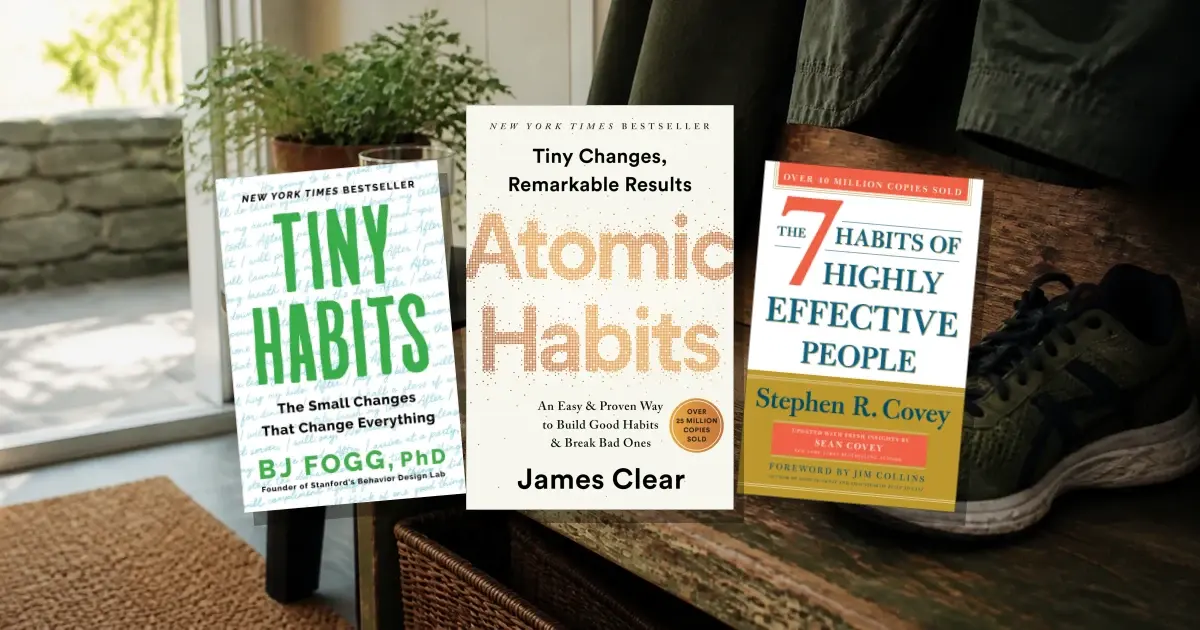
Atomic Habits · James Clear
James Clear connects repeated behavior to cues, friction, rewards, identity, and environment. The useful shift is from blaming each individual lapse to examining a repeatable system. A habit still needs a worthwhile purpose; efficiency does not supply one.
- Read it for
- The conditions that make a chosen routine easier to repeat.
- Keep in mind
- A general behavior framework does not explain every clinical or structural barrier.

Examine what a setback seems to prove
Mindset · Carol S. Dweck
Carol Dweck contrasts beliefs that treat ability as fixed with beliefs that leave room for development. The question is how those beliefs shape responses to challenge, feedback, and effort. Praising effort mechanically misses the role of strategies and learning conditions.
- Read it for
- A language for noticing interpretations of difficulty and feedback.
- Keep in mind
- A growth mindset is not a promise that effort erases unequal circumstances.
Remove a commitment before adding a productivity tool
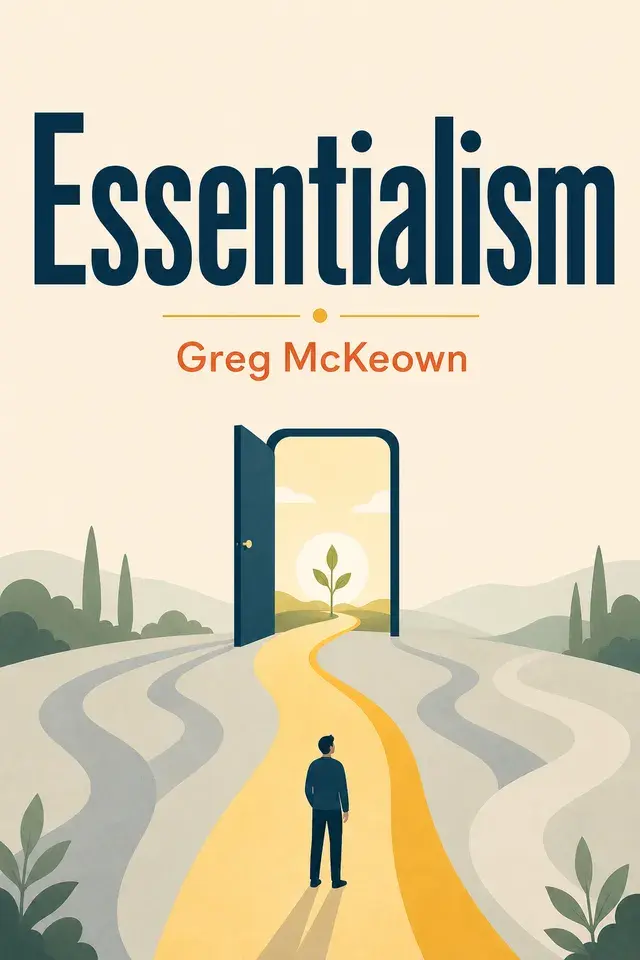
Essentialism · Greg McKeown
Greg McKeown argues for making trade-offs explicit and choosing the vital few. This book is useful when the problem is the load itself, rather than forgetting how to organize it. Saying no is presented as a practice, but its social costs deserve attention.
- Read it for
- Choosing which commitments deserve continued effort.
- Keep in mind
- Readers have unequal power to refuse work or renegotiate responsibilities.

Separate a philosophy from a permission slip
The Courage to Be Disliked · Ichiro Kishimi & Fumitake Koga
Ichiro Kishimi and Fumitake Koga stage a dialogue around Adlerian ideas about purpose, relationships, and others’ judgments. Follow the questions and objections rather than turning the title into an instruction to disregard people.
- Read it for
- A philosophical challenge to organizing life around approval.
- Keep in mind
- The dialogue’s claims are an interpretive framework, not a universal account of trauma or mental health.

Make a limit understandable
Set Boundaries, Find Peace · Nedra Glover Tawwab
Nedra Glover Tawwab examines how boundaries are communicated and maintained across relationships. A boundary is more useful when it names a behavior and what the speaker can do, rather than trying to command another person’s feelings.
- Read it for
- Language for identifying and communicating limits.
- Keep in mind
- The right response depends on safety, dependence, and the actual relationship; a book cannot know those circumstances.
Take one question back to an ordinary week
After reading, write the author’s proposed mechanism in a sentence and identify one place it might fit. Also write what would make it a poor fit. This gives the book something concrete to answer without making your whole life a test of its system.
Sources and scope
Book ideas are attributed to their authors. External evidence is linked directly when a claim needs more than the source book.
- Atomic Habits: James Clear connects repeated behavior to cues, friction, rewards, identity, and environment. The useful shift is from blaming each individual lapse to examining a repeatable system. A habit still needs a worthwhile purpose; efficiency does not supply one. Scope: A general behavior framework does not explain every clinical or structural barrier.
- Mindset: Carol Dweck contrasts beliefs that treat ability as fixed with beliefs that leave room for development. The question is how those beliefs shape responses to challenge, feedback, and effort. Praising effort mechanically misses the role of strategies and learning conditions. Scope: A growth mindset is not a promise that effort erases unequal circumstances.
- Essentialism: Greg McKeown argues for making trade-offs explicit and choosing the vital few. This book is useful when the problem is the load itself, rather than forgetting how to organize it. Saying no is presented as a practice, but its social costs deserve attention. Scope: Readers have unequal power to refuse work or renegotiate responsibilities.
- The Courage to Be Disliked: Ichiro Kishimi and Fumitake Koga stage a dialogue around Adlerian ideas about purpose, relationships, and others’ judgments. Follow the questions and objections rather than turning the title into an instruction to disregard people. Scope: The dialogue’s claims are an interpretive framework, not a universal account of trauma or mental health.
- Set Boundaries, Find Peace: Nedra Glover Tawwab examines how boundaries are communicated and maintained across relationships. A boundary is more useful when it names a behavior and what the speaker can do, rather than trying to command another person’s feelings. Scope: The right response depends on safety, dependence, and the actual relationship; a book cannot know those circumstances.
To report a factual, attribution, rights, or accessibility concern, email hello@wiseley.app.