They begin at different causal levels
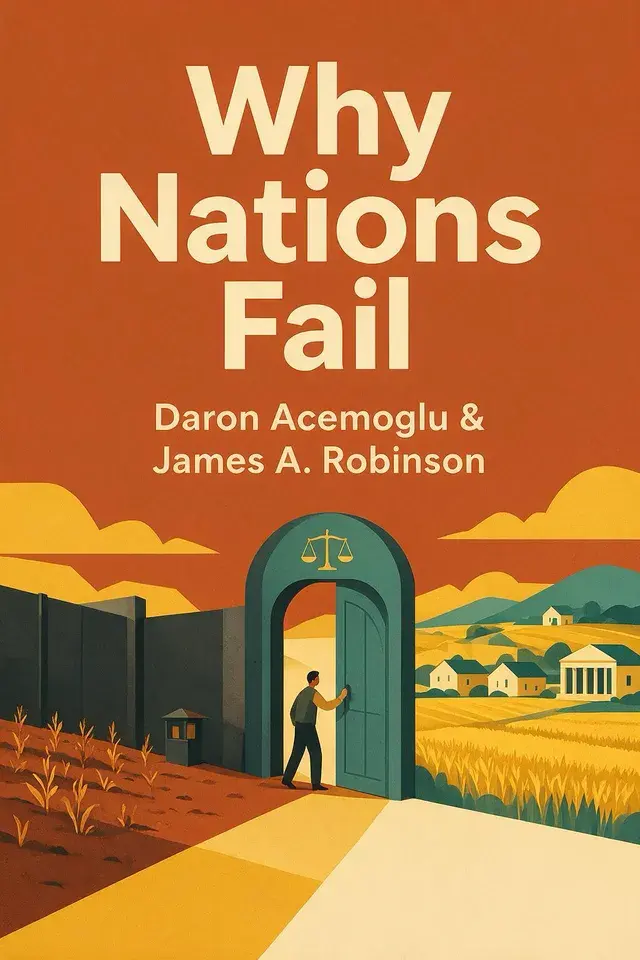
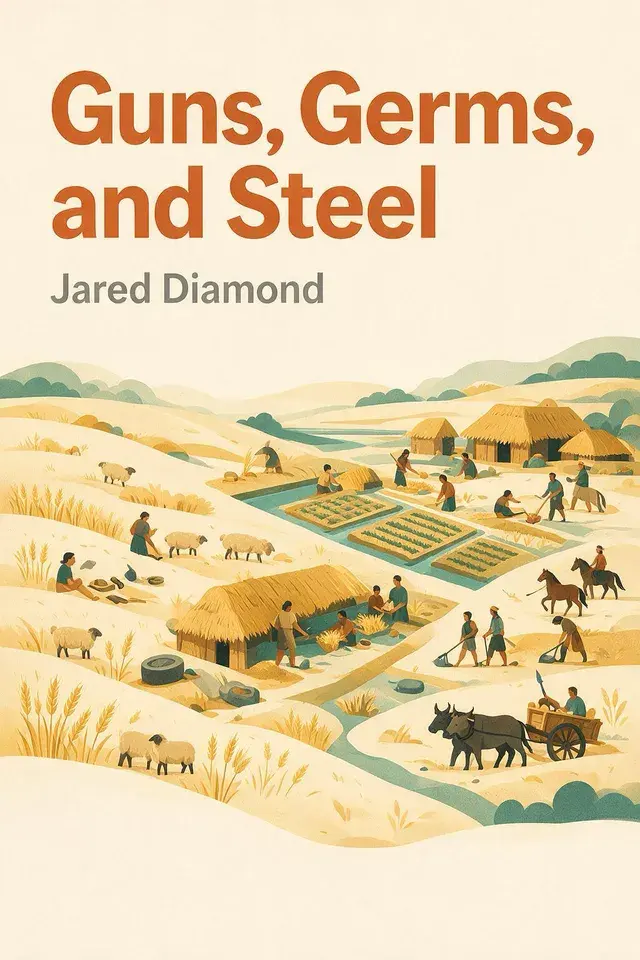
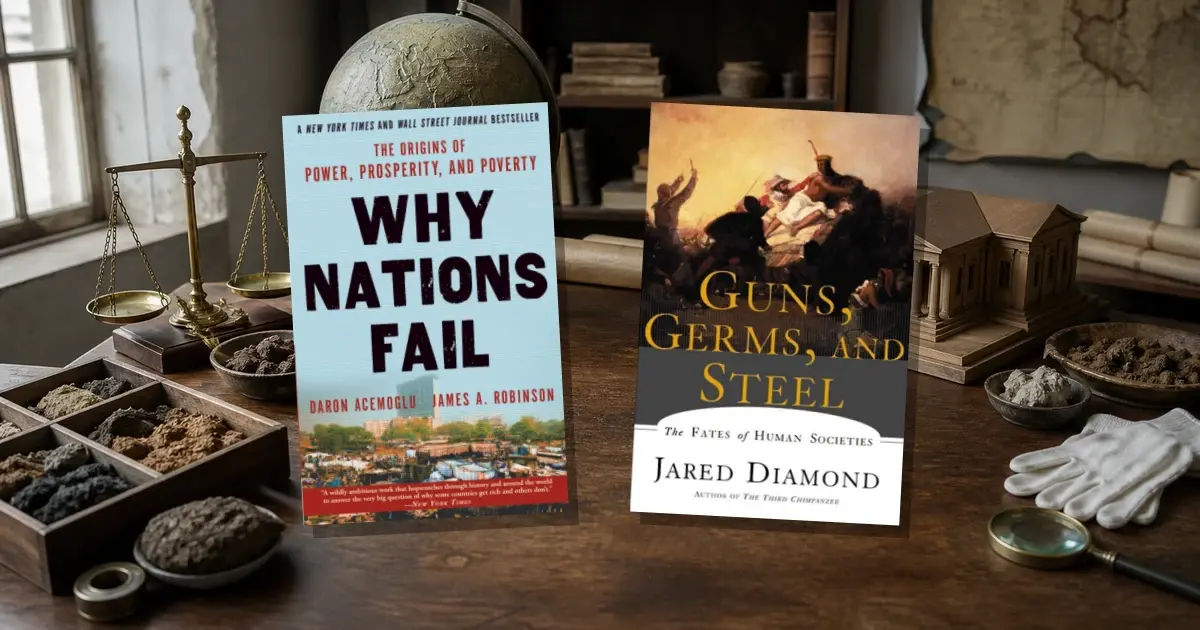
Why Nations Fail gives priority to political power and the economic institutions it creates. Inclusive arrangements distribute opportunity and constrain rulers; extractive arrangements concentrate gains and can block innovation. Guns, Germs, and Steel moves further back, asking why food production, dense populations, disease environments, writing, states, and military technologies developed earlier in some regions. Its proposed chain begins with geography and biogeography rather than racial ability.
- Institutions and struggles over power: Why Nations Fail.
- Domesticable species, continental axes, germs, and diffusion: Guns, Germs, and Steel.
- Different starting questions mean the books can interact without becoming interchangeable.
Each framework reveals and compresses
Institutional comparisons make policy choices and political coalitions visible, but labels such as inclusive and extractive can flatten mixed institutions or make successful outcomes look inevitable in retrospect. Environmental comparison explains broad asymmetries over very long periods, but its scale can leave culture, contingency, state decisions, and internal conflict underdescribed. Both books range across cases that specialists continue to debate, so a memorable example should be treated as evidence within an argument, not as a settled natural experiment.
- Ask whether the case was selected before or after the proposed outcome was known.
- Separate a necessary condition from a sufficient explanation.
- Look for variation the framework predicts poorly, not only cases it narrates well.
A useful reading order
Start with Guns, Germs, and Steel if your question concerns the deep preconditions behind intercontinental divergence. Start with Why Nations Fail if your question concerns why societies facing constraints still take different institutional paths. Then read the second book against one shared case: list the time scale, mechanism, actors, and counterfactual each explanation requires. The goal is not to award geography or institutions every causal point, but to see what changes when the unit of analysis changes.
- Define the outcome and period before comparing explanations.
- Write the causal chain in steps instead of repeating the thesis label.
- Consult narrower regional histories before generalizing from either synthesis.
Sources and scope
Book ideas are attributed to their authors. External evidence is linked directly when a claim needs more than the source book.
- Why Nations Fail: Primary source for the political-power, inclusive-institution, extractive-institution, and innovation argument.
- Guns, Germs, and Steel: Primary source for the geography, food production, disease, diffusion, technology, and conquest argument.
To report a factual, attribution, rights, or accessibility concern, email hello@wiseley.app.
Questions readers ask
Do the books directly contradict each other?
They compete for explanatory priority more than they offer simple opposites. Environmental constraints can shape possibilities while political institutions influence how societies use, distribute, or resist those possibilities.
Which book is easier to apply to a specific country?
Why Nations Fail offers a more direct institutional vocabulary, but that ease can encourage overconfident diagnosis. Pair either framework with specialist history and evidence from the place and period in question.