Citizen habits and institutional gatekeepers
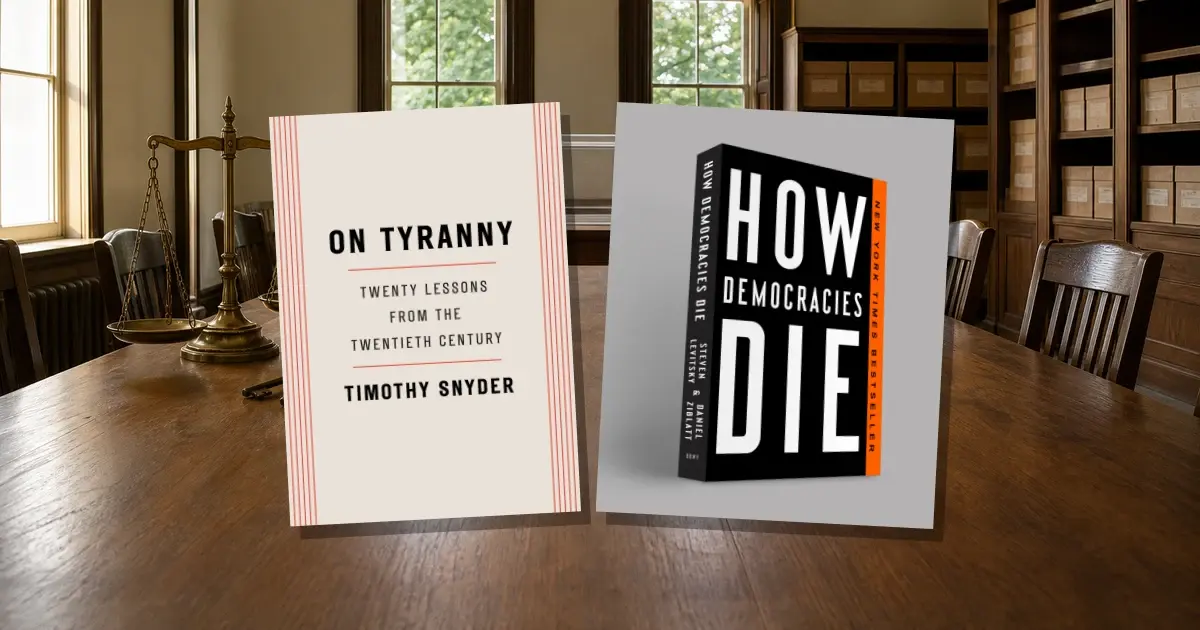
On Tyranny condenses lessons from twentieth-century European history into practices for ordinary citizens: resist anticipatory obedience, defend institutions, protect factual truth, maintain professional ethics, and build relationships beyond screens. How Democracies Die uses comparative political history to examine a different mechanism: elected leaders erode democracy when parties fail to screen authoritarian behavior and when mutual toleration and institutional forbearance collapse. The first speaks in imperatives; the second builds a diagnostic framework.
- Personal and professional civic conduct: On Tyranny.
- Parties, alliances, constitutional powers, and unwritten norms: How Democracies Die.
- Shared warning: formal institutions do not defend themselves automatically.
Their formats produce different risks
Snyder’s brevity makes action memorable, but historical analogies can be stretched when context, sequence, and institutional differences are ignored. Levitsky and Ziblatt’s framework helps compare cases, but warning indicators are not mechanical predictions and norms can protect exclusion as well as democracy. Neither book eliminates the need to define the institution, actor, legal power, evidence, and historical period behind a claim.
- Use analogy to generate a question, not to declare two situations identical.
- Distinguish a norm being broken from a law being violated.
- Evaluate democratic defense by both institutional survival and inclusive participation.
Choose a practical lens
Read On Tyranny when you want a short civic prompt that can be discussed lesson by lesson. Read How Democracies Die when you want a fuller account of party gatekeeping, polarization, norm erosion, and the legal use of institutional powers against opponents. Together they connect individual conduct to organizational restraint: citizens influence parties and institutions, while durable institutions make responsible civic action more consequential and less dangerous.
- State which historical case supports a proposed lesson.
- Identify the actor with the power and duty to respond.
- Prefer lawful, coalition-based action over dramatic but undefined resistance.
Sources and scope
Book ideas are attributed to their authors. External evidence is linked directly when a claim needs more than the source book.
- On Tyranny: Primary source for Snyder’s civic lessons and use of twentieth-century European history.
- How Democracies Die: Primary source for the party-gatekeeping, authoritarian-warning, mutual-toleration, and forbearance framework.
To report a factual, attribution, rights, or accessibility concern, email hello@wiseley.app.
Questions readers ask
Which book is the better introduction?
On Tyranny is shorter and more immediately discussable. How Democracies Die offers more comparative machinery for understanding parties, norms, and incremental institutional erosion.
Can either book diagnose a current democracy by itself?
No. Both provide questions and historical patterns, not a live measurement instrument. Current diagnosis requires dated evidence, local legal and political expertise, and serious attention to competing explanations.