What you'll learn
Key ideas from Guns, Germs, and Steel
These ideas compress the book's argument without treating the author's view as settled fact. Use them as an orientation before reading the full work or listening in Wiseley.
Geography and biogeography, especially domesticable species and their movement, shape historical possibilities more than racial ability.
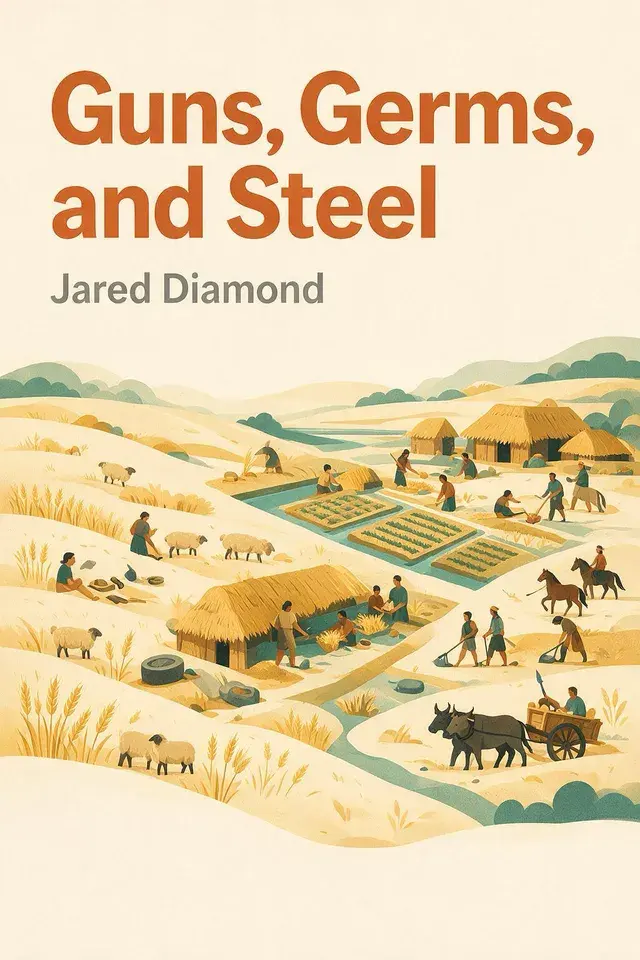
Food production forms the proposed chain toward population, specialists, governments, technology, writing, germs, and conquest.
At Cajamarca, a tiny Spanish force captured Atahuallpa because steel, cavalry, surprise, and organization outweighed the Inca army’s numerical advantage.
Domestication followed the Anna Karenina principle: only animals meeting many dietary, reproductive, behavioral, and social requirements could become useful large domesticates.
Eurasia’s east-west axis helped crops and livestock cross similar latitudes, while north-south routes faced changing climates and ecological barriers.
Eurasian disease exchange was largely one-way because Eurasia had more suitable herd animals and closer human-animal contact.
Technology accumulates through tinkering, borrowed components, social adoption, and maintenance; invention alone does not guarantee historical impact.
Historical comparison supports probabilistic patterns, while individual accidents and cultural path dependence limit prediction.
How Guns, Germs, and Steel builds its case
Follow how the book develops its argument. Each note is a brief orientation, not a replacement for the chapter.
The Question Behind Inequality
In 1972, Yali asked Jared Diamond why white people had brought so much more “cargo” than New Guineans. The question reached beyond manufactured goods.
The Starting Line
To test whether any continent began with a decisive advantage, Diamond moves the clock back to about eleven thousand B.C. It is a useful starting line: village life was emerging, the Ice Age was ending, the Americas had first undisputed settlers, and domestication would begin within a few thousand years.
Islands as History’s Lab
Polynesia offers the book’s clearest natural experiment in social development. Controlled experiments on human societies are impossible, but history can compare related populations that entered different environments.
Cajamarca and Farmer Power
On November 16, 1532, at Cajamarca in the Andes, Atahuallpa, ruler of the largest and most advanced New World state, faced a Spanish force that seemed no match for his empire. He commanded about eighty thousand soldiers.
The Unplanned Rise of Farming
All humans once lived by hunting and gathering, so farming raises a historical puzzle: why did some communities begin producing food at different times, while others in apparently fertile places did not? The answer is not a single invention or a universal decision to improve life.
Why Crops Took Root
Domestication began not as a single invention, but as an unconscious process. People gathered wild plants, ate them, discarded or accidentally sowed their seeds, and later replanted favored descendants.
Domesticates and Continental Axes
Domesticating animals looks like a matter of finding a useful wild species and keeping it nearby. The chapter argues that this misses the real difficulty.
Germs and the Written Word
Food production changed human life in a less visible way: it changed the ecology of infection. A single farmer was not inherently stronger than a hunter-gatherer, but settled agriculture supported populations ten to one hundred times denser.
Technology, States, and Conquest
Technology does not enter history as a parade of finished inventions. The Phaistos disk used raised stamps to press signs into soft clay, anticipating printing, yet remained isolated.
Australia’s Environmental Test
On a hot walk near Menindee, Jared Diamond and his wife carried water yet became exhausted and disoriented, and had to turn back. Aboriginal Australians had survived in the same country for generations by knowing where to find water and food.
China, Austronesia, and Expansion
China’s apparent unity is a historical puzzle. North China was colder and drier than the hotter, wetter south, and northern and southern populations differed physically and genetically.
The Hemispheres Collide
At Cajamarca, Pizarro's small force captured Atahuallpa. It looked like a sudden triumph, but the chapter treats it as the continental culmination of a much longer divergence.
Africa’s Divergent Paths
Africa’s diversity is evidence of a long, uneven history. By about A.D. 1000, its peoples could be described in five broad groupings: blacks, whites, African Pygmies, Khoisan, and Asians.
Patterns, Limits, and Legacies
The book closes by returning to Yali’s question: why did some societies gain wealth and power while others did not? Its answer remains environmental, not racial.