What you'll learn
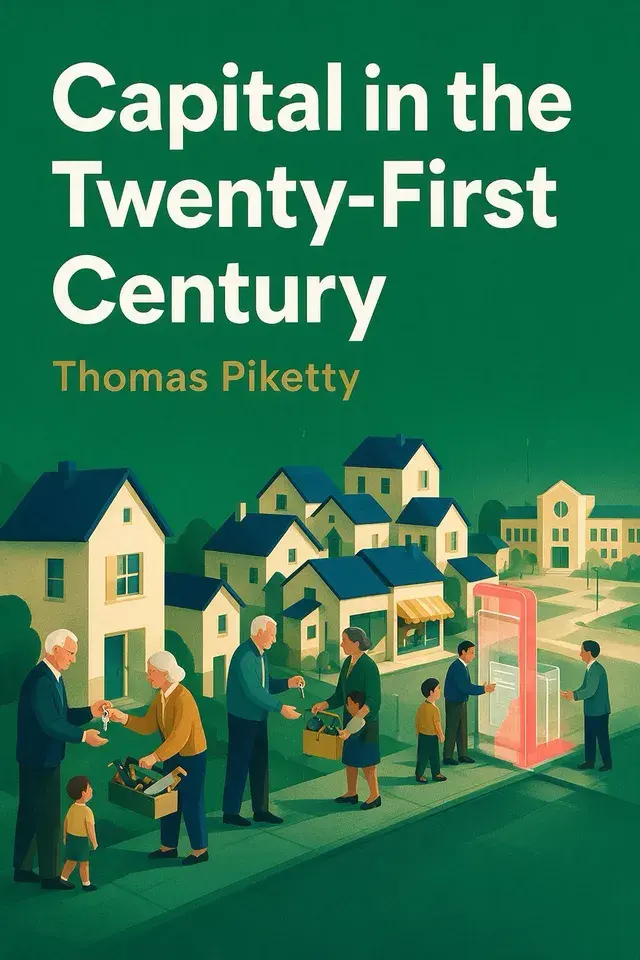
Key ideas from Capital in the Twenty-First Century
These ideas compress the book's argument without treating the author's view as settled fact. Use them as an orientation before reading the full work or listening in Wiseley.
Inequality follows interacting economic, historical, institutional, and political forces rather than an automatic capitalist or developmental law.
Wealth is far more concentrated than labor income, while the middle 40 percent holds a meaningful but fragile share of property.
Persistent r greater than g lets reinvested fortunes outpace wages and output, allowing capital to reproduce itself without continued labor.
Wars, inflation, taxation, and exceptional postwar growth interrupted inheritance’s dominance; the interruption was historical rather than capitalism’s automatic correction.
Portfolio scale gives large fortunes and endowments access to higher returns through expertise, diversification, and alternative investments.
The social state turns redistribution into collective rights to services and income security, combining equal access with benefits linked partly to prior earnings.
A progressive annual tax on worldwide net wealth is presented as a market-compatible response to concentration when returns exceed growth.
Automatic cross-border reporting and a financial cadaster are prerequisites for accurate ownership records, valuation, enforcement, and democratic wealth statistics.
How Capital in the Twenty-First Century builds its case
Follow how the book develops its argument. Each note is a brief orientation, not a replacement for the chapter.
The Question of Inequality
Why does inequality rise in some periods, fall in others, and take different forms across countries? Piketty opens with that historical and political question: what do we know about the long-run evolution of wealth and income, and what might it teach us about the twenty-first century?
The Measures Behind Growth
To follow the book’s later comparisons, begin by separating a flow from a stock. Income is the annual flow of goods and services produced and distributed.
Capital’s Long Historical Cycle
Capital’s long history is a story of transformation, not disappearance. In Europe and the United States, wealth moved from farmland and foreign holdings toward housing, business capital, infrastructure, and financial assets.
The Architecture of Inequality
To understand inequality, it is not enough to ask how much capital an economy contains. We must ask who earns income from work, who owns wealth, and whether the same people occupy both positions.
When Returns Beat Growth
Capital changes social meaning when its return exceeds growth. Let r be the annual return on capital and g the economy’s annual growth rate.
The Global Fortunes Problem
National averages show how much wealth a country has, but not who ultimately owns it. Once fortunes cross borders, global analysis must include foreign assets, inequalities between countries, and unequal returns across portfolios.
The Social State’s Bargain
The modern social state emerged from the Depression, war, and reconstruction. Between 1930 and 1980, wealthy countries expanded government beyond policing, justice, and administration.
Taxing Globalized Wealth
After tracing how wealth can compound when the return on capital exceeds economic growth, the book turns from diagnosis to institutional design. Piketty’s preferred instrument is a progressive annual tax on each person’s worldwide net wealth.
Debt, Democracy, and the Future
At the end of the book, public debt is not a simple measure of national scarcity. A country may have indebted governments while households own great private wealth.