What you'll learn
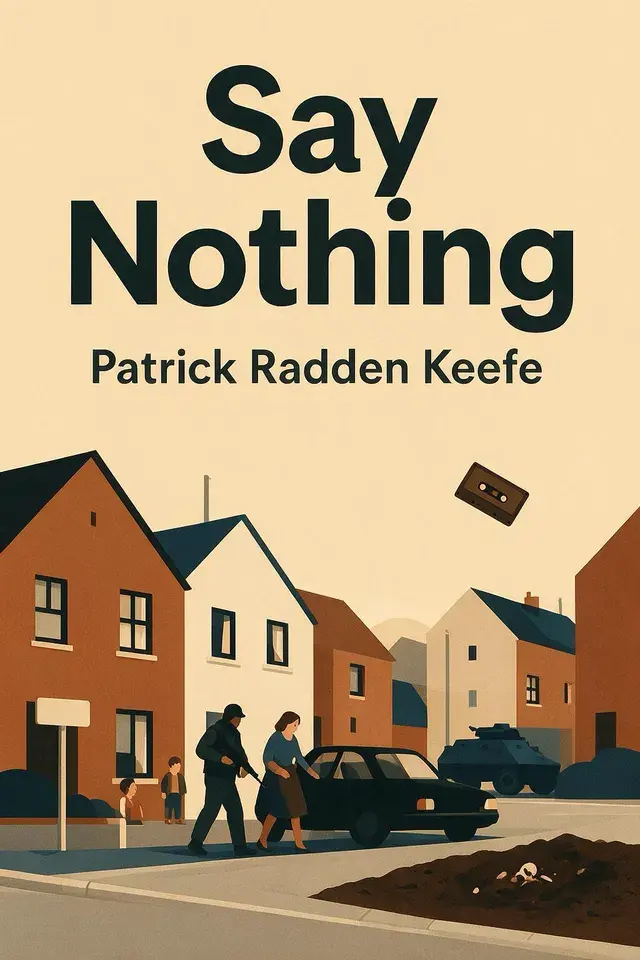
Key ideas from Say Nothing
These ideas compress the book's argument without treating the author's view as settled fact. Use them as an orientation before reading the full work or listening in Wiseley.
Belfast’s religious divisions shaped work, housing, marriage, political power, and inherited memory.
Bloody Sunday and distrusted authorities made armed republicanism appear to Dolours and Marian as a route to purpose, identity, and agency.
Internment and the Hooded Men showed how faulty intelligence and coercive interrogation alienated Catholics while crossing contested legal boundaries.
The McConville children moved from abandonment at home into care that separated them and exposed them to institutional abuse.
Sands’s election shows how Sinn Féin could use the ballot while the IRA retained armed struggle.
The cease-fire and Good Friday Agreement made peace through compromise, consent, power sharing, and ambiguity.
The Belfast Project used insider interviewers, secrecy, coded identities, and delayed release where no public truth process existed.
Jean McConville’s recovery restored burial and identity, but not the family’s lost years, social stigma, or disputed account of her alleged informing.
How Say Nothing builds its case
Follow how the book develops its argument. Each note is a brief orientation, not a replacement for the chapter.
The Archive and the Abduction
In July 2013, Belfast detectives arrive at Boston College’s Burns Library, where a highly secured Treasure Room holds one of the book’s most consequential collections. They are looking for secret MiniDiscs and transcripts recorded nearly a decade earlier.
Inherited War, Divided City
Before the underground war, Belfast had already made sectarian identity practical. Religion shaped neighborhoods, schools, work, voting, marriage, and safety.
Joining the Underground War
After Burntollet Bridge, Dolours Price no longer saw peaceful protest as a route to change. Bloody Sunday made that conclusion harder to resist.
Guerrillas and Counterinsurgents
In West Belfast, the battlefield was a neighborhood. On September 2, 1972, Brendan Hughes spotted a green van while temporarily unarmed.
Silence, Bombs, and the Children Left Behind
The 1972 cease-fire briefly restored ordinary life: fugitives returned, barricades opened, shops reopened, and Brendan Hughes saw his pregnant wife. Secret talks then failed.
Bombs, Trials, and Hunger
After Belfast’s bombing campaign had made ordinary life dangerous, Dolours Price argued that the IRA was fighting in the wrong place. The British public seemed insulated from Northern Ireland’s catastrophe, while civilians there paid the human and economic cost.
From Protest to Political Power
After the earlier account of the McConville family’s institutional aftermath, the story moves inside Long Kesh. For Gerry Adams, prison’s routine could feel more predictable than life on the run, and sharing Cage Eleven with Brendan Hughes deepened their relationship.
Peace Without a Truth Process
Peace did not arrive as a clean break. It entered lives formed by war and exposed how unevenly a movement could leave it behind.
Informers and the Missing
After the peace settlement, Say Nothing turns from the conflict’s operations to what surviving veterans carry. Brendan Hughes lives in the remaining Divis Tower, where British soldiers once occupied the roof and top floors.
The Tapes Become Evidence
By 2005, the IRA was dismantling its arsenal. Father Alec Reid and Methodist minister Harold Good witnessed the final phase; the method was secret, though weapons were said to be sealed in concrete.
A Reckoning Without Closure
By the time the Good Friday Agreement had made Northern Ireland largely peaceful, it had not made the past disappear. A 2015 report said every major Troubles-era paramilitary group still existed.