What you'll learn
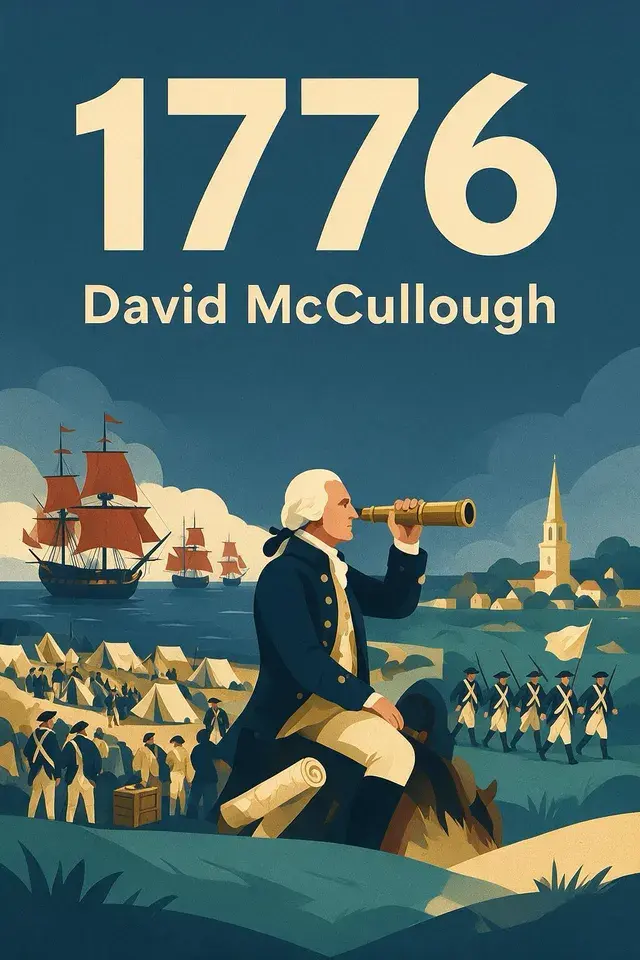
Key ideas from 1776
These ideas compress the book's argument without treating the author's view as settled fact. Use them as an orientation before reading the full work or listening in Wiseley.
Washington inherits manpower without a settled army, reliable counts, trained engineering, or adequate gunpowder.
Knox’s artillery train supplied the guns, while prefabricated works, coordinated labor, deception, and disciplined timing turned terrain into leverage.
The Declaration gave New York’s defense its final political stakes just as a vastly larger British fleet and army gathered offshore.
Secrecy, Glover’s boatmen, shifting wind, silence, and rear-guard deception turned defeat into a night escape that preserved the army.
The New Jersey retreat preserved the army by trading ground for time as civilian suffering and competing proclamations intensified the conflict.
Trenton’s surprise victory restores morale by proving American troops can defeat the feared Hessians, while evidence rejects the drunkenness legend.
The victories keep the cause alive without ending war; McCullough locates their deeper force in Washington’s perseverance amid contingency and structural weakness.
How 1776 builds its case
Follow how the book develops its argument. Each note is a brief orientation, not a replacement for the chapter.
Empire Meets Improvisation
At the outset of the conflict, the two sides possess different kinds of strength. Britain has an empire, a parliamentary government, regular troops, and institutions accustomed to command.
Making Soldiers from Citizens
At Boston, the army’s first task was to make citizens function as soldiers. Its ranks included farmers and artisans, sailors and fishermen, immigrants, Black soldiers, Indians, boys, older men, drifters, and men with families and trades waiting at home.
Engineering the Boston Breakthrough
By January 1776, Boston’s stalemate tested judgment. On January seventeenth, Washington argued that a bold attempt was indispensable.
New York Under Impossible Odds
Boston’s evacuation was celebrated as the first great American news of the war. It traveled quickly, brought public praise to the troops, and made Washington a national hero.
Brooklyn and the Night Escape
Brooklyn was not simply a defeat caused by soldiers losing their nerve. The disaster began with illness, weak recruitment, and inexperience, compounded by British sea power and superior intelligence.
Defeat Without Destruction
The Brooklyn escape preserved the American army, but not its position. McCullough calls the withdrawal daring and well timed, yet still treats Brooklyn as a fiasco.
The Retreat Becomes a Strategy
After Harlem Heights, fine weather suggested that fighting might rest until spring, but British naval movement ended the pause. American defections convinced British commanders that the rebellion was nearly over.
Trenton, Princeton, and Perseverance
At the end of 1776, Washington faced an exhausted army, expiring enlistments, and the risk that another withdrawal would expose it to discovery and harassment. His counterstroke began with a dangerous but rational choice: cross the Delaware, attack Trenton, and accept that action might be safer than retreat.