What you'll learn
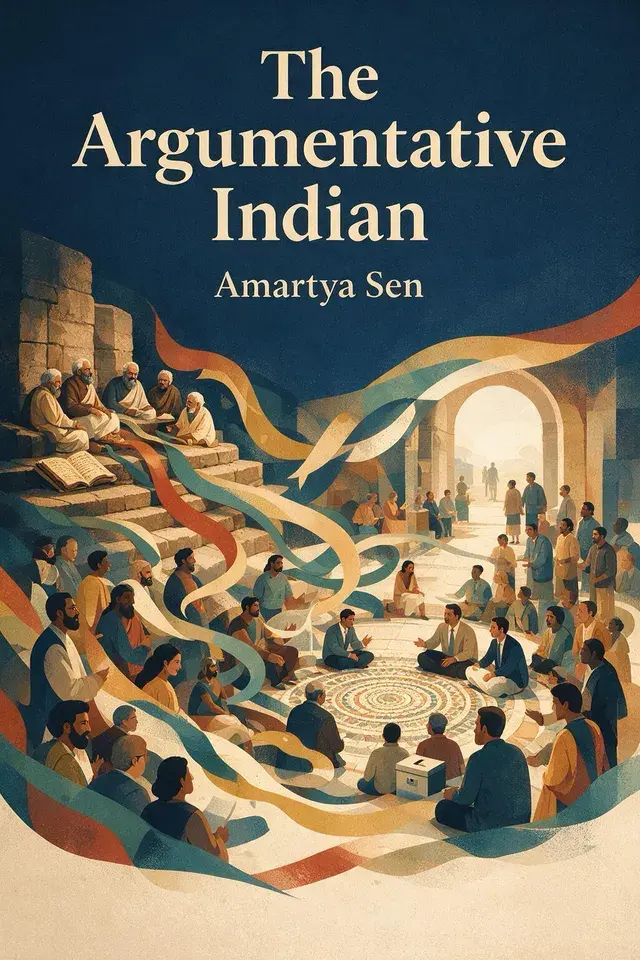
Key ideas from The Argumentative Indian
These ideas compress the book's argument without treating the author's view as settled fact. Use them as an orientation before reading the full work or listening in Wiseley.
Public reasoning becomes democratic only when people can speak, be heard, and influence shared decisions.
India’s identity includes heterodoxy, interreligious interaction, and equal citizenship; Hindu numerical majority does not define the whole nation.
Tagore’s freedom of mind joins cultural rootedness with questioning inherited authority and openness to ideas beyond narrow national boundaries.
Traditions and policies are judged by substantive effects rather than labels such as modern, traditional, Western, or indigenous.
Democracy can expose failures and protect against catastrophe, but elections alone do not secure health, education, or equality.
Women become agents when literacy, work, property, income, and decision-making power expand their independence and ability to question inherited norms.
Indian secularism rejects religious privilege while leaving the state’s exact distance from religion open to argument.
Globalization brings reciprocal benefits and unequal harms, so trade and institutions require practical judgment alongside domestic capabilities and public goods.
How The Argumentative Indian builds its case
Follow how the book develops its argument. Each note is a brief orientation, not a replacement for the chapter.
The Argumentative Inheritance
Amartya Sen begins with a warning about selection. India’s scale and diversity make any account of its culture, history, or politics necessarily partial.
Voice, Pluralism, and Inequality
Pluralism is an important condition for social justice, but it is not justice itself. Sen distinguishes between recognizing people as legitimate members of a shared society and ensuring that they stand as equals within it.
India Beyond a Narrow Nation
India’s identity becomes a political question when history is used as a boundary marker. Sen contrasts a “large India,” shaped by heterodoxy, argument, interreligious interaction, and varied loyalties, with a “small India” that makes Hinduized identity the test of belonging.
Tagore’s Freedom of Mind
Freedom of mind, in Amartya Sen’s account, is not a slogan about being modern. It is the discipline of asking whether inherited authority, political passion, or popular custom deserves obedience.
Culture Without Purity
Culture has no sealed container. It is shaped by particular people, local histories, and contact.
India and Reciprocal Civilizations
India’s long relationship with China offers a direct challenge to the picture of civilizations as sealed worlds. It is often reduced to a simple story: Buddhism traveled from India to China.
Democracy and Unequal Development
Development is judged twice: by whether people can make demands heard, and by what society achieves. Nehru’s pledge sets three linked tests: democracy, removal of social inequality and backwardness, and economic progress with equity.
Women as Agents of Change
Gender inequality is not one affliction with one reliable measure. It can appear in survival, births, schooling, access to facilities, property, paid work, household sharing, violence, political representation, and participation outside the home.
Security, Reason, and Nuclear Power
At first glance, the nuclear question seems to be about justice. The established nuclear powers hold official status and permanent Security Council seats, while their military policies give India and Pakistan grounds for complaint.
Secularism as Equal Citizenship
Indian secularism, in Sen’s account, is neither a Western import nor a demand that religion disappear from public life. It is a political practice: the state must refuse religious privilege and protect citizens symmetrically, while the exact form of engagement remains open to argument.
Calendars, Globalization, and Identity
India’s story can be read in its calendars. They combine mathematics and astronomy with religion, politics, culture, and practical life.