Choose the mechanism of power you want to understand
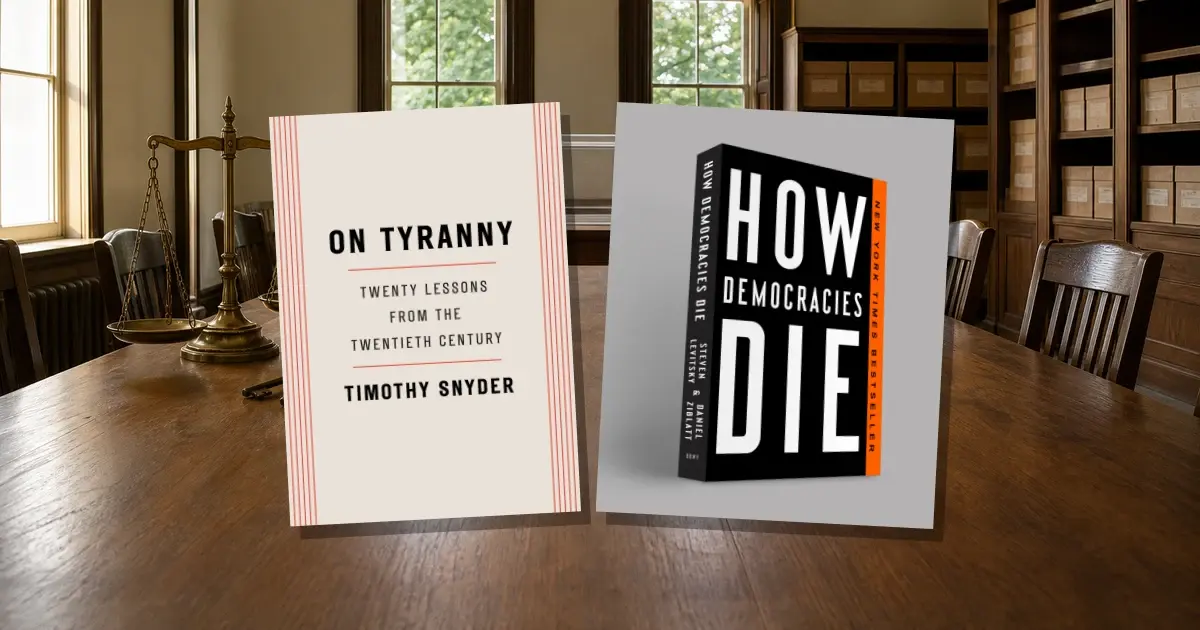
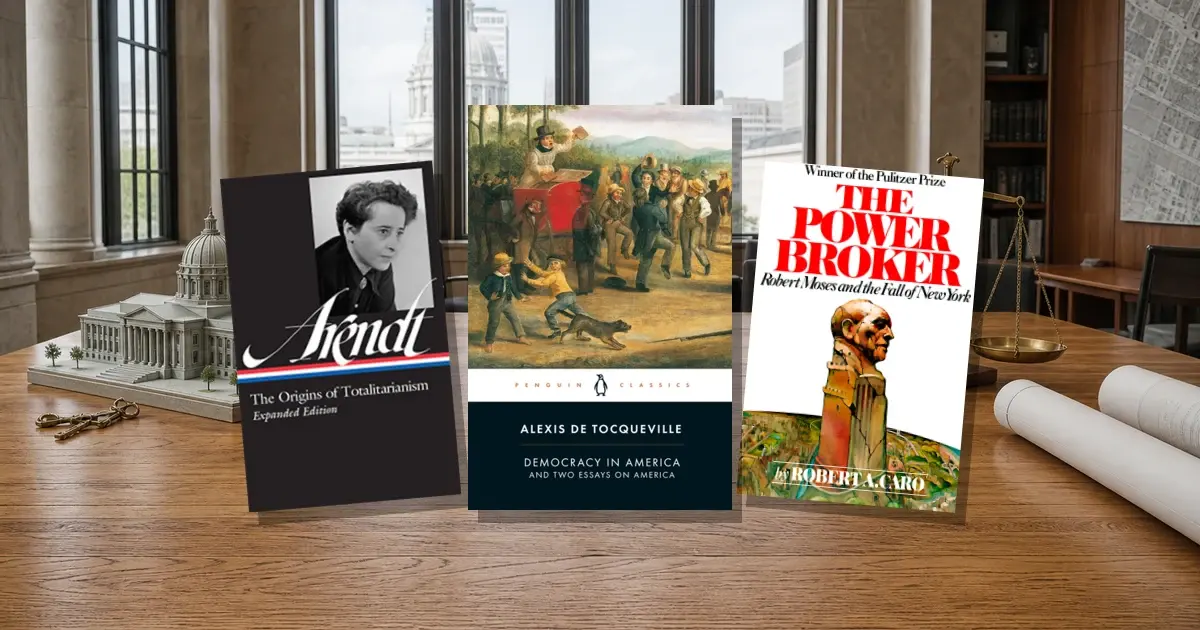
Democracy in America studies how equality reshapes institutions, associations, local government, majority power, and private life. The Origins of Totalitarianism asks how atomization, ideology, propaganda, secret police, terror, and camps enable a distinct form of total domination. The Power Broker follows Robert Moses as legal design, public authorities, revenue, expertise, and speed produce durable unelected power. On Tyranny distills civic lessons from twentieth-century Europe. How Democracies Die examines parties, elected leaders, mutual toleration, forbearance, and the incremental hollowing of competition.
- Democratic habits, associations, majority rule, and soft despotism: Democracy in America.
- Mass isolation, ideological fiction, terror, and total rule: The Origins of Totalitarianism.
- Infrastructure, legal machinery, and authority without ordinary accountability: The Power Broker.
- Compact practices for citizens and professionals: On Tyranny.
- Party gatekeeping, elected erosion, and unwritten guardrails: How Democracies Die.
Do not collapse different failures into one label
Tocqueville’s nineteenth-century observations combine lasting questions with assumptions and exclusions that require historical context. Arendt distinguishes totalitarianism from ordinary dictatorship; using her vocabulary for every abuse empties the distinction. Caro shows that public works can deliver real benefits while displacement, exclusion, debt, and secrecy weaken accountability. Snyder’s analogies are prompts for civic judgment, not proof that two periods are identical. Levitsky and Ziblatt’s warning signs organize comparison but do not operate as mechanical predictions.
- Name the institution, actor, power, and affected group before choosing a theory.
- Distinguish formal law, administrative design, party behavior, civic norm, and coercion.
- Use historical analogy to generate questions, then test differences as carefully as similarities.
A reading path from everyday practice to extreme domination
Begin with The Power Broker because a concrete city, set of projects, and legal institutions make power visible without requiring a complete theory of government. Add Democracy in America for associations, local responsibility, majority power, and the tension between equality and dependence. Read How Democracies Die and On Tyranny together to connect organizational restraint with civic conduct. Finish with The Origins of Totalitarianism, whose difficult account belongs at the end so its extreme category does not become a shortcut for every earlier problem.
- Map where authority comes from, how it renews itself, and who can challenge it.
- Record both the public benefit and democratic cost of an institution’s action.
- Prefer historically specific comparisons over universal labels.
Sources and scope
Book ideas are attributed to their authors. External evidence is linked directly when a claim needs more than the source book.
- Democracy in America: Source for equality of conditions, local government, associations, majority power, racial exclusion, and soft despotism.
- The Origins of Totalitarianism: Source for the account of atomized masses, propaganda, ideological fiction, objective enemies, terror, camps, and total domination.
- The Power Broker: Source for Moses’s public authorities, financial independence, infrastructure, displacement, traffic, and weakened public review.
- On Tyranny: Source for Snyder’s historically framed civic lessons about institutions, truth, professional ethics, association, and emergency power.
- How Democracies Die: Source for elected democratic erosion, party gatekeeping, warning signs, mutual toleration, forbearance, and coalition-based repair.
To report a factual, attribution, rights, or accessibility concern, email hello@wiseley.app.
Questions readers ask
Which book is the best introduction to power?
The Power Broker is the most concrete study of how rules, money, expertise, projects, and political relationships accumulate into durable authority. On Tyranny is the shortest entry but has a narrower civic purpose.
Can these books diagnose a current political system?
Not by themselves. They provide historical concepts and comparative questions. Any current assessment needs dated local evidence, legal and institutional expertise, and serious testing of alternative explanations.