What you'll learn
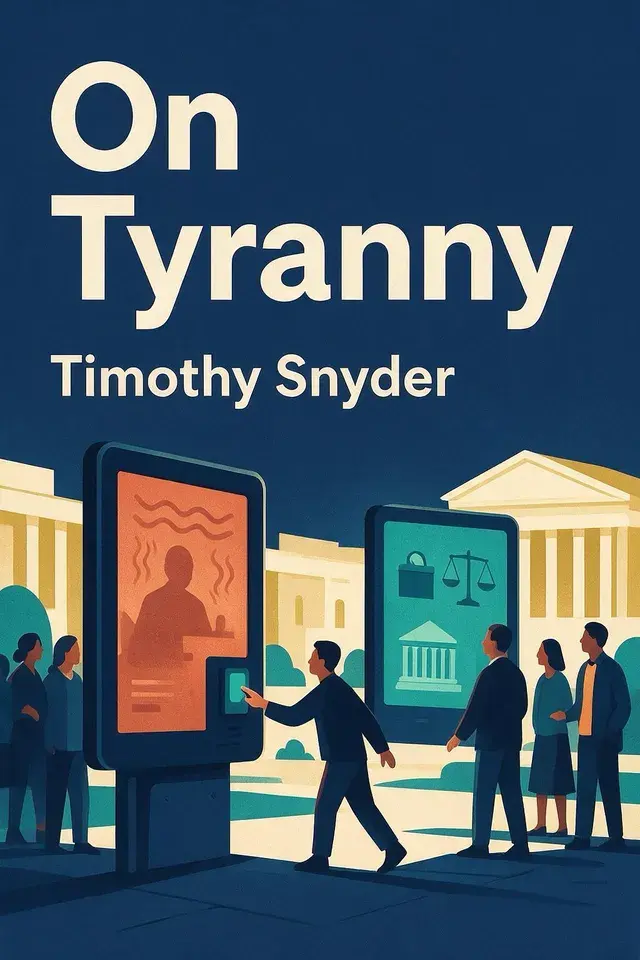
Key ideas from On Tyranny
These ideas compress the book's argument without treating the author's view as settled fact. Use them as an orientation before reading the full work or listening in Wiseley.
Anticipatory obedience expands a new ruler’s practical power before direct coercion begins.
Institutions preserve decency only when citizens actively claim and defend them.
Visible dissent and practical aid break the social performance that allows coercion to look unanimous.
Since internet users are publishers, verification and refusing falsehoods become forms of civic responsibility.
Voluntary associations build trust beyond family and help sustain democratic freedom against authoritarian control.
Emergency vocabulary turns vague labels such as extremism and exception into tools for making temporary power permanent.
Acknowledging genuine danger does not require treating reduced liberty as the unavoidable price of security.
Patriotism serves a country by holding it to universal ideals, while nationalism feeds resentment and mythic victimhood.
How On Tyranny builds its case
Follow how the book develops its argument. Each note is a brief orientation, not a replacement for the chapter.
History Warns, Compliance Opens the Door
Democracy does not protect itself. History can make citizens more alert, but it does not repeat mechanically, and it does not guarantee a different response next time.
Conformity Makes Coercion Social
Once a political order is weakened, coercion still has to enter ordinary life. Snyder argues that tyranny is not carried only by leaders or committed fanatics.
Guard the Shared World of Facts
Citizens cannot judge power independently when they no longer share a world of facts. Snyder’s concern is not merely that rulers lie.
Make Freedom Social and Embodied
Freedom does not survive as an idea held by isolated individuals. In Snyder’s account, independent judgment becomes durable when people can meet, speak, and act with others.
Refuse Permanent Emergency
One defense against emergency politics begins with learning from people who have seen similar pressures earlier. The chapter treats domestic difficulties as part of a wider trend, not an isolated national story.
Choose Patriotism, Keep Agency
The book's practical lessons converge on a final question: what can citizens do when history offers no guarantee and the future is not scripted? Snyder rejects two ways of imagining time.