What you'll learn
Key ideas from The Wealth of Nations
These ideas compress the book's argument without treating the author's view as settled fact. Use them as an orientation before reading the full work or listening in Wiseley.
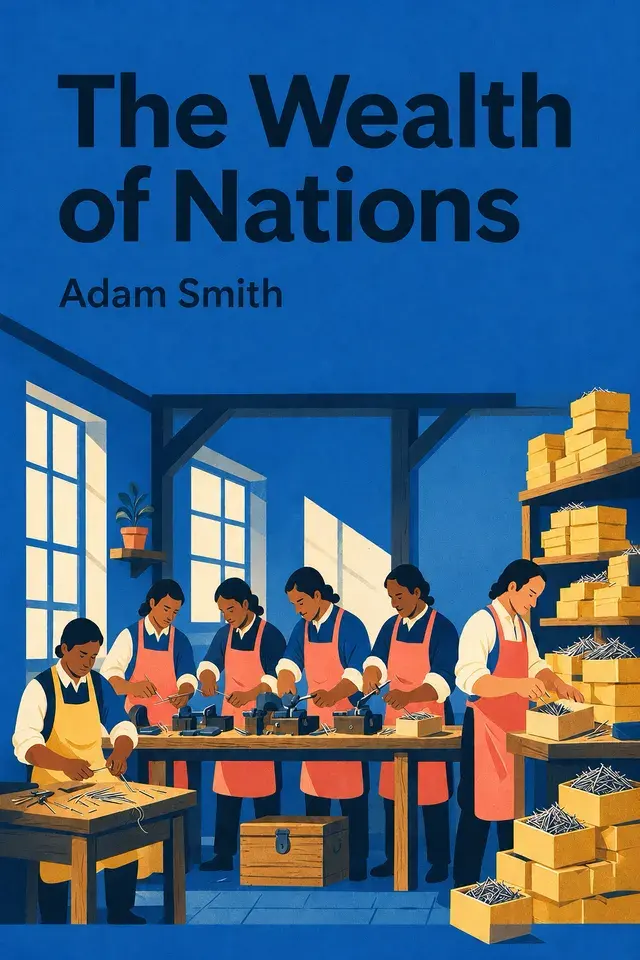
Division of labor raises output through dexterity, saved transition time, and machinery.
Exchange turns specialized surpluses into access to a common pool of goods and makes production interdependent.
Market price rises with shortage, falls with surplus, and draws resources toward more profitable employments.
Growing employment funds can raise real wages and population, while stationary or declining funds press wages toward scarcity and subsistence.
European policy magnifies ordinary occupational differences by restricting entry, overcrowding selected professions, and obstructing labor and capital mobility.
Parsimony turns goods into capital and redirects consumption toward workers who can reproduce its value; prodigality draws capital back into immediate consumption.
Commerce improved the countryside by creating markets, moving capital into land, and extending urban order, liberty, and security.
How The Wealth of Nations builds its case
Follow how the book develops its argument. Each note is a brief orientation, not a replacement for the chapter.
The Productivity of Specialization
Adam Smith begins with the annual labor of a nation, the fund supplying its necessities and conveniences, directly or through goods bought with its produce. Abundance depends on output per consumer, shaped by labor’s skill, dexterity, and judgment and by the share of people in useful work.
Money, Labor, and Value
Once people specialize, they produce more of some things than they need and exchange the surplus. Barter works only when each party wants what the other offers at the same moment.
How Prices Divide Income
Earlier, the book showed how labor could measure exchange. Chapter three asks what changes once land is privately owned and stock has accumulated.
Wages, Profits, and Social Change
Once stock is accumulated, most workers depend on masters who advance materials and maintenance. Wage bargaining therefore starts unequally: workers seek higher wages, masters lower ones.
Rules That Block Mobility
Smith separates natural occupational differences from inequalities created by policy. Even with competition, work can differ in training, hardship, trust, or uncertainty.
Rent, Scarcity, and Farm Returns
Smith defines rent as payment for using land, but its role is clearest when rent is treated as a residual. After seed, labor, cattle, tools, and ordinary farming profit are paid, the remaining produce can go to the landlord.
Mines, Metals, and Real Value
Once rent is understood as the surplus left after labor costs, replacing stock, and ordinary profit, mines show why that surplus is conditional. A mine is fertile relative to comparable mines when the same labor produces more mineral.
Improvement Changes Relative Prices
Improvement does not make every commodity cheaper, nor does it benefit every class in the same way. Smith’s question is relative: how readily can supply respond, what does production cost, what alternative use has land, and how do trade and regulation alter the market?
Capital Makes Specialization Possible
The earlier account showed why specialization can raise output. This chapter asks what must already exist before specialized production can continue.
Banking’s Productive Limit
Smith starts with a limit: banking can activate existing capital, but cannot create it. A note circulates because holders trust its issuer to redeem it in gold or silver on demand.
Saving and Productive Employment
National growth, in Smith’s account, depends not simply on producing more, but on deciding what annual produce will maintain. Productive labour adds value to its material and leaves a durable, vendible object.
Trade, Towns, and Land
Smith begins by asking where a given stock of capital most supports domestic production, and how quickly it returns. He distinguishes three wholesale trades.
Commerce Unmakes Feudal Dependence
Smith’s conclusion begins with an unintended political change. Medieval towns were weak and dependent, but collective defense made them useful allies to kings against great lords.