What you'll learn
Key ideas from The Gulag Archipelago
These ideas compress the book's argument without treating the author's view as settled fact. Use them as an orientation before reading the full work or listening in Wiseley.
Article fifty-eight and arrest quotas converted elastic accusations into a repeatable administrative supply of prisoners.
Interrogation converts suspicion into confession by substituting exhaustion, coercion, and paperwork for evidence.
The camp system grew when revolutionary coercion met industrial demand for cheap, mobile labor.
Hunger, disease, ruined clothing, and bare housing made the body both the instrument of production and the system’s disposable output.
The narrator locates good and evil within every person, making self-examination more demanding than political labeling.
Kengir’s forty-day self-government formed a rival public sphere before propaganda, tanks, and indiscriminate punishment ended it.
National deportations replaced individual accusation with collective guilt, extending exile across whole populations, unborn children, and future generations.
Survivors are asked to correct and extend the testimony, making truth an intergenerational responsibility rather than a closed verdict.
How The Gulag Archipelago builds its case
Follow how the book develops its argument. Each note is a brief orientation, not a replacement for the chapter.
The Gate Into the Archipelago
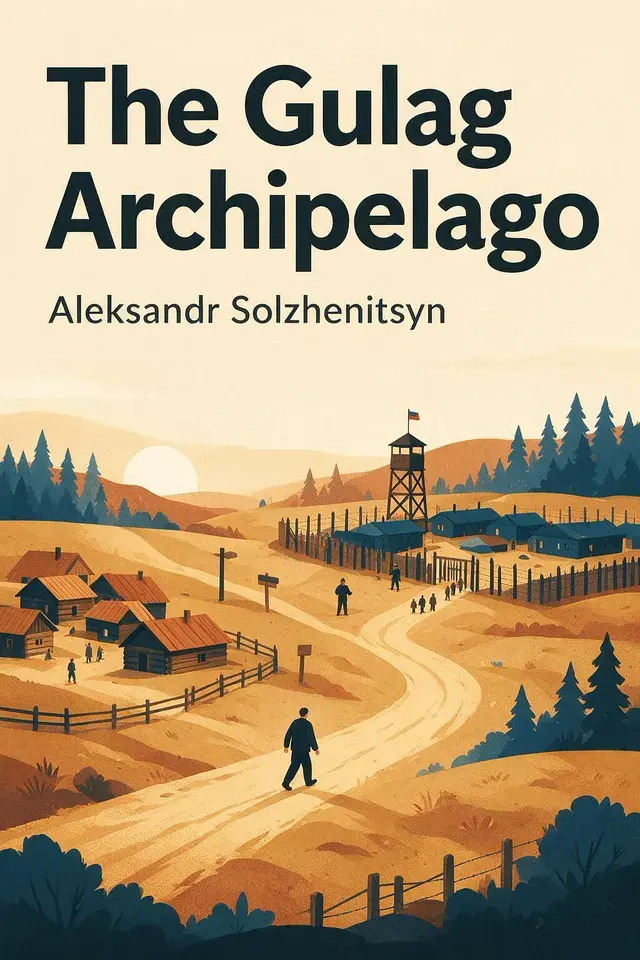
Imagine a country present everywhere and visible almost nowhere. Aircraft, ships, and trains move toward it, yet their destinations carry no ordinary sign.
Repression Without a Calendar
The Gulag did not begin or peak in a single calendar year. Solzhenitsyn presents it as a system whose pressure rose and fell but whose prisons were never empty.
Confession as State Manufacture
Interrogation, in Solzhenitsyn’s account, is not a search for what happened. It is a production line for confessions.
The Cell Rebuilds the Person
After isolation, the first cell is no refuge in an ordinary sense. It may be filthy, cold, overcrowded, or designed to break sleep and thought.
Law Without a Court
At Butyrki, a sentence arrives as routine paperwork. An NKVD major reads the narrator an eight-year term and asks him to sign a carbon copy.
Transporting the Hidden Nation
The Archipelago was not only a collection of camps but a moving system of prisoner cars, transit prisons, convoys, barges, marches, and transfer points. Solzhenitsyn presents it as a network built over decades by a stable bureaucracy.
The Camp Becomes an Industry
The Gulag, in Solzhenitsyn’s account, grew with the country rather than existing beside it. The revolutionary program replaced ordinary coercive institutions with new ones and treated forced labor as discipline.
Bodies Consumed by Work
Against the preceding chapter’s propaganda image of construction, Solzhenitsyn asks what camp production did to the bodies producing it, and whether the result paid for the system. He separates political utility, usefulness to the country, and profitability to the state.
A Society Inside the Wire
Inside the camp, authority does not remain a line from official to prisoner. It becomes a social ecology, with state categories carried through prisoners’ relationships.
Children, Keepers, and Campside
The Gulag reproduced itself in more than one direction. It took children into its machinery, trained some of them in violence, selected officials who could tolerate and extend cruelty, and spread its language and incentives beyond the fences.
The Soul Under Barbed Wire
After tracing the Archipelago’s machinery, the book asks what it does to the human soul. Its answer holds two truths together.
Katorga, Memory, and Defiance
Katorga was more than a harsher prison. Solzhenitsyn says Stalin revived it twenty-six years after the February Revolution, designing camps to prolong suffering while extracting labor.
Escape as Freedom’s Practice
Escape begins, in Solzhenitsyn’s account, as the free soul’s refusal to accept a fate imposed by others. Georgi Tenno did not begin there.
When Prisoners Become a People
The narrator begins with a paradox: the surprising fact is not that camp mutinies were absent, but that they occurred at all. Authorities erased them, destroyed participants, silenced witnesses, and polished the record.
Exile as Collective Punishment
The camps were not the first punishment considered here. Exile is older than prison.
Release, Rulers, and Repression
Release is not the clean opposite of arrest. In Solzhenitsyn’s account, it is another state-controlled transition.
Witnesses Against Oblivion
The book closes by turning from the Gulag’s history to the question of how that history can be known. Solzhenitsyn presents the book as a collective monument, not a solitary invention.