
Make the claim specific enough to fail
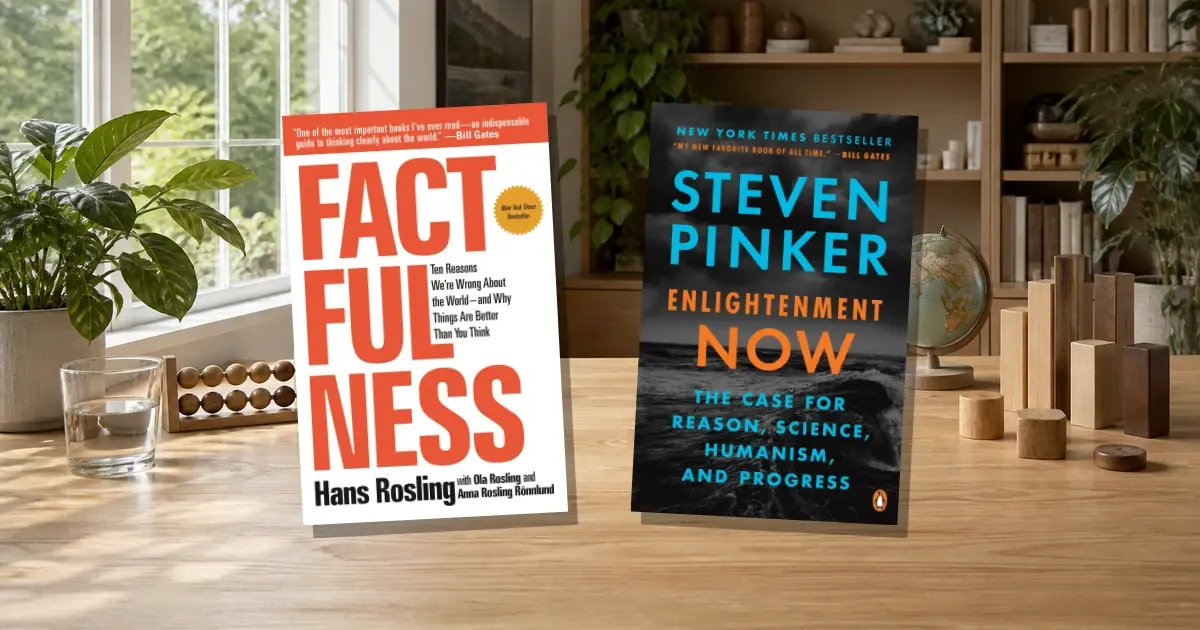
Rewrite words such as better, divided, free, unequal, or traditional as an observable comparison. Better for whom, on which measure, over what period, and against what baseline? Factfulness repeatedly asks readers to replace dramatic categories with distributions, rates, and trends. The Righteous Mind asks how moral intuitions and group identities shape judgment. The Dawn of Everything warns that familiar stages of social development may hide historical variety. Each lens begins by making the original slogan less comfortable and more testable.
- Define the population and time period.
- Choose a measure before looking for supporting examples.
- State what result would weaken the claim.
Inspect the comparison doing the work
Ask whether the claim compares totals with rates, averages with distributions, one country with the world, or the present with an unusually favorable past. Check who is absent from the data and whether categories changed over time. Then inspect the narrator’s incentives: a claim can be numerically correct while using a baseline chosen to create alarm or reassurance. When a psychological explanation is offered, look for institutional and material alternatives; when structure is blamed, look for agency and variation within the same structure.
- Keep denominators and category definitions visible.
- Compare more than two dates when a trend is claimed.
- Ask which rival mechanism could produce the same pattern.
Seek boundaries, not a final verdict
Find one case that fits, one that does not, and one where the evidence is genuinely ambiguous. Use them to state the boundary of the claim: where it appears strong, where it needs another mechanism, and where available evidence cannot decide. Avoid replacing one sweeping story with its mirror image. A useful conclusion is conditional and names the next fact that would change it. That makes the claim portable to new evidence without pretending a single book has settled society.
- Record a confirming and disconfirming case.
- Separate uncertainty from evidence against the claim.
- End with a conditional conclusion and one next check.
Sources and scope
Book ideas are attributed to their authors. External evidence is linked directly when a claim needs more than the source book.
- Factfulness: Grounds checks on categories, distributions, trends, rates, risk, and single-cause explanations.
- The Righteous Mind: Grounds the role of intuition, group identity, moral framing, and motivated judgment.
- The Dawn of Everything: Grounds the warning against linear social stages and the search for historical variation and political experimentation.
To report a factual, attribution, rights, or accessibility concern, email hello@wiseley.app.
Questions readers ask
Does every social claim need statistics?
No. Historical, institutional, and qualitative evidence can be essential. The evidence still needs a clear connection to the claim and visible limits.
How can I avoid false balance between strong and weak arguments?
Apply the same standards to each claim, then weight conclusions by evidence quality. Fair comparison does not require treating unequal evidence as equal.