The disagreement is about history’s shape
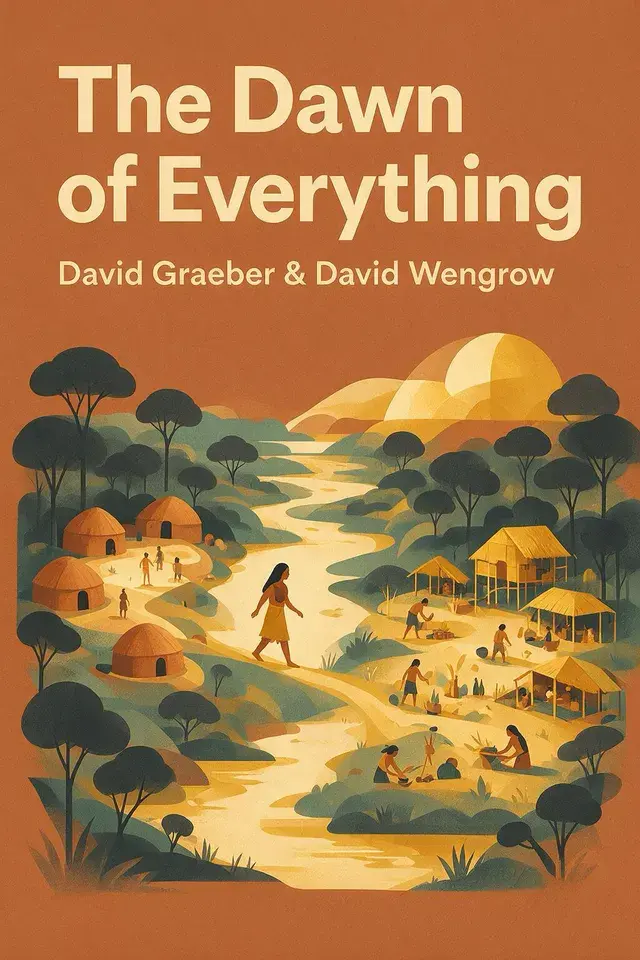
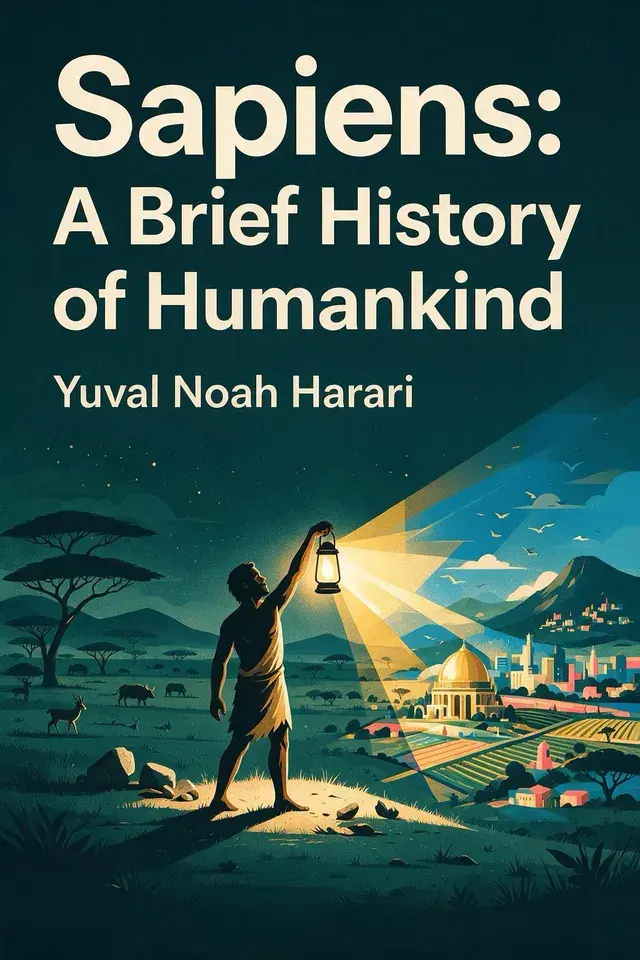
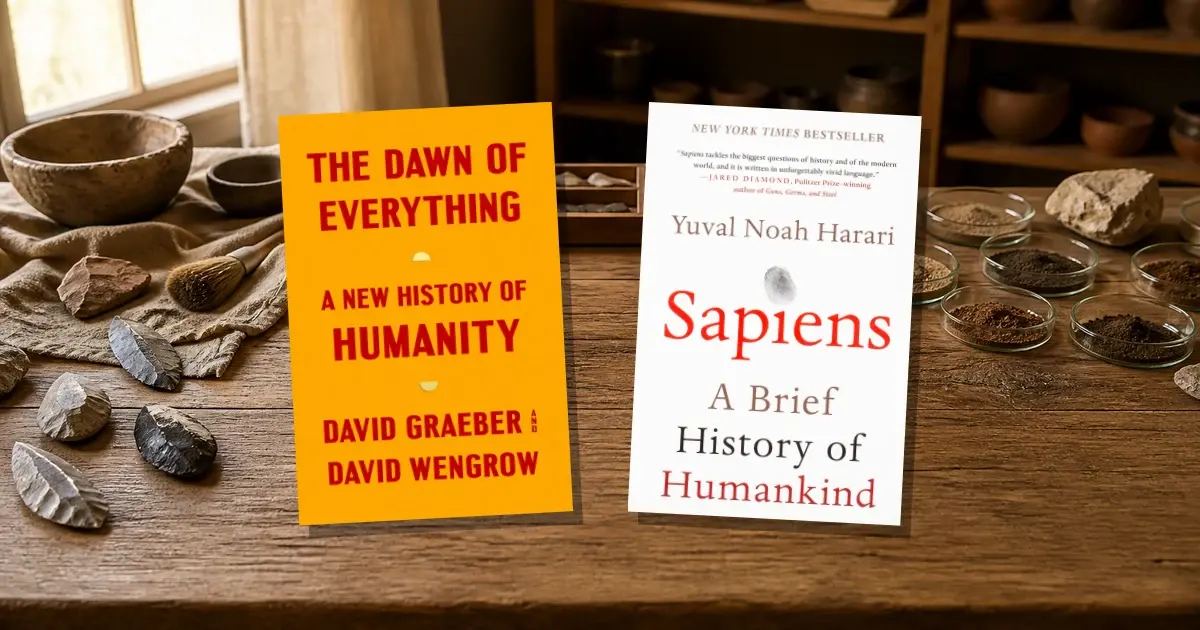
Sapiens organizes a vast story around Cognitive, Agricultural, and Scientific Revolutions. Shared fictions enable cooperation at scale; farming expands population while often worsening individual welfare; later institutions amplify both power and cost. The Dawn of Everything resists a single ladder from egalitarian foragers to farming, cities, hierarchy, and states. Graeber and Wengrow emphasize seasonal politics, delayed farming, cities without familiar rulers, and communities that deliberately changed arrangements.
- A portable macro-narrative built around major transitions: Sapiens.
- A case-rich challenge to evolutionary stages and inevitability: The Dawn of Everything.
- A shared concern: increasing scale or productivity does not automatically equal greater freedom or welfare.
Agency enters the story differently
Harari often shows choices accumulating into systems—agriculture as a demographic trap, imagined orders becoming materially durable, and markets reshaping desire. Graeber and Wengrow foreground conscious political experimentation: people move away, disobey, reorganize care, or alternate authority by season. The contrast is useful but should not be overstated. Sapiens includes contingency, and The Dawn of Everything does not make every arrangement freely chosen. Their emphases change which evidence feels central and which constraints recede.
- Track when a local case supports a possibility rather than a global frequency claim.
- Distinguish the origin of inequality from its persistence and enforcement.
- Ask whose freedom, labor, and vulnerability each social form distributes.
Read the pair as arguments, not timelines
Sapiens is the faster orientation because its recurring concepts make thousands of years legible. The Dawn of Everything is the stronger second read when that clarity begins to feel inevitable. Build a comparison table for farming, cities, hierarchy, and the state. For each, note the mechanism, archaeological or historical case, uncertainty, and inference. A counterexample can disprove inevitability without establishing how common the alternative was; a broad pattern can orient inquiry without explaining every society.
- Mark synthesis, evidence, and speculation separately.
- Check whether a disputed category means the same thing in both books.
- Use specialist archaeology and regional history to test the memorable cases.
Sources and scope
Book ideas are attributed to their authors. External evidence is linked directly when a claim needs more than the source book.
- The Dawn of Everything: Primary source for the critique of linear stages, archaeological examples, and political-freedom framing.
- Sapiens: A Brief History of Humankind: Primary source for the Cognitive, Agricultural, and Scientific Revolutions and shared-fictions argument.
To report a factual, attribution, rights, or accessibility concern, email hello@wiseley.app.
Questions readers ask
Is The Dawn of Everything a rebuttal to Sapiens?
It challenges the family of linear stories to which Sapiens belongs, especially links among agriculture, cities, hierarchy, and the state. But its target is broader than one book, and the two works organize different bodies of evidence.
Which book should a beginner read first?
Sapiens offers the clearer high-level map. Reading The Dawn of Everything next helps reveal what that map compresses. Readers who distrust grand narratives may prefer reversing the order.