Choose by the question you want answered
This is a curated general selection, not the whole catalog: five books for readers who are already comfortable staying with a large idea for a few chapters. If this would be your first science book, the beginners list explains its prerequisites as it goes, and the Science topic page holds the complete catalog. "I want to understand science" hides several different hungers. Some readers want the whole story from the Big Bang to human origins. Others want the machinery of space and time itself. Some care less about findings than about how anyone could trust them. And some just want something short that permanently rearranges intuition. Naming your question prevents buying the same wonder in five bindings.
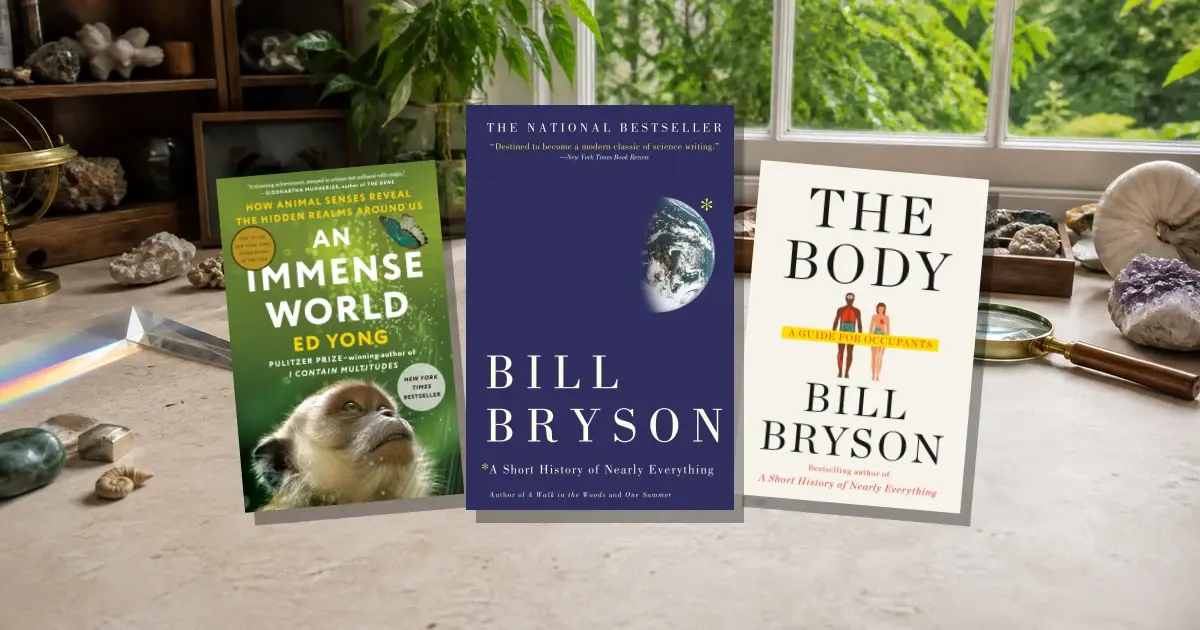
- How did anything — Earth, cells, us — come to be: A Short History of Nearly Everything.
- What do black holes, entropy, and cosmic origins actually mean: A Brief History of Time.
- Why does the universe deserve both awe and exploration: Cosmos.
- How can I tell reliable knowledge from comforting stories: The Demon-Haunted World.
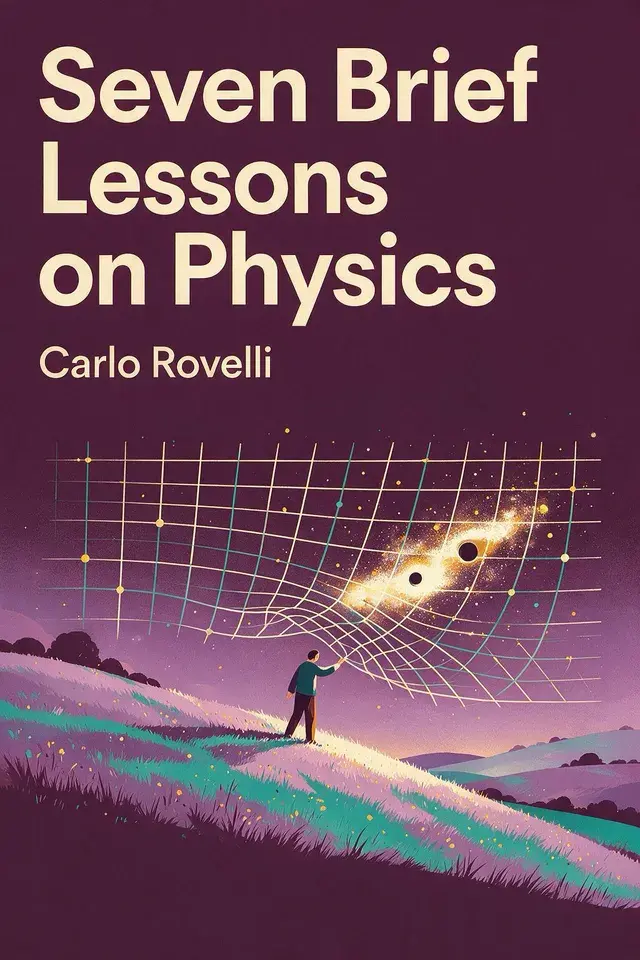
- What is the shortest honest tour of modern physics: Seven Brief Lessons on Physics.
What each book adds
Bryson delivers scope with company: ordinary atoms, deep time measured in pieces, cyanobacteria remaking the atmosphere, and the fragile contingency of habitability — narrated through the people who got things wrong en route. Hawking supplies the theoretical spine: theories as models risking disproof, relativity's curved spacetime, quantum uncertainty, evaporating black holes, and aligned arrows of time. Sagan's Cosmos binds it into one story where stellar fusion makes the elements of life and knowledge obligates its holders. His Demon-Haunted World then hands over the maintenance tools — the baloney-detection kit, institutional self-correction, and skepticism joined to wonder. Rovelli compresses the frontier into six essays where heat gives time its direction and a mind finds itself inside nature.
- Best single-volume overview: A Short History of Nearly Everything.
- Best book about science as a practice: The Demon-Haunted World.
- Best gateway when time is short: Seven Brief Lessons on Physics.
A reading order that builds
Start with whichever question burns hottest; all five stand alone. For a sequence, take Bryson first for the narrative scaffolding of discoveries, then Rovelli for the modern physics Bryson treats lightly. Hawking deepens that layer for readers ready to work. Read Sagan's two books as companions — Cosmos for motivation, Demon-Haunted World for method — and finish by asking which claims you now hold on better evidence.
- Keep a list of ideas each book overturns from school science.
- Read Sagan's baloney-detection chapter before any news-cycle claim.
- Let Hawking wait until Rovelli's lessons feel comfortable rather than dizzying.
Sources and scope
Book ideas are attributed to their authors. External evidence is linked directly when a claim needs more than the source book.
- A Short History of Nearly Everything: Source for cosmic-to-human scope, deep-time measurement, microbial worlds, extinction, and planetary fragility.
- A Brief History of Time: Source for theory-as-model, spacetime curvature, quantum uncertainty, black-hole radiation, and arrows of time.
- Cosmos: Source for the cosmic perspective, stellar element formation, Kepler's laws, climate parallels, and planetary responsibility.
- The Demon-Haunted World: Source for the baloney-detection kit, institutional self-correction, memory fallibility, and civic scientific literacy.
- Seven Brief Lessons on Physics: Source for curved spacetime, quantum indeterminacy, quantum fields, quantum gravity's open problem, and heat's arrow of time.
To report a factual, attribution, rights, or accessibility concern, email hello@wiseley.app.
Questions readers ask
Which science book should I read first?
For most readers, A Short History of Nearly Everything: it covers cosmology, geology, chemistry, biology, and evolution in one connected narrative with humor and human stories. If your interest is specifically physics or specifically how science works, start instead with Seven Brief Lessons or The Demon-Haunted World.
Is A Brief History of Time still worth reading?
Yes, especially in summary form: its chain of reasoning — theory as falsifiable model, curved spacetime, quantum uncertainty, black-hole thermodynamics, why time has a direction — remains the cleanest map of what made modern cosmology strange. Later observations have refined details without replacing its conceptual arc.
Do I need math to follow these books?
No. All five were written for general audiences and carry their arguments through analogy, history, and experiment descriptions. You will meet concepts like probability amplitudes or entropy, but each author supplies the intuition needed to follow why they matter rather than how they are calculated.