What you'll learn
Key ideas from Seven Brief Lessons on Physics
These ideas compress the book's argument without treating the author's view as settled fact. Use them as an orientation before reading the full work or listening in Wiseley.
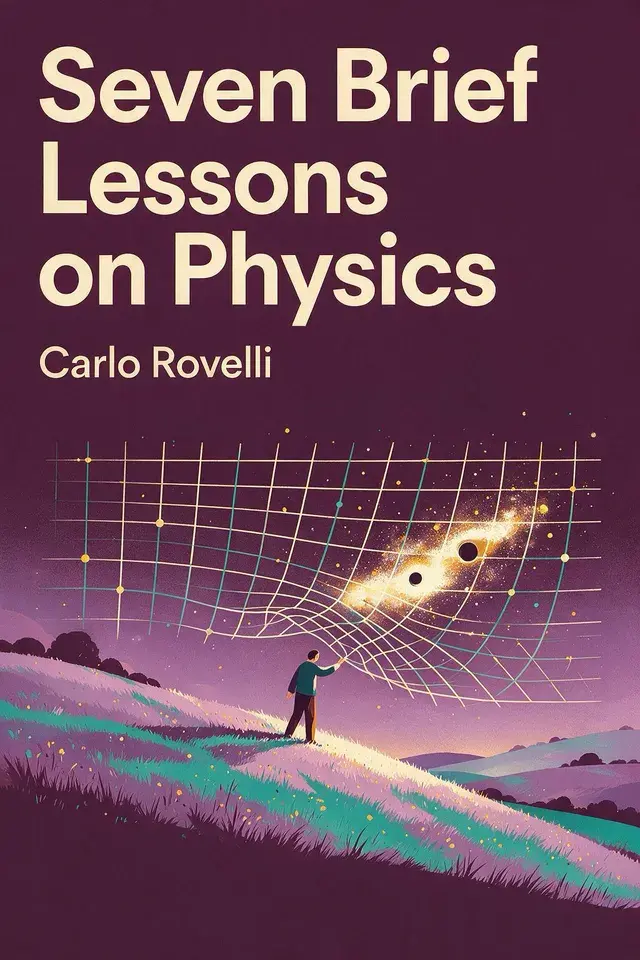
Matter and energy curve spacetime, and that curvature guides the motion of bodies and light.
Quantum mechanics replaces continuous classical change with discrete energy levels, jumps between states, and probabilistic outcomes.
Ordinary matter is organized from a small inventory of particles that are better understood as fluctuating excitations of quantum fields.
General relativity and quantum mechanics both succeed, yet their continuous and quantized pictures conflict, making quantum gravity an unresolved unification problem.
Heat is molecular motion, and its usual transfer from hot to cold supplies the physical asymmetry that distinguishes past from future.
Science follows traces, tests partial models, and revises them when evidence exposes error.
How Seven Brief Lessons on Physics builds its case
Follow how the book develops its argument. Each note is a brief orientation, not a replacement for the chapter.
When Space Became Dynamic
Carlo Rovelli opens this book as a rapid tour of twentieth-century physics for readers who may know little or nothing about modern science. The route matters.
Reality in Quantum Jumps
The quantum lesson is a second foundational rupture. It does not merely take classical physics into a smaller room.
From Cosmic Vastness to Fields
Once physics stops treating everyday appearance as the final guide, it changes our place in the picture. At the cosmic scale, the first change is a quiet demotion.
The Search Beneath Spacetime
Modern physics has reached a peculiar crossroads. General relativity and quantum mechanics are both extraordinarily successful, yet they describe reality in concepts that clash.
How Heat Gives Time Direction
We normally imagine time as a universal stream, carrying everything from a shared past through a shared present toward a shared future. Modern physics offers no such universal present.
A Mind Inside Nature
After following physics toward its most unfamiliar conclusions, the book turns back to the person doing the following. The final question is what it means to be a mind within nature.