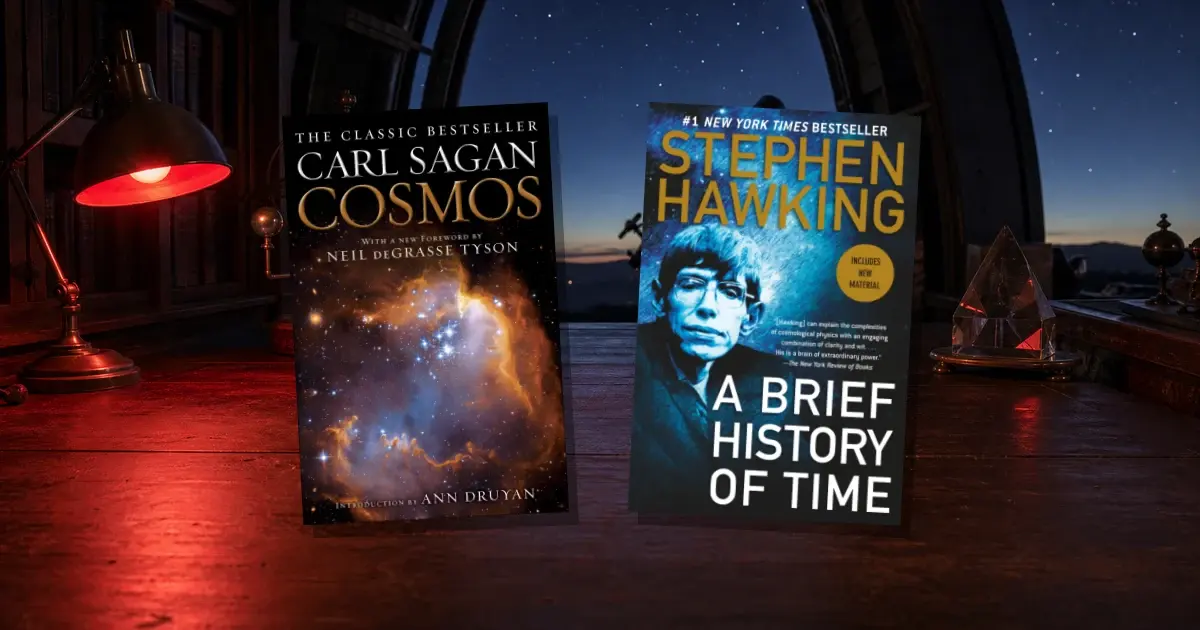
Two journeys through the universe
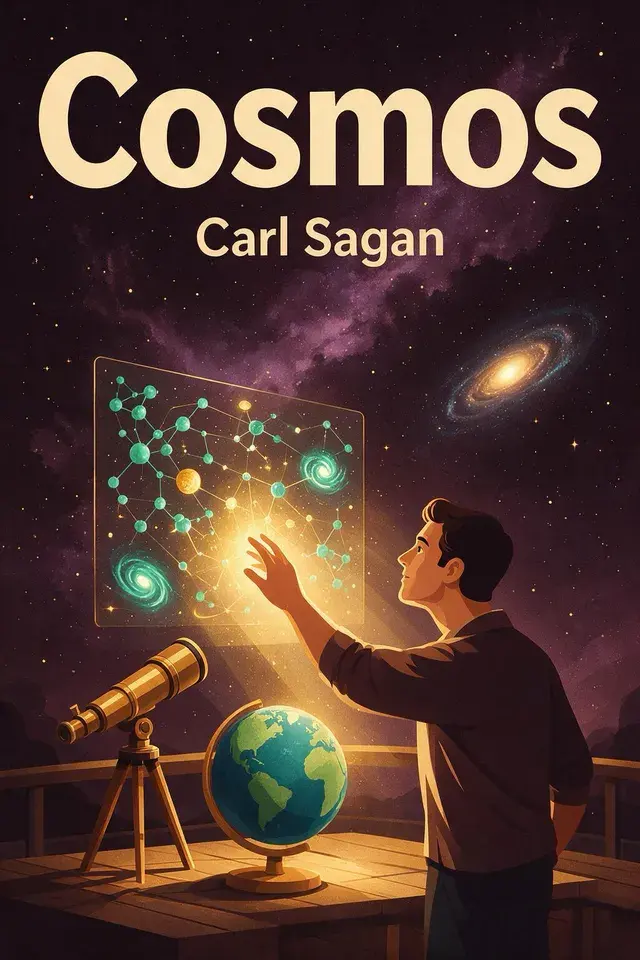
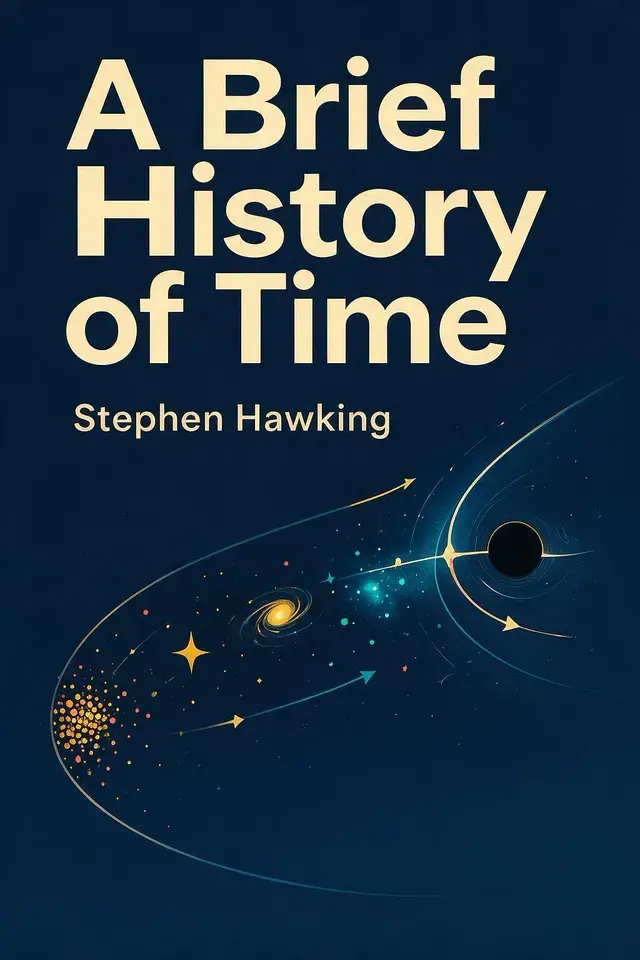
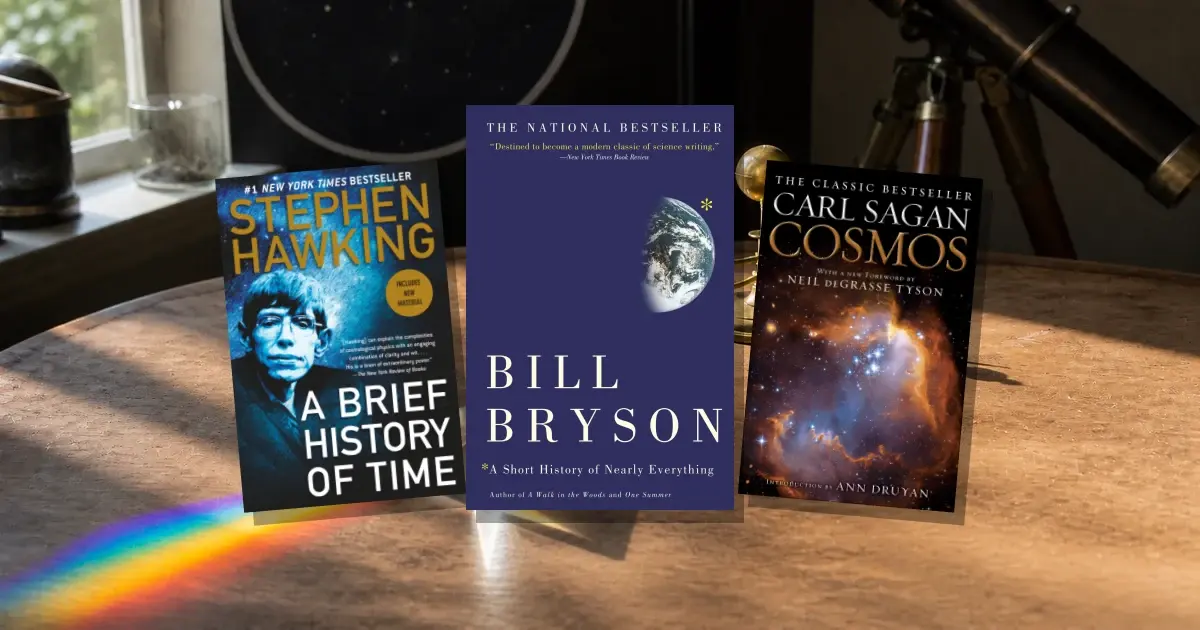
Cosmos moves across astronomy, chemistry, evolution, planetary exploration, scientific history, intelligence, and the responsibilities of a technological civilization. Carl Sagan’s cosmic perspective joins wonder to skeptical inquiry and repeatedly returns to Earth as the only known living world. A Brief History of Time narrows the route. Stephen Hawking develops the conceptual chain from relativity and expansion through quantum uncertainty, stellar collapse, black-hole radiation, cosmic origins, time’s arrows, and the unresolved search for unification.
- Breadth, history, life, and civic meaning: Cosmos.
- A concentrated tour of modern cosmological physics: A Brief History of Time.
- Shared lesson: scientific knowledge advances through models exposed to observation and correction.
Wonder and difficulty come from different places
Sagan explains through narrative, analogy, historical character, and travel between scales, so a reader can follow the arc even when a scientific detail is unfamiliar. Hawking removes most equations but not the conceptual strain: observer-dependent time, curved spacetime, uncertainty, horizons, entropy, and imaginary time resist ordinary intuition. The harder book is not necessarily the deeper experience. Cosmos asks more persistently what knowledge means for human conduct; Hawking asks the reader to stay with a smaller set of difficult explanatory problems.
- Pause for a diagram when a spatial or causal relation becomes unclear.
- Separate an established framework from a qualified proposal for unification.
- Do not measure understanding by whether every analogy feels literal.
The best reading order for a beginner
Start with Cosmos if you want motivation, context, and a broad map before tackling compact physics. Start with A Brief History of Time if black holes, the beginning of the universe, and the limits of theory are already your questions. For a paired read, choose one bridge topic—relativity, stellar life, or cosmic expansion—and write what each author is trying to explain, what observation constrains the account, and where uncertainty remains.
- Summarize the question before memorizing the answer.
- Sketch the causal sequence in plain language.
- Use current introductory resources for updated measurements while reading these books for their arguments and craft.
Sources and scope
Book ideas are attributed to their authors. External evidence is linked directly when a claim needs more than the source book.
- Cosmos: Primary source for Sagan’s treatment of cosmic history, life, scientific inquiry, exploration, and human responsibility.
- A Brief History of Time: Primary source for Hawking’s explanations of relativity, expansion, quantum uncertainty, black holes, time, and unification.
To report a factual, attribution, rights, or accessibility concern, email hello@wiseley.app.
Questions readers ask
Which book is easier for a science beginner?
Cosmos is usually the gentler entry because its human stories and wider scope provide more routes back into the subject. A Brief History of Time is compact but conceptually denser.
Are the books outdated?
Some measurements and scientific context have developed since publication. Their enduring value lies in the explanatory questions, methods, and prose; verify time-sensitive facts with current scientific sources.