What you'll learn
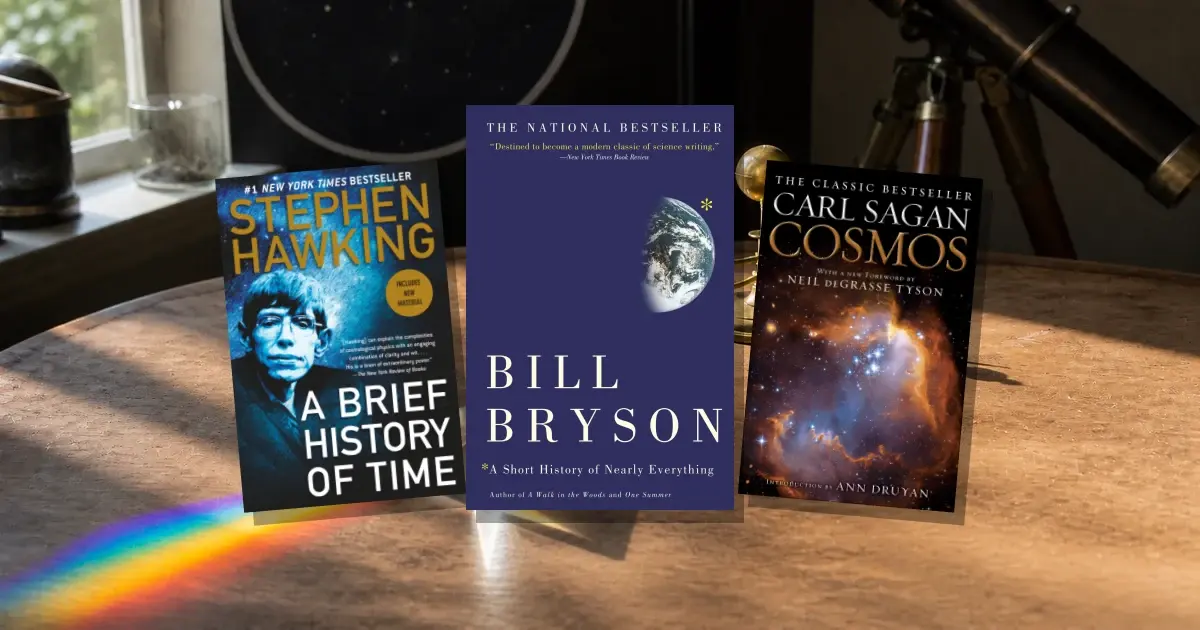
Key ideas from A Short History of Nearly Everything
These ideas compress the book's argument without treating the author's view as settled fact. Use them as an orientation before reading the full work or listening in Wiseley.
Human life is a temporary, contingent arrangement of ordinary matter shaped by cosmic history and a long chain of ancestors.
Early age estimates varied wildly because evidence and physics were incomplete, until Rutherford opened a credible path into deep time.
Leaded gasoline and chlorofluorocarbons show how useful technologies can create delayed, widespread harm that institutions and industries resist acknowledging.
Earth’s habitability is a coupled balance of solar position, planetary interior, atmosphere, water, circulation, and ecological buffering rather than a passive backdrop.
Life appeared early, shared a common genetic code, and transformed Earth when cyanobacteria released oxygen.
Natural extinction repeatedly redirects evolution, while selective survival and delayed recovery make large-scale life contingent rather than inevitable.
Darwin supplied selection and common descent; Mendel supplied particulate inheritance, allowing variation to persist instead of blending away.
Human expansion has driven or accompanied major losses, and incomplete records do not erase the choice to protect Earth’s remaining life.
How A Short History of Nearly Everything builds its case
Follow how the book develops its argument. Each note is a brief orientation, not a replacement for the chapter.
From Singularity to Starlight
Human beings are not made of rare matter. A person is a temporary arrangement of ordinary, mindless atoms whose coordinated activity sustains a living individual for a while.
Measuring a Deep Earth
Earth did not become geologically intelligible because one instrument suddenly revealed it. It became measurable in pieces, as surveyors, astronomers, physicists, geologists, and fossil hunters converted different uncertainties into linked, revisable evidence.
Matter’s Hidden Machinery
Once geology had made rocks, layers, and fossils evidence of deep time, a hidden question remained: what is matter made of, and how can its history be measured? Chemistry did not separate cleanly from alchemy.
Incomplete Laws, Moving Worlds
A scientific law can look complete until an awkward measurement refuses to fit. By the late nineteenth century, physics seemed to have organized electricity, magnetism, optics, gases, and heat into universal laws.
A Planet That Can Kill
The planet’s most frightening hazards are often easier to reconstruct after they happen than to predict beforehand. Craters, ash beds, and seismic waves preserve evidence, but the hidden machinery behind them remains partly inaccessible.
The Conditions of Life
Earth’s habitability is less a fixed backdrop than a working system. For humans, the useful part is especially narrow: we evolved as land-dwelling, oxygen-breathing organisms, so most of the planet’s habitable volume is unavailable to us.
Life’s First Experiments
Earth’s habitability is only the beginning. The chapter separates three questions: how chemistry became life, how early life remade the planet, and how fossils preserve that history.
Microbes, Extinction, and the Uncounted Living World
Most of Earth's living world is invisible. Microbes live on us, inside us, and throughout the environment.
Cells, Selection, and Inheritance
Evolution can sound like a story about changing species, but its machinery operates at a much smaller scale. The body begins as one cell that divides repeatedly, creating a vast cooperative population.
Ice, Us, and Obligation
By the end of the book, climate and human history meet in a single lesson: Earth is sensitive, and our place on it is contingent. The 1815 eruption of Tambora cooled the globe by only about 1.5 degrees Fahrenheit, yet the following year brought failed crops, famine, disease, and hardship.