What you'll learn
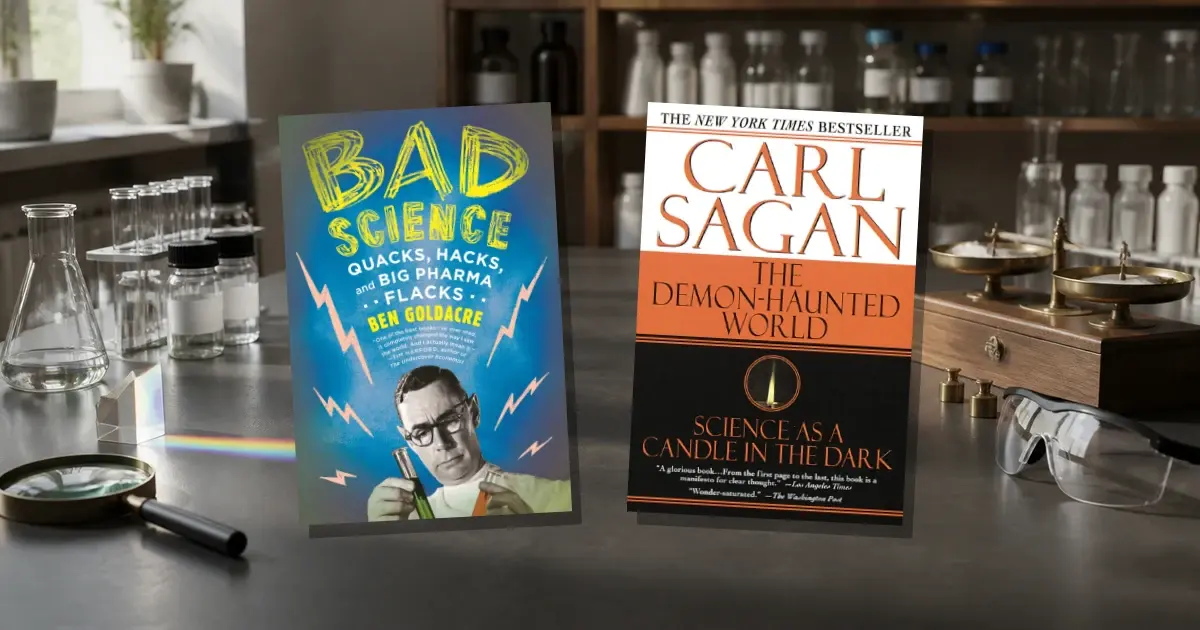
Key ideas from The Demon-Haunted World
These ideas compress the book's argument without treating the author's view as settled fact. Use them as an orientation before reading the full work or listening in Wiseley.
Scientific thinking joins wonder about surprising possibilities with disciplined testing, uncertainty, and correction.
Suggestion, hypnosis, and reconstructive memory can produce confident narratives, so emotional certainty is not independent evidence.
The baloney-detection kit combines independent confirmation, alternative hypotheses, quantification, controls, blinding, replication, and fallacy checks.
Science’s advantage is institutional: testable claims, measurement, criticism, replication, and correction make dependable knowledge possible despite individual bias and error.
Scientific power creates ethical responsibility for foreseeable consequences, especially when lethal applications can alter the global environment.
Education, fair debate, and public communication turn scientific skepticism into a civic capacity.
How The Demon-Haunted World builds its case
Follow how the book develops its argument. Each note is a brief orientation, not a replacement for the chapter.
Wonder Against Credulity
Carl Sagan begins with a childhood lesson in the unstable border between wonder and credulity. He imagined distant figures fighting at the horizon, until his mother questioned what he had actually seen.
Faces, Saucers, and Secrecy
A face can feel like a discovery before it becomes evidence. Sagan begins with the human tendency to connect irregular bright and dark patches into familiar forms.
Dreams, Demons, and Memory
An extraordinary experience can be real as an experience without being accurate as an explanation. Someone may truly see, hear, feel, or remember something that seems external, while its causes lie in sleep, physiology, imagination, or suggestion.
The Discipline of Doubt
Drawing on the earlier paranormal cases, Sagan turns from the origins of conviction to the discipline required to judge it. Sincerity is not the same as truth, and skepticism is not automatic denial.
Why Science Corrects Itself
After the skeptical habits developed earlier, a harder question remains: why prefer science when scientists are biased, theories change, and discoveries can be disturbing? Carl Sagan’s answer is not that scientists are unusually pure.
Wonder, Power, and Responsibility
Scientific knowledge becomes a moral problem when it becomes power. The same inquiry that improves lives can also create weapons capable of planetary destruction.
Learning to Think in Public
Sagan opens with a Buddhist story about children playing inside a burning house because they do not understand the danger. Their father has escaped, yet worries about those left behind.
Freedom, Research, and Democracy
Sagan closes by asking what society owes to knowledge with no immediate product. His answer reaches beyond technology.