What you'll learn
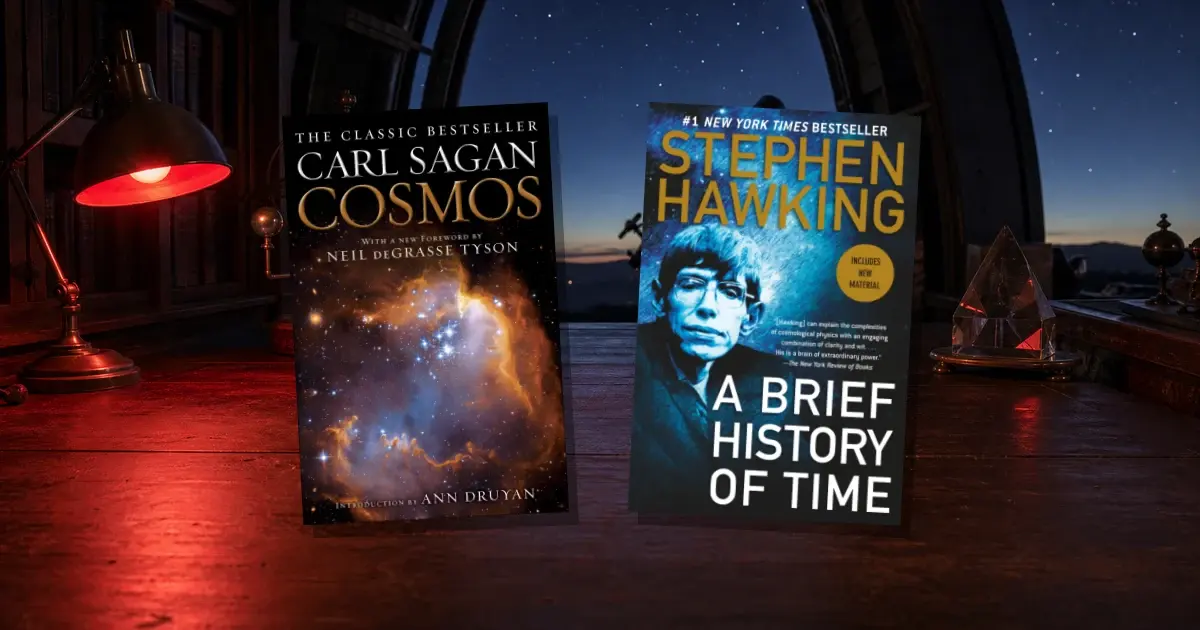
Key ideas from A Brief History of Time
These ideas compress the book's argument without treating the author's view as settled fact. Use them as an orientation before reading the full work or listening in Wiseley.
Scientific theories earn confidence by explaining many observations simply and risking disproof through definite predictions.
General relativity recasts gravity as spacetime curvature, tested through orbital, light-bending, and clock effects.
Galaxy redshifts, microwave radiation, and relativistic models establish an expanding universe with a hot, dense classical beginning.
Quantum mechanics replaces exact trajectories with uncertainty, probabilities, wave-particle behavior, interference, and multiple histories, motivating quantum gravity.
Collapse creates a one-way horizon and a relativistic singularity, while gravitational waves carry energy away and point toward quantum gravity.
Quantum radiation gives black holes a mass-dependent temperature, drives evaporation, and leaves the final endpoint uncertain.
Small density differences grew into galaxies, stars, heavy elements, planets, and the chemistry that could support life.
The proposed low-entropy beginning links increasing disorder, memory of the past, and cosmic expansion as aligned arrows of time.
How A Brief History of Time builds its case
Follow how the book develops its argument. Each note is a brief orientation, not a replacement for the chapter.
From Heavens to Spacetime
To understand why one picture of the universe gives way to another, begin with what counts as knowledge. A scientific theory is a model plus rules connecting its quantities with observations.
Expansion, Origins, and Quantum Rules
Once general relativity made spacetime dynamic, its next test was the sky. Parallax measured nearby stellar distances; assumed stellar luminosities extended the scale to other galaxies.
Matter, Forces, and Stellar Collapse
With the quantum framework in place, matter can be followed inward from atoms to quarks. The distinction between matter and forces remains useful, though Aristotle’s elements and forces are obsolete.
Black Holes, Heat, and Radiation
Once a collapsing star has settled, the black hole it leaves behind is surprisingly simple from the outside. A nonrotating hole must be spherical, with its size fixed by mass.
From Hot Beginnings to Structure
The hot-big-bang model is most useful as a causal sequence. Expansion cools the universe: when its size doubles, its temperature falls by half.
Quantum Cosmology and Time’s Arrows
Classical cosmology can describe how a universe develops once its state is supplied. It cannot explain why that state had its particular form.
Time Travel and the Unification Problem
Once relativity and quantum theory meet, the question becomes not only what the universe does, but what spacetime permits. General relativity contains geometries that return a traveler to an earlier event, while quantum theory permits local negative energy, an ingredient such geometries seem to need.
What a Complete Theory Means
The prospect of a complete theory is also a test of what “complete” can mean. Hawking imagines a unified account that compresses the fundamental laws into a form specialists and ordinary people could understand in outline.