Choose the question that already pulls you forward
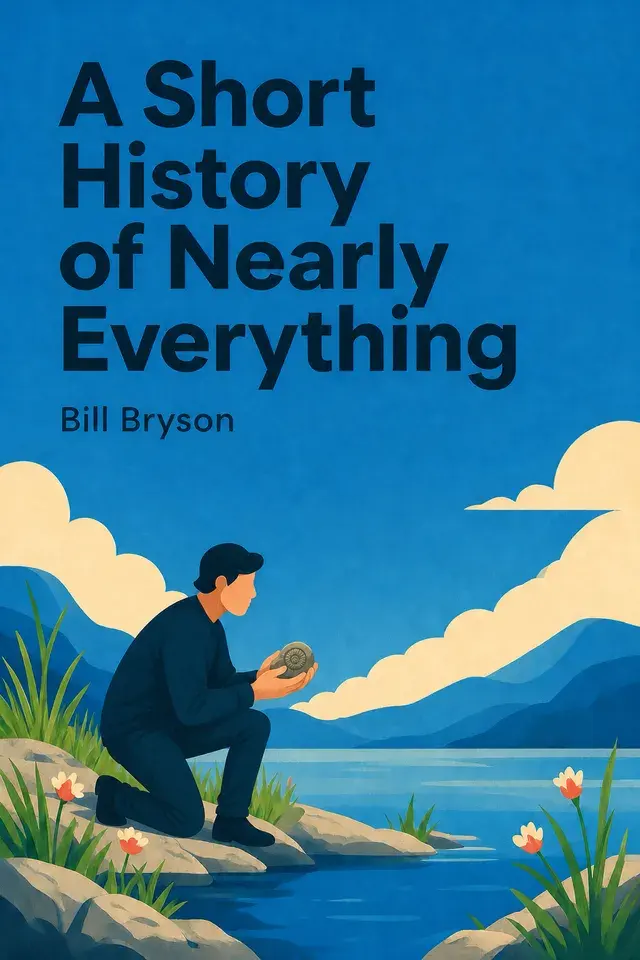
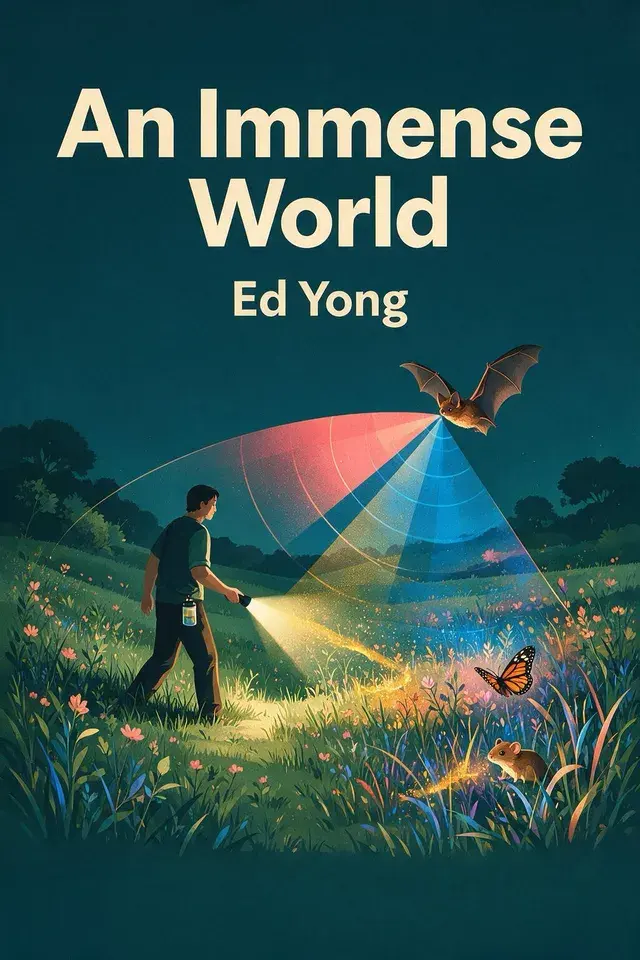
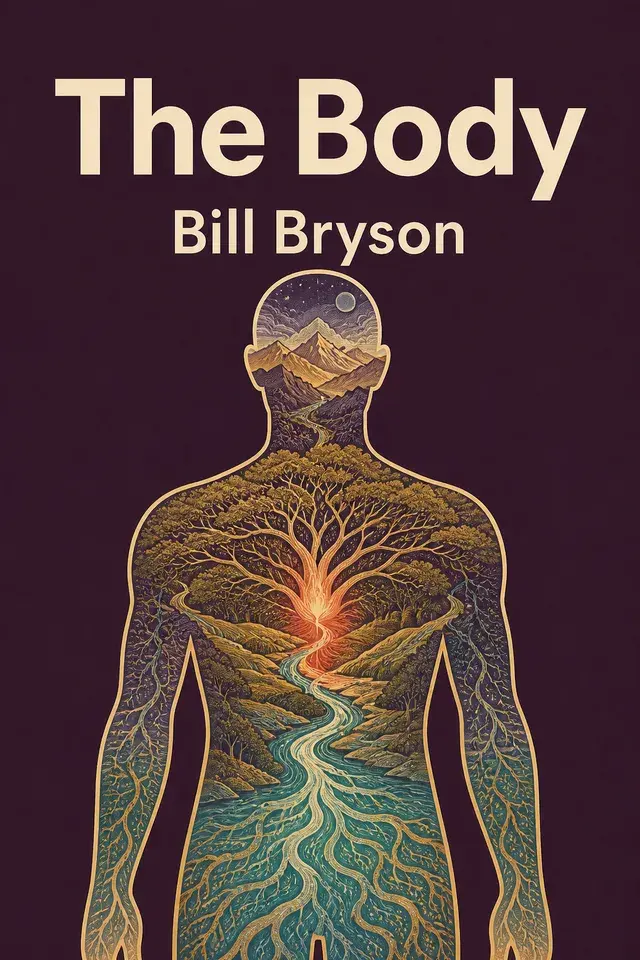
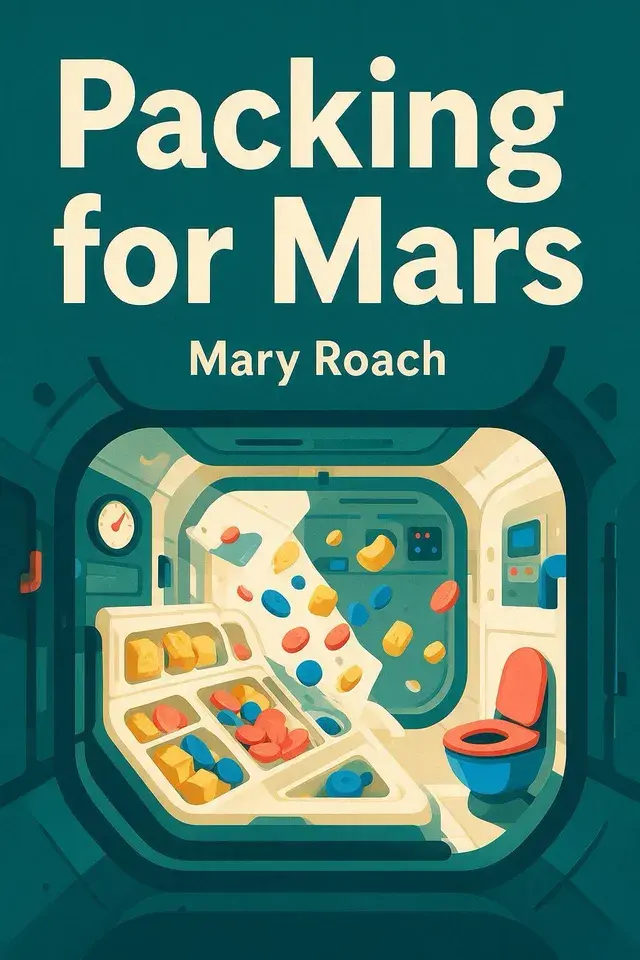
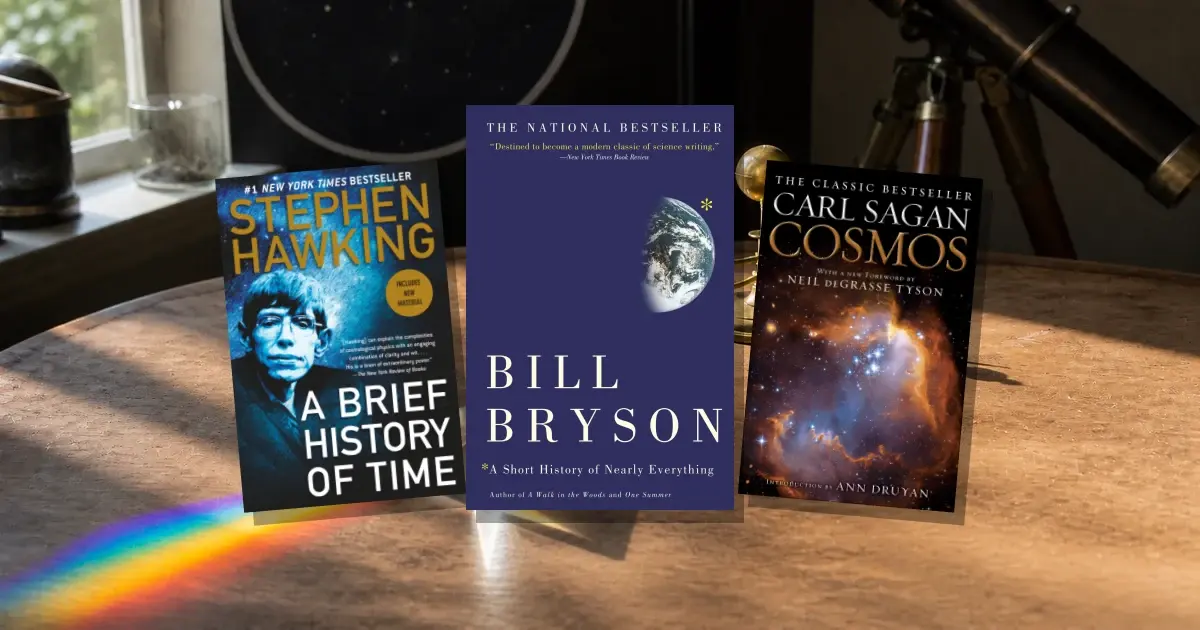
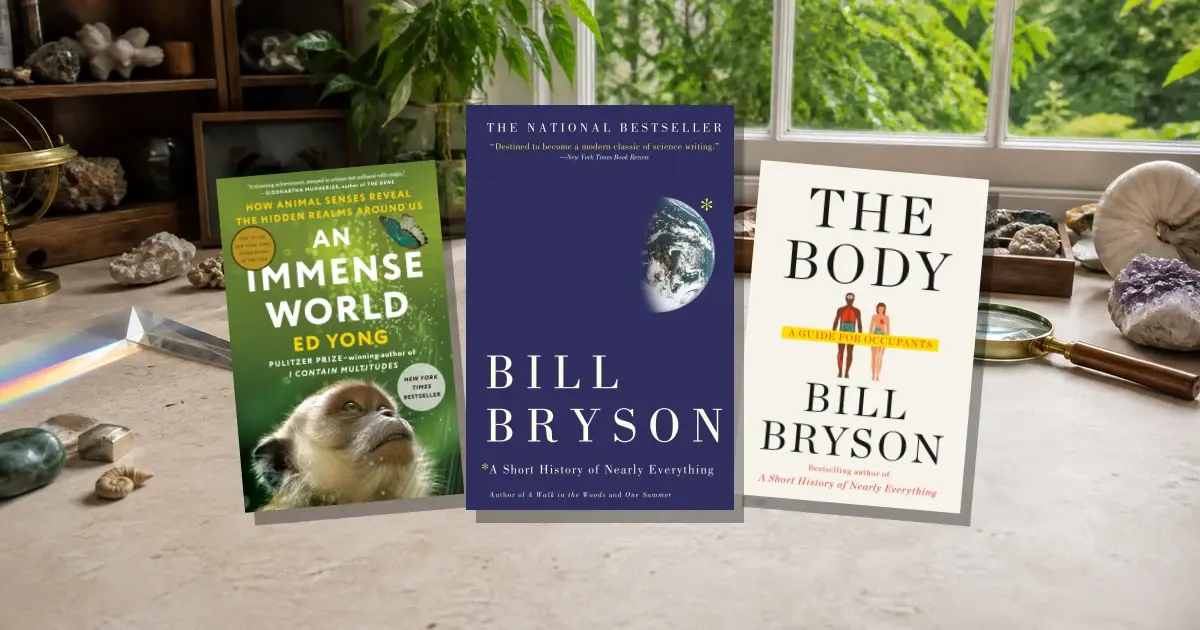
These five are starting books: each explains the background it needs as it goes, so no earlier coursework is assumed. Readers already comfortable with big ideas may prefer the curated general science selection, and the Science topic page holds the complete catalog. A Short History of Nearly Everything travels from the Big Bang and deep time through atoms, Earth, cells, evolution, extinction, and human origins. An Immense World asks how smell, light, vibration, sound, electricity, and magnetism create radically different perceptual worlds for other animals. The Body follows ordinary matter into coordinated cells, senses, organs, immunity, disease, medicine, aging, and death. Packing for Mars turns the human body and mind into a spacecraft engineering problem. Cosmos connects stars, planets, life, scientific history, exploration, and civic responsibility.
- A funny, wide-ranging survey of how we know nearly everything: A Short History of Nearly Everything.
- The most perspective-changing tour of animal perception: An Immense World.
- A system-by-system journey through human biology and medicine: The Body.
- The awkward bodily reality of human spaceflight: Packing for Mars.
- Cosmic wonder joined to scientific and civic imagination: Cosmos.
Five different ways to make science legible
Bill Bryson uses scientists’ mistakes, accidents, rivalries, and incomplete measurements to make uncertainty part of the story in both A Short History and The Body. Ed Yong repeatedly asks readers to leave the human Umwelt, showing that senses trade acuity, range, speed, and energy rather than approaching one perfect design. Mary Roach begins with bodily embarrassment and follows it into serious questions of confinement, bone loss, motion sickness, radiation, waste, and mission design. Carl Sagan uses historical episodes to join tested explanation with wonder and responsibility.
- Notice what observation would distinguish two explanations.
- Separate a well-supported finding from an unresolved mechanism or speculative extension.
- Treat a vivid analogy as a bridge to the model, not as the model itself.
A reading order that keeps expanding the world
Begin with A Short History of Nearly Everything for a broad map and a reassuring demonstration that science advances through correction rather than perfect first answers. Read An Immense World next to unsettle the assumption that human perception defines reality. Move inward with The Body, then place that vulnerable organism in an engineered extreme with Packing for Mars. Finish with Cosmos, whose scale lets the earlier geology, evolution, sensation, physiology, and exploration become one connected account of knowledge and responsibility.
- Keep a list of established result, open question, and proposed explanation.
- Follow one footnote or named experiment from each book to its original context.
- Update time-sensitive measurements with current scientific sources while preserving the book’s explanatory question.
Sources and scope
Book ideas are attributed to their authors. External evidence is linked directly when a claim needs more than the source book.
- A Short History of Nearly Everything: Source for the journey through cosmic history, deep time, matter, Earth, life, evolution, extinction, and human responsibility.
- An Immense World: Source for the Umwelt framework and animal senses involving chemicals, light, touch, vibration, sound, electricity, and magnetism.
- The Body: Source for the account of coordinated cells, perception, movement, immunity, diet evidence, disease, medicine, aging, and uncertainty.
- Packing for Mars: Source for confinement, weightlessness, bodily change, mission risk, reproduction, food, waste, and the engineering of human spaceflight.
- Cosmos: Source for the connected treatment of astronomy, life, scientific history, exploration, skepticism, and planetary responsibility.
To report a factual, attribution, rights, or accessibility concern, email hello@wiseley.app.
Questions readers ask
Which popular science book is easiest for a complete beginner?
A Short History of Nearly Everything is the broadest and most conversational starting point. Packing for Mars is especially approachable if you prefer concrete human problems over a chronological survey.
Do I need to understand equations for these books?
No. All five teach primarily through narrative, observation, analogy, and experiments. Sketching a mechanism or causal sequence can still deepen understanding when the prose becomes dense.