The books work at different scales
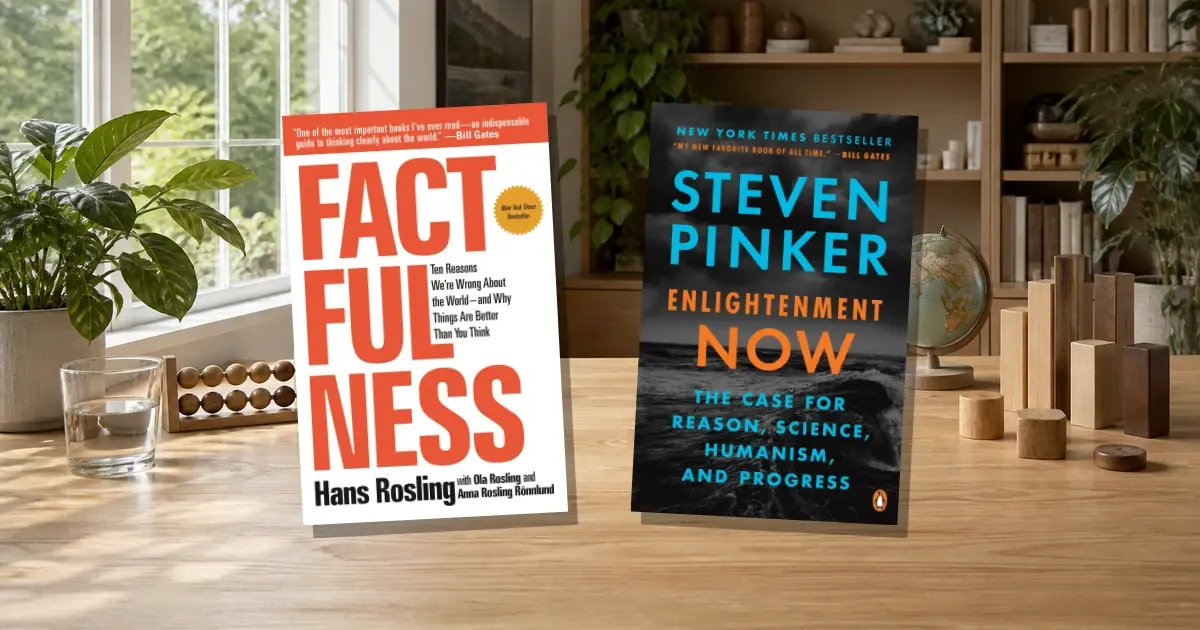
Factfulness begins with recurring errors in ordinary judgment: binary categories, frightening headlines, isolated numbers, straight-line projections, single causes, and urgent demands. Hans Rosling turns each into a checking habit using distributions, trends, rates, proportions, and multiple explanations. Enlightenment Now builds a larger historical case that reason, science, humanism, and institutions have contributed to gains across health, wealth, safety, rights, and knowledge. One is primarily a diagnostic toolkit; the other is an argumentative synthesis.
- A portable method for interrogating dramatic impressions: Factfulness.
- A broad defense of measurable human progress and its enabling ideals: Enlightenment Now.
- Shared premise: serious problems can coexist with improvement.
Optimism becomes useful only when it remains testable
Rosling’s categories make statistical humility memorable, yet a calmer framing can still miss power, distribution, or harms hidden by an average. Pinker’s long series of indicators counters selective memory, yet the chosen measures, baselines, regions, and causal story remain open to debate. Neither “the world is improving” nor “the world is worsening” is a complete empirical claim until an outcome, population, time interval, and comparison are specified.
- Inspect the denominator and the distribution behind an average.
- Separate evidence of a trend from the proposed cause of that trend.
- Ask whether improvement is durable, equally shared, and relevant to the decision at hand.
Which should you read first?
Start with Factfulness if you want habits you can apply to charts, news, risks, and forecasts immediately. Start with Enlightenment Now if you want a sustained thesis about modernity and the institutions that support progress. Then choose one shared indicator and reconstruct it from its cited source: record definition, coverage, uncertainty, and alternative explanations. This turns agreement with the books’ tone into an actual test of their method.
- Define the measure before interpreting its direction.
- Compare absolute counts with rates where both matter.
- Update the conclusion when the population or time window changes.
Sources and scope
Book ideas are attributed to their authors. External evidence is linked directly when a claim needs more than the source book.
- Factfulness: Primary source for the ten instincts and habits involving distributions, trends, rates, risks, and multiple causes.
- Enlightenment Now: Primary source for the historical progress indicators and argument about reason, science, humanism, and institutions.
To report a factual, attribution, rights, or accessibility concern, email hello@wiseley.app.
Questions readers ask
Are both books simply optimistic?
No. Both argue for measuring conditions before reacting, and both acknowledge serious problems. Their vulnerability is not optimism alone but the possibility that selected measures or causal explanations omit important dimensions.
Which book teaches more practical data literacy?
Factfulness is more immediately procedural because its instincts pair common errors with checks. Enlightenment Now supplies a wider set of historical claims on which to practice those checks.