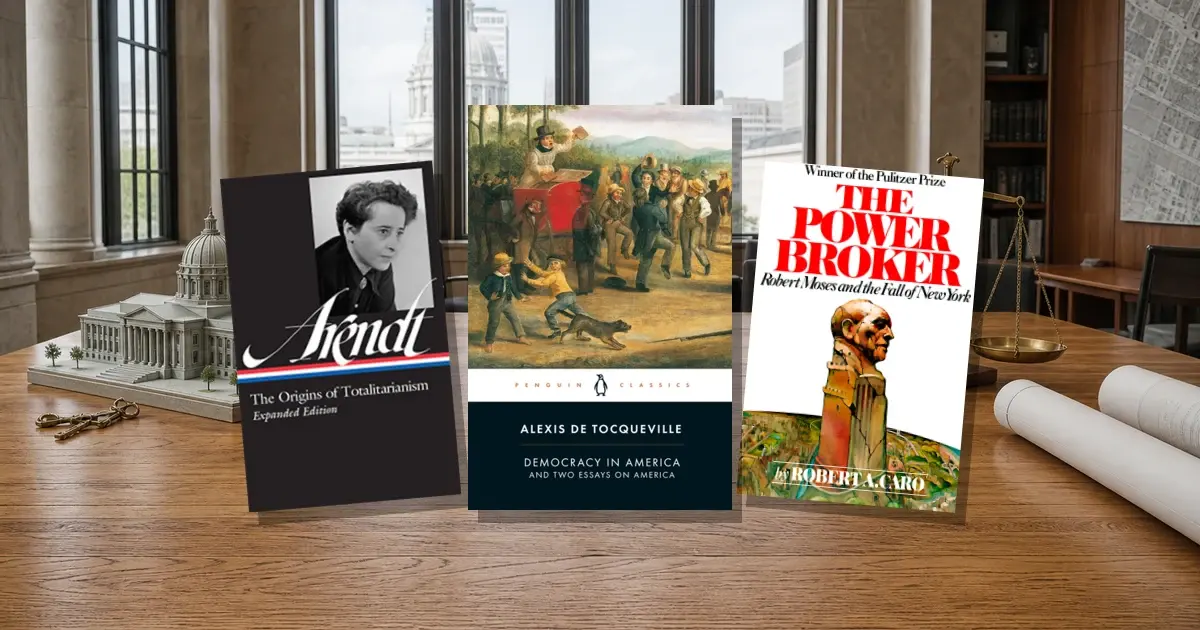
What you'll learn
Key ideas from Democracy in America
These ideas compress the book's argument without treating the author's view as settled fact. Use them as an orientation before reading the full work or listening in Wiseley.
Equality of conditions is the book’s master lens because it reshapes laws, government, opinion, sentiments, and daily practices.
Repeated local responsibility builds practical knowledge, attachment, and public spirit, making liberty a civic practice.
Popular sovereignty remains active between elections through representation, public opinion, parties, the press, and associations.
Its distinctive strength is the possibility of correcting mistakes after experience becomes intelligible, provided society survives and understands the remedy.
Local administration, lawyers, independent judges, and juries provide restraints on majority power while teaching citizens to govern through law.
Legal forms can regularize removal instead of securing democratic equality.
Emancipation can end slavery in law while visible racial stigma and social exclusion survive in custom.
Soft despotism preserves comfort through detailed guardianship while gradually weakening independent action and self-government.
How Democracy in America builds its case
Follow how the book develops its argument. Each note is a brief orientation, not a replacement for the chapter.
Equality Changes the Political World
Tocqueville begins with a question larger than American institutions: what happens when equality of conditions becomes society’s governing fact? He treats equality not merely as a legal rule or distribution of property, but as a historical force.
Colonial Origins of Equality
To understand why democracy took root in America, Tocqueville begins with the continent. North America offered an immense, varied space: mountain chains, rivers, the fertile Mississippi valley, and an Atlantic strip difficult to farm.
Religious and Social Foundations of Sovereignty
Tocqueville begins with a society formed by purpose as well as migration. Puritanism joined religious belief to worldly affairs, so settlers treated civil organization as part of their mission.
Townships as Schools of Freedom
Local self-government is where popular sovereignty becomes habit. Tocqueville treats the township as the smallest political association, but a fragile one whose liberties need law, custom, and public opinion.
Central Government Without Central Administration
Once township life has shown how citizens learn self-government, Tocqueville asks a larger question: can a nation be strong without directing every local act? His answer depends on separating central government from central administration.
Federal Compromise and Weak Executive
The Federal Constitution emerged from a failed union. Wartime necessity held the first system together, but peace exposed a government unable to act reliably at home or abroad.
Federal Courts, Union, and Limits
Federalism becomes workable only when national law can reach someone who must obey it. Tocqueville therefore treats the federal judiciary as the Union’s practical foundation.
Parties, Press, and Associations
Democracy does not act only on election day. Tocqueville presents the people as the sovereign force behind institutions, directing them through representation, public opinion, interests, and passions.
Democracy’s Administrative Tradeoffs
Democracy’s central administrative tradeoff is between broad responsiveness and concentrated competence. Tocqueville rejects the belief that universal suffrage reliably selects the most capable rulers.
Participation Against Majority Tyranny
Tocqueville treats political rights as a school for citizenship. They connect private interest with public law by making people participants in government.
Why American Democracy Holds
Tocqueville explains American democratic durability through three kinds of causes: physical circumstances, laws, and manners. He ranks their effectiveness: physical circumstances help, laws help more, and manners matter most.
Indigenous Dispossession Through Law
Tocqueville’s account of Indigenous decline exposes a limit in his account of democratic legality. He places Indigenous peoples within the racial hierarchy of his era, yet describes European expansion destroying communities while law and humanitarian language accompany the result.
Slavery’s Unequal Legacy
Slavery presents Tocqueville with a problem law alone cannot solve. He separates its immediate cruelty from its enduring social legacy.
Sectional Interests, Expansion, and Union
Tocqueville treats the Union as a balance, not a settled fact. National affairs require national authority, local affairs local authority, and mixed matters may be assigned to either level.
Minds and Culture Under Equality
Equality changes not only who rules, but how people decide what is true. Tocqueville finds no distinct American philosophical school: citizens distrust inherited systems, class maxims, and tradition as final authority, ask their own reason, and prefer useful results to formal rules.
From Individualism to Common Interest
Equality can free people from inherited dependence, but it can also leave citizens facing one another as strangers. Tocqueville calls this tendency individualism: a calm withdrawal into a small circle of family and friends.
Commerce, Labor, and Social Equality
Equality reorganizes economic life by making prosperity widespread rather than a privilege attached to rank. Tocqueville argues that the taste for material well-being often comes first: commerce and manufactures answer it, then strengthen it.
Family, Honor, and Democratic Ambition
Tocqueville carries equality into the household. In an aristocratic family, the father is a ruler, a link to the past, and an interpreter of tradition.
Peace, War, and Soft Despotism
Tocqueville closes his political argument with a paradox. Equality weakens the authority of exceptional individuals and gives majority opinion unusual power.