What you'll learn
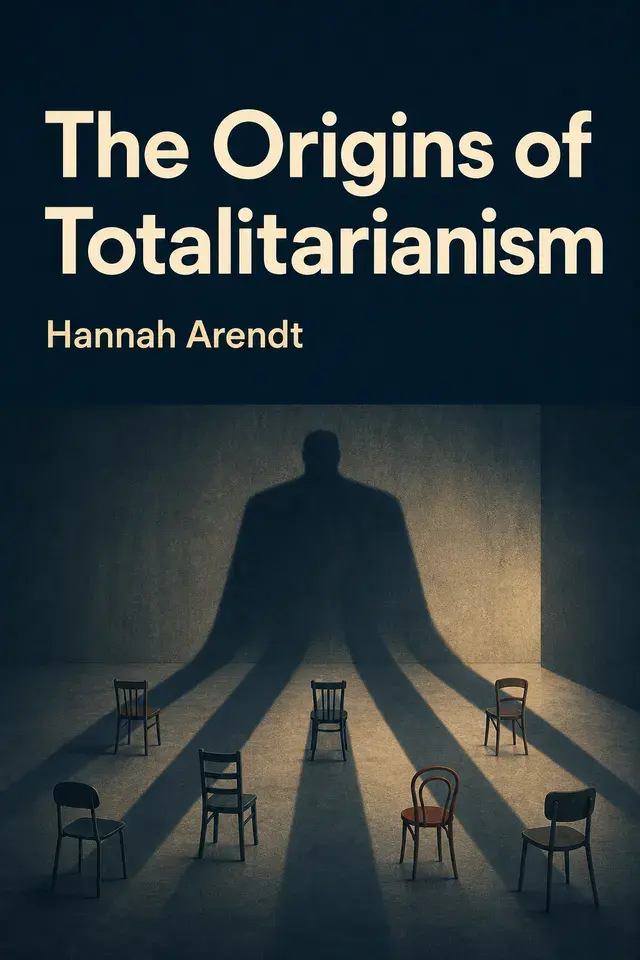
Key ideas from The Origins of Totalitarianism
These ideas compress the book's argument without treating the author's view as settled fact. Use them as an orientation before reading the full work or listening in Wiseley.
Totalitarianism is a distinct form of government seeking total domination, not merely a more violent dictatorship.
Totalitarian movements recruit masses formed by atomization and loneliness, not by shared class interests alone.
Totalitarian propaganda offers a consistent prophetic fiction when ordinary reality appears arbitrary, fragmented, or concealed.
Totalitarian power preserves revolutionary motion because national normalization would confine a universal claim within ordinary borders.
Objective enemies are created from ideological categories, so persecution can target people without hostile acts and expand as the movement names new obstacles.
Camps test total domination by reducing people from legal persons to predictable, interchangeable reactions.
Terror destroys the space between people while ideological deduction replaces experience, making loneliness a foundation for subjects unable to distinguish fact from fiction.
How The Origins of Totalitarianism builds its case
Follow how the book develops its argument. Each note is a brief orientation, not a replacement for the chapter.
A New Form of Government
Totalitarianism begins with a problem of political understanding. After the defeat of Nazi Germany, Arendt treats the recent catastrophe as a historical question.
Masses and the Temporary Alliance
Totalitarian movements become possible when the social ties that once gave people a place, an interest, and a limit have broken down. Arendt calls the resulting population the masses.
How Fiction Becomes Organization
Totalitarian propaganda begins with a problem: ordinary reality is full of accidents, gaps, and contradictions, while uprooted people want an explanation that holds together. The movement offers a complete story in which hidden forces explain visible events and future victory makes present sacrifice meaningful.
Power Kept in Permanent Motion
Taking state power does not complete a totalitarian revolution. It creates a contradiction.
The Police and Objective Enemies
Once a totalitarian movement takes power, its state does not become an ordinary government. The visible administration remains a façade, while the movement’s real executive core is the secret police.
Camps and the Destruction of Personhood
Arendt treats concentration and extermination camps as the decisive laboratories of totalitarian rule. Their purpose was not simply to imprison opponents, extract labor, or exact retaliation.
Ideology, Loneliness, and New Beginnings
Arendt’s final question is not simply why totalitarian regimes used terror or why they spread ideological claims. It is what happens when these forces become one form of government.