What you'll learn
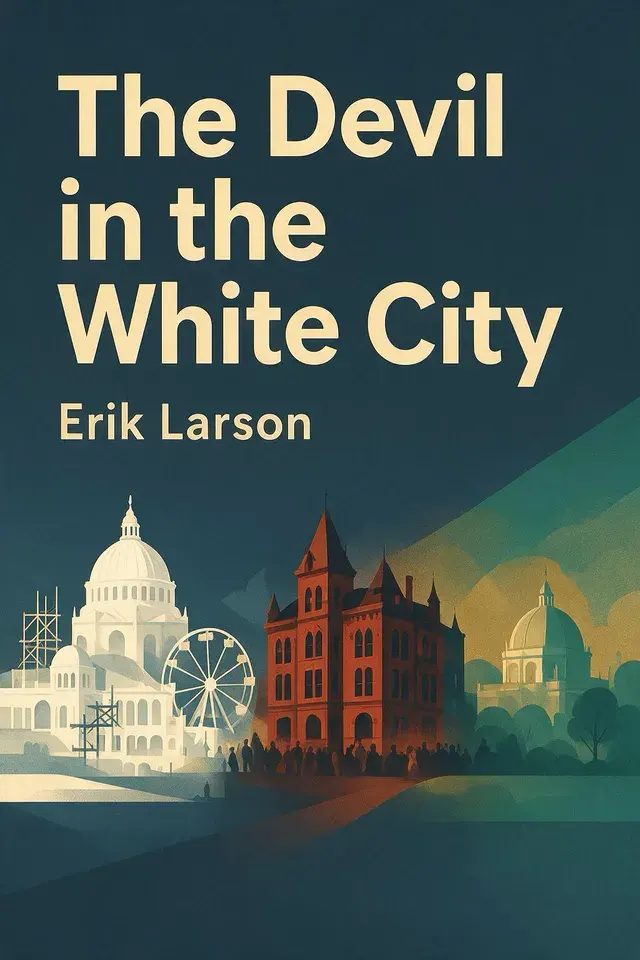
Key ideas from The Devil in the White City
These ideas compress the book's argument without treating the author's view as settled fact. Use them as an orientation before reading the full work or listening in Wiseley.
The book pairs Daniel Burnham’s constructive ambition with H.H. Holmes’s destructive self-mythology through the shared setting of the eighteen ninety-three fair.
The White City’s scale and wonder depended on collective labor, while injuries, poverty, and death exposed its human cost.
Holmes converts medical knowledge, charm, false identities, property, labor, and concealed architecture into a system of private control.
The Midway transformed foreign people, rumor, and staged authenticity into profitable spectacle, showing how memorable publicity could replace accurate description.
Civic services, neoclassical architecture, and electric light make the White City feel like an orderly ideal city by day and night.
July Fourth demonstrated the fair’s power to create mass enchantment, but its immediate attendance collapse exposed the spectacle’s financial limits.
Geyer reconstructs the Pitezel children’s route by joining letters, aliases, hotel records, witnesses, and physical clues.
The fair’s strongest legacy was psychological: it made beauty and coordinated urban design seem possible to ordinary Americans.
How The Devil in the White City builds its case
Follow how the book develops its argument. Each note is a brief orientation, not a replacement for the chapter.
The City and Its Double
The Devil in the White City begins by placing two men beside each other: Daniel H. Burnham, the architect associated with Chicago’s great exposition, and H.H.
The Machinery of Ambition
Chicago’s bid for the fair grew from civic status anxiety as much as from a desire to commemorate Columbus. The city had become a national center of commerce, manufacturing, and architecture, yet eastern critics still imagined it as a crude industrial place.
Hidden Rooms, Public Dreams
Plans matter when they meet ground and human resistance. Here the World’s Columbian Exposition and Holmes’s enterprise face that test in opposite moral directions.
Pressure Makes the System
By early 1893, the fair was becoming presentable through endurance and improvisation rather than ease. Severe cold froze all three of Chicago’s water-system intake valves, yet a heated movable shelter kept work moving on major buildings.
The White City Goes Live
On the night before the fair opened, Jackson Park still looked like a work site. Ponds, freight cars, lumber, crates, lunches, litter, and debris covered the grounds.
The Cost of Enchantment
By June, the fair had become a luminous, orderly city beside the lake. But its success still depended on ordinary problems: attracting enough visitors, keeping them comfortable, and paying for the machinery of wonder.
Triumph, Violence, and Closure
Late in the fair, the White City became a stage on which people imagined new futures. The Ferris Wheel had become a romantic ritual, although its operator refused most requests to marry at the summit.
The Black City and the Hunt
When the fair closed, its palaces did not simply disappear. They became shelters.
What the Dream Left Behind
When the gates closed, the White City did not simply become a vanished spectacle. Larson traces its afterlife through American culture, technology, entertainment, and civic memory.