What you'll learn
Key ideas from The Myth of Sisyphus
These ideas compress the book's argument without treating the author's view as settled fact. Use them as an orientation before reading the full work or listening in Wiseley.
The absurd is a relation between the human demand for clarity and a world that offers no conclusive answer.
Meaninglessness does not establish that life is unworthy, and physical suicide ends the consciousness sustaining the confrontation.
Lucidity preserves limited reason and an irrational world, requiring renewed revolt without hope rather than reconciliation, resignation, or suicide.
Absurd freedom is finite freedom of thought and action, released from inherited purposes but bounded by mortality and the luck of how much life remains.
The conqueror turns lucid struggle toward history, shared action, friendship, and threatened human solidarity rather than eternal victory.
Absurd creation gives concrete form to experience without turning art into hidden meaning, consolation, or a promise of future value.
The decisive scene is the lucid descent, where awareness makes him superior to fate rather than victorious over it.
The struggle gives present life value, but it offers no immortality, final success, or metaphysical rescue.
How The Myth of Sisyphus builds its case
Follow how the book develops its argument. Each note is a brief orientation, not a replacement for the chapter.
The Absurd and the First Test
Camus begins with a question so practical that it outranks almost every abstract problem: is life worth living? The answer matters because it precedes action.
No Appeal: From Escape to Lucid Living
Having received the diagnosis of absurdity as a tension between a mind that wants clarity and a world that resists it, Camus examines the urge to escape through thought. The issue is not whether faith or metaphysics can feel legitimate.
Three Finite Ways of Living
With revolt, finite freedom, and passion as its framework, Camus now tests the absurd ethic against three lives: Don Juan, the actor, and the conqueror. Each shows a different way to spend a mortal existence without appealing to eternal completion.
Art Against the Return of Hope
After the earlier examination of lucid living, Camus turns to creation. He calls it the supreme absurd joy, not because art rescues us, but because it keeps the creator in tension with the world.
Sisyphus, Owner of the Struggle
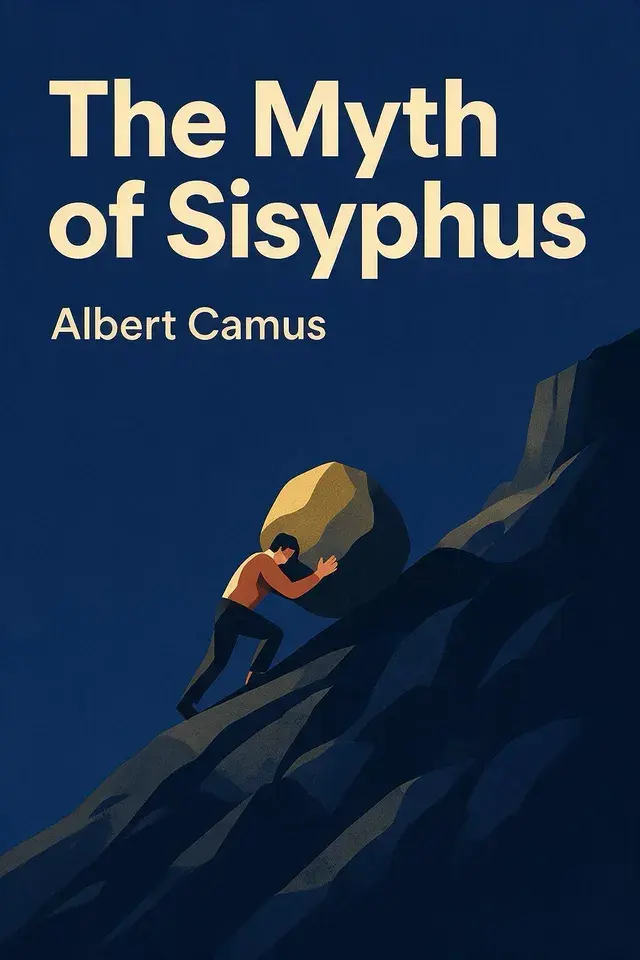
After showing how an absurd life can appear in passion, action, and creation, Camus turns to an ancient myth that gathers these consequences into one figure. Sisyphus is condemned by the gods to roll a rock up a mountain.