What you'll learn
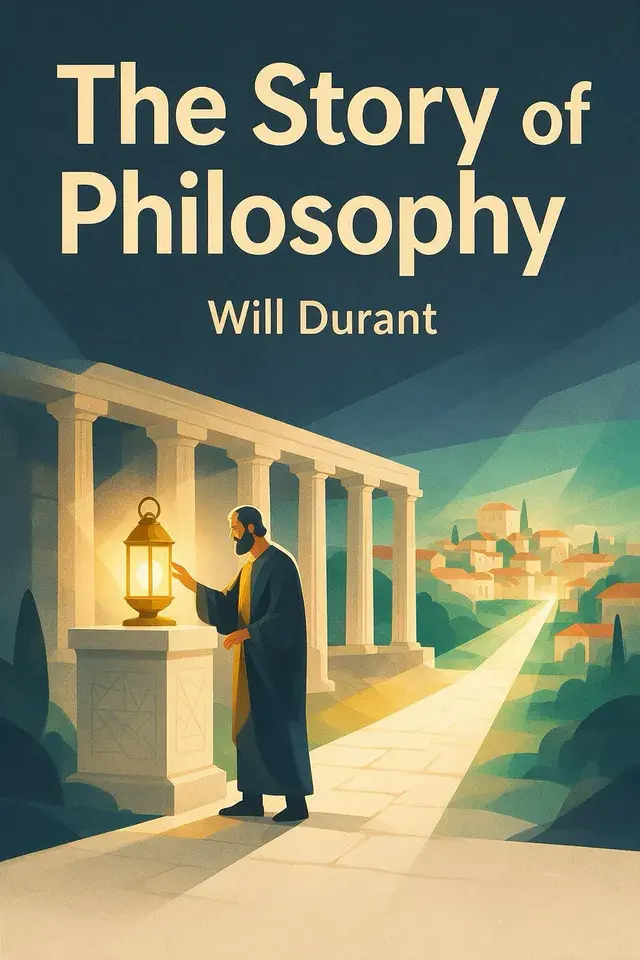
Key ideas from The Story of Philosophy
These ideas compress the book's argument without treating the author's view as settled fact. Use them as an orientation before reading the full work or listening in Wiseley.
Durant defines philosophy as the synthesis of experience, values, and purposes that reconnects specialized knowledge with wisdom.
Matter and form, internal purpose, habituated virtue, the golden mean, and rational happiness connect Aristotle’s metaphysics to lived character.
The Idols and induction demand disciplined classification, experiment, and the search for forms rather than reliance on inherited authority.
His knowledge ladder moves from hearsay and vague experience toward deduction and rare intuition, making understanding of causes the basis of freedom.
Kant limits theoretical reason while grounding scientific necessity in mental forms and moral faith in practical reason.
Hegel treats contradiction as the engine by which thought, society, and history develop toward more inclusive forms.
Nietzsche replaces herd morality with strength, will to power, value-creation, and self-overcoming, using the Superman and eternal recurrence as guiding tests.
Dewey treats thought as an instrument of adjustment and makes education, growth, intelligence, and democratic participation central to ethical life.
How The Story of Philosophy builds its case
Follow how the book develops its argument. Each note is a brief orientation, not a replacement for the chapter.
From Greek Inquiry to Just Rule
Durant opens with a problem: knowledge can multiply while wisdom becomes harder to share. Science separates experience into processes and parts; philosophy seeks meaning, values, purposes, and ends.
Aristotle Organizes Nature and Rule
After Plato’s idealized political design, Aristotle asks how philosophy can become an organized account of the world we can investigate. At the Lyceum, students share meals, walk while discussing problems, and make regulations for their large school.
Bacon Rebuilds Knowledge for Use
Durant presents Francis Bacon as a hinge between scholastic inheritance and philosophy organized around discovery. Aristotle had gathered and classified nature, but weak instruments, scarce experiment, and untested assumptions limited the system.
Spinoza’s Freedom Within Necessity
Bacon organized inquiry around ordered experience and useful discovery. Spinoza shifts the question to the reality knowledge must understand, and to the freedom understanding might provide.
From Enlightenment Critique to Kant
The movement from Voltaire to Kant changes philosophy’s central question. It begins by asking which inherited beliefs deserve obedience and ends by asking what the mind can know, and what moral commitments remain possible when proof reaches its limit.
Dialectic, Will, and Suffering
After Kant, philosophy faced a choice. Kant had shown that the mind actively organizes experience, while theoretical reason cannot reach the thing-in-itself.
Evolution, Power, and Self-Overcoming
After Schopenhauer had made suffering and desire central, Durant turns toward philosophies that ask whether struggle can become progress. Auguste Comte seeks unity through science; Herbert Spencer extends evolution into a broad account of nature and society; Friedrich Nietzsche makes struggle itself the test of strength and value.
Life, History, and Experience
After the preceding evolutionary and power-centered systems, Durant turns to thinkers who ask whether philosophy has mistaken the world for a machine or a diagram. Their answers diverge.
Pragmatism and Philosophy’s Future
At the end of Durant’s survey, philosophy is asked to leave detached systems and show what thinking can do in an unfinished world. William James and John Dewey supply an operating standard: ideas are instruments, and their worth appears in the consequences they produce.