What you'll learn
Key ideas from The Bhagavad Gita
These ideas compress the book's argument without treating the author's view as settled fact. Use them as an orientation before reading the full work or listening in Wiseley.
Arjuna’s crisis makes the moral meaning of action the question that drives the teachings that follow.
The indwelling Spirit is unborn, imperishable, and untouched by the body’s death.
Karma-yoga transforms necessary work into a path of freedom by releasing attachment to results rather than ending action.
The wandering mind is not expected to remain still; each movement toward desire becomes an occasion for patient redirection.
The text contrasts desire-driven worship and heavenly merit, which have temporary destinations, with devotion aimed beyond recurring rebirth.
The universal form places all animate and inanimate existence within Krishna’s single, radiant body.
Sattva binds through knowledge and pleasure, rajas through desire and action, and tamas through heedlessness, sleep, and delusion.
Divine character is marked by sincerity, self-control, compassion, and humility, while pride, anger, greed, and contempt form a demonic orientation toward bondage.
How The Bhagavad Gita builds its case
Follow how the book develops its argument. Each note is a brief orientation, not a replacement for the chapter.
The Crisis Before Action
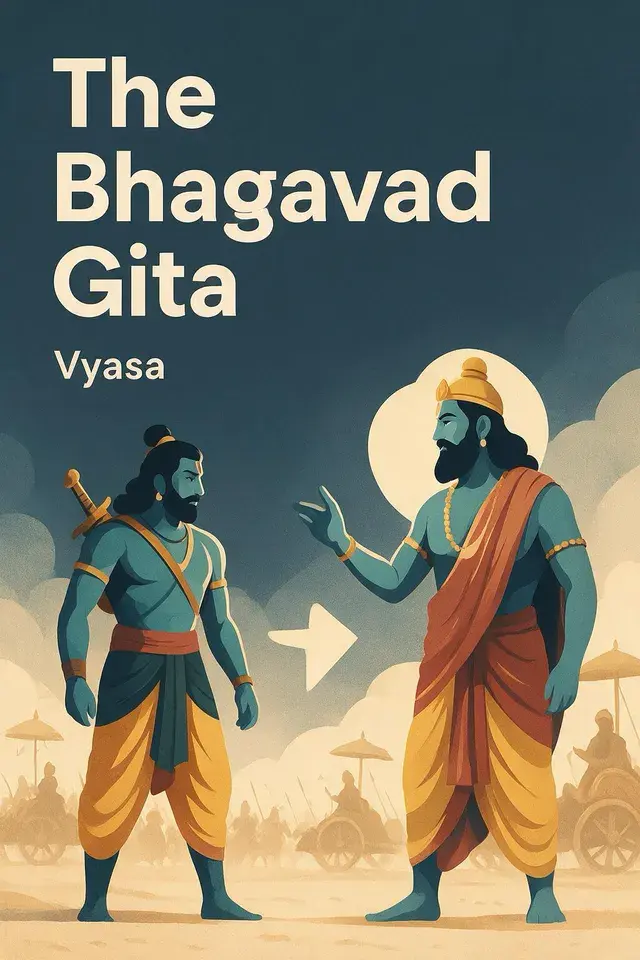
The Bhagavad Gita opens at the instant when action becomes morally impossible. A battlefield stands before Arjuna, a warrior expected to fight, yet duty collides with his recognition of what fighting means.
The Eternal Self and Duty
Arjuna’s distress is about more than the danger of battle. He sees the possible destruction of family and the moral disorder that may follow, so bodily death appears tied to the collapse of everything that gives life meaning.
Action Without Attachment
After the earlier distinction between the imperishable Self and changing bodies, the Gita turns to a practical question: what should a person do while living and acting in the world? Krishna's answer is karma-yoga, action without attachment.
Training the Wandering Mind
Having distinguished inward renunciation from simply stopping outward activity, the Gita now turns to the discipline that makes such renunciation real. Meditation is presented not as an idea about detachment, but as a way of training attention.
Devotion and the Supreme
If earlier teaching asks how a person can act without bondage and train a restless mind, this chapter asks where transformed consciousness is directed. Its answer is devotion to the Supreme, not as an alternative to knowledge and action, but as their most accessible meeting point.
The Universal Form and Choice
After Krishna has described his relation to creation and his manifestations, Arjuna asks to see that reality directly. Hearing about divine origin, dissolution, and majesty has prepared him for a test of vision.
Field, Qualities, and Freedom
The teaching now turns from the cosmic vision to an anatomy of embodied life. It asks us to distinguish what is experienced from what knows experience.
Ethics, Faith, and Surrender
The Gita closes by asking what its teaching looks like when it is embodied in a person. Its answer begins with character.