What you'll learn
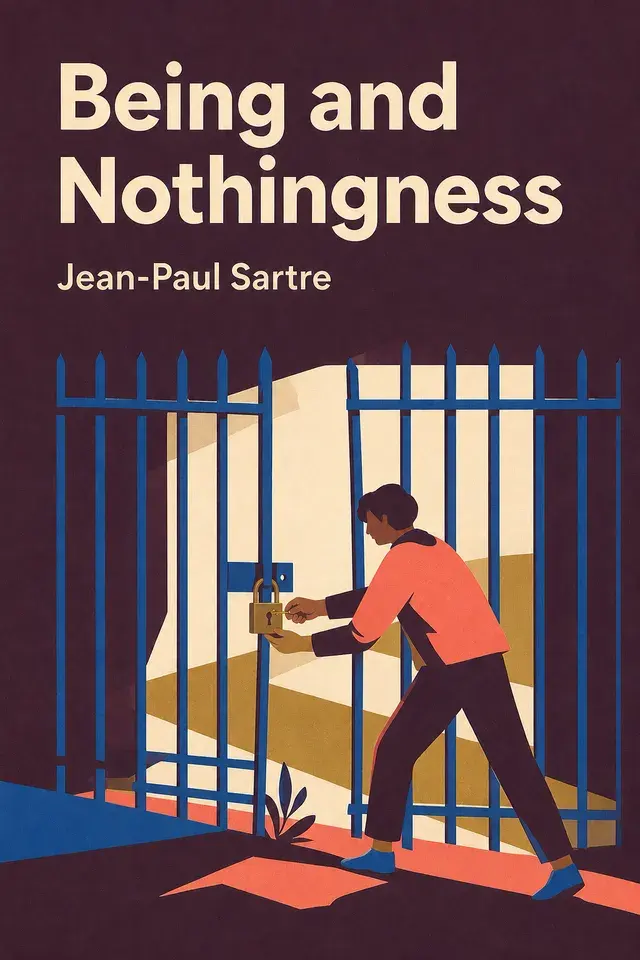
Key ideas from Being and Nothingness
These ideas compress the book's argument without treating the author's view as settled fact. Use them as an orientation before reading the full work or listening in Wiseley.
Appearances are positive disclosures organized into inexhaustible series, not surfaces hiding a truer reality.
Bad faith flees anguish by treating live possibilities, essence, roles, or determinism as fixed realities, while hiding that the evasion remains free.
Lack generates desire and value by orienting consciousness toward a missing totality that is normative but never a completed fact.
Past, present, and future are interdependent modes in which facticity, presence, and possibility become intelligible.
The Look makes the self an object for another freedom, decentering the world and turning possibilities into probabilities without abolishing freedom.
Action is intentional projection toward a desirable end that is not yet real; accidental consequences alone do not constitute action.
Existential responsibility concerns authorship of a situation, not legal guilt, omnipotence, or the power to control every outcome.
How Being and Nothingness builds its case
Follow how the book develops its argument. Each note is a brief orientation, not a replacement for the chapter.
Appearances, Being, and Nothingness
Sartre begins with appearances, rejecting the idea that they conceal a deeper reality. An existent is the connected series of ways it manifests itself.
Nothingness, Freedom, Bad Faith
Having established that nothingness is not an independent realm outside being, Sartre asks what kind of being can introduce it into the world. Being-in-itself is full positivity; it cannot receive nothingness or generate it by itself.
The For-Itself as Lack
Sartre asks what consciousness is. The answer begins with the for-itself. Unlike the in-itself, which coincides completely with itself, the for-itself is present to itself without being identical with itself. Consciousness of belief is not a second belief beside the first; belief exists as consciousness of belief, in a unity that never becomes identity. This self-presence is a relation to oneself maintained by nothingness. The for-itself can found its consciousness, but not the fact that it exists. It is…
Temporality and Reflection
For Sartre, time is not a container holding independent nows. If each instant were complete in itself, nothing would explain succession, transition, or the persistence of one life through change.
Knowledge, World, and Transcendence
Chapters 3 and 4 showed the for-itself as a self-detotalizing, temporal being. This chapter asks what that structure discloses: a world.
The Other’s Look and Body
At this point, Sartre’s analysis can no longer remain with consciousness alone. The problem is not how an isolated mind infers another mind from bodily evidence, but how another freedom enters experience.
Conflict, Desire, and the We
Once the Look makes each person both a freedom and an object for another, concrete relations become attempts to live with that contradiction. Sartre treats love, language, masochism, indifference, desire, sadism, and hatred as shifting projects within one circle, not fixed stages.
Freedom as Projected Action
Sartre begins by asking what it means to act. An action intentionally modifies the world: consciousness organizes means toward an anticipated end.
Situation, Facticity, and Responsibility
The previous discussion treated freedom as action and projection. Here Sartre asks what that freedom means when it is lodged in a body, a place, a history, and a world shared with others.
Projects, Possession, and Ethics
Sartre now asks how the ontology of lack and projection appears in individual life. His answer is existential psychoanalysis.