What you'll learn
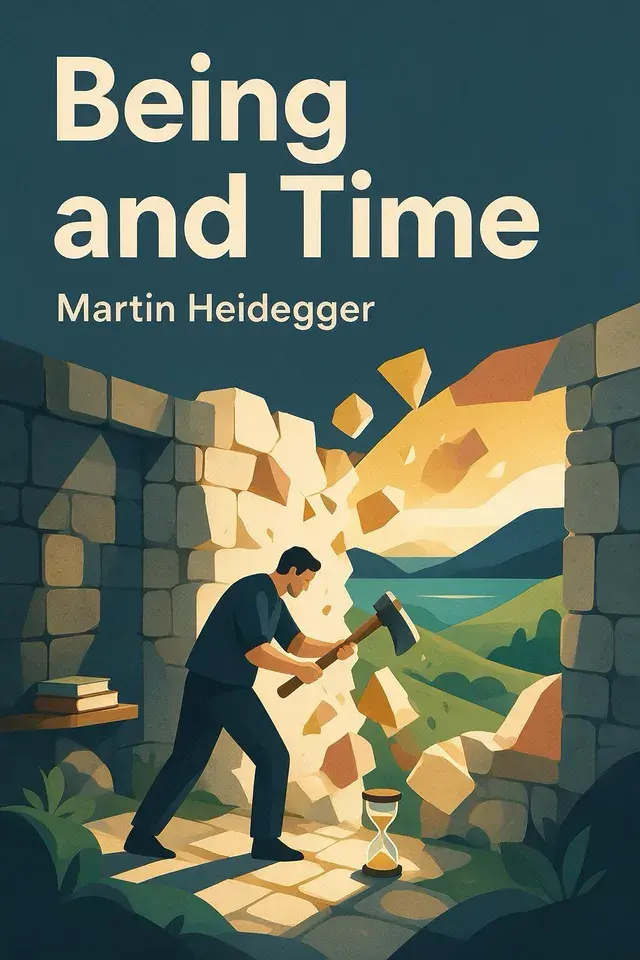
Key ideas from Being and Time
These ideas compress the book's argument without treating the author's view as settled fact. Use them as an orientation before reading the full work or listening in Wiseley.
Being and Time proposes time as the horizon of understanding Being while keeping the question of the human being open.
Being-in-the-world describes a relation belonging to existence itself, not a person inside a container.
Anxiety discloses being-in-the-world itself, loosening ordinary significance and exposing nothingness without turning it into an object.
Authenticity is a modified grasp of fallen everydayness, not an escape from ordinary existence.
Saying is showing: language opens a way for beings to appear while every disclosure remains vulnerable to concealment.
Metaphysics becomes onto-theological and nihilistic when it explains beings without asking about Being’s own truth.
How Being and Time builds its case
Follow how the book develops its argument. Each note is a brief orientation, not a replacement for the chapter.
Reopening the Question of Being
The opening problem is deceptively simple: what does “Being” mean? The selection argues that contemporary people have no adequate answer.
Dasein and the Shared World
To ask what Being means, Heidegger starts with the being for whom the question can arise: Dasein. The word names human existence, but not a mind detached from its surroundings.
Everydayness, Anxiety, and Authenticity
The previous chapter established the starting point: Dasein is already involved in a world, not standing outside it as a detached observer. This chapter asks what that involvement becomes in ordinary life.
Language as Disclosure
Once existence is understood as an openness in which beings can appear, a further question arises: how does that openness become shared and intelligible? In the passages gathered here, Heidegger locates the answer in language.
Metaphysics, Faith, and Liberation
At the project’s final turn, the question of Being turns back upon philosophy itself. Inherited frameworks must now be examined, not simply repeated.