Start with the reading experience you want
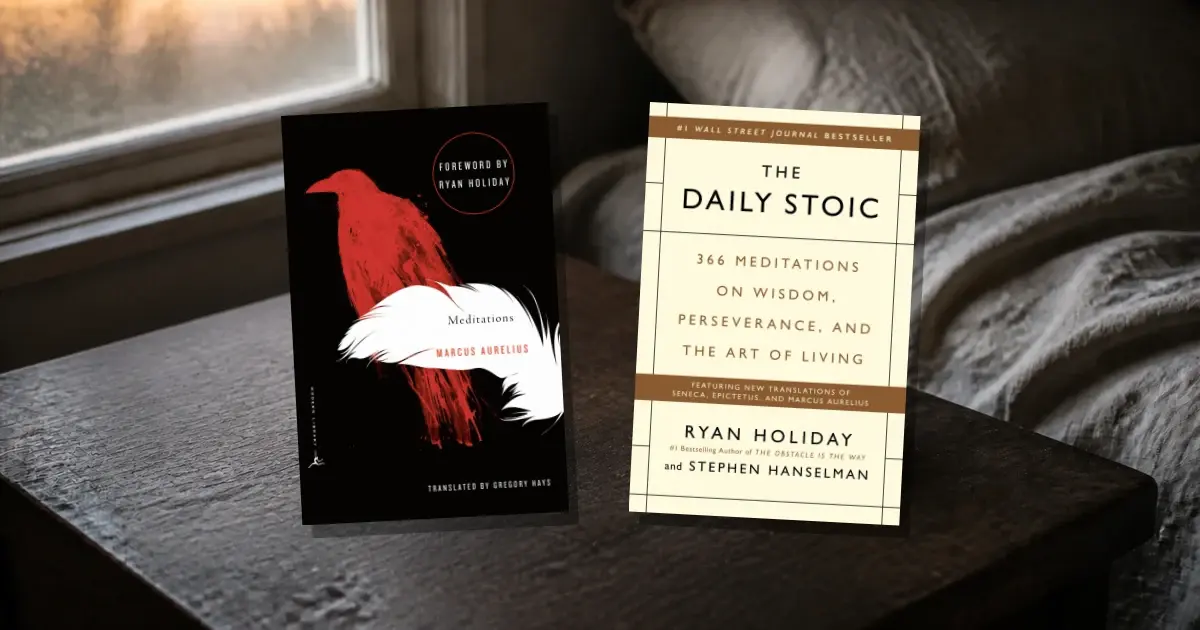
Meditations is a private set of reminders written by Marcus Aurelius, not a systematic introduction composed for modern readers. Its repetition and abruptness are part of the encounter: you watch someone return to attention, duty, mortality, judgment, and self-command. The Daily Stoic selects short passages from several Stoic voices and adds modern commentary in a calendar structure. It offers orientation and consistency, but it necessarily filters the tradition through an editor’s sequence.
- Want direct contact with a primary ancient text: Meditations.
- Want a guided daily practice and wider cast of Stoics: The Daily Stoic.
- Want historical depth: use either as an entry, then read complete primary works and context.
Their strengths create their limits
Meditations feels intimate because it was not written to persuade you, yet that privacy means examples arrive without a teaching sequence. The Daily Stoic is easy to return to, yet one page can make a difficult idea appear complete before it has been tested. Do not measure either book by the number of lines underlined. A Stoic claim becomes useful only when you can distinguish what is within your agency, identify the judgment adding distress, and choose a responsible action.
- Read slowly enough to restate a passage in ordinary language.
- Name what the passage does not excuse—avoidance, indifference, or harm.
- Test one idea in a small real situation before collecting another quotation.
A beginner-friendly reading order
Try seven entries from The Daily Stoic to learn recurring vocabulary, then read one book of Meditations without chasing every reference. Keep a two-column note: “claim” and “practice.” If the ancient text feels alive, continue directly. If it feels opaque, return to the guide for orientation and try again. This avoids turning a daily reader into a substitute for the source or turning difficulty into a test of worthiness.
- One passage, one plain-language restatement.
- One situation in which the idea might apply.
- One boundary that keeps the idea from becoming an excuse.
Sources and scope
Book ideas are attributed to their authors. External evidence is linked directly when a claim needs more than the source book.
- Meditations: Primary source for the form and recurring Stoic reminders attributed to Marcus Aurelius.
- The Daily Stoic: Primary source for the modern calendar structure and selected daily practices.
To report a factual, attribution, rights, or accessibility concern, email hello@wiseley.app.
Questions readers ask
Is The Daily Stoic a replacement for Meditations?
No. It is a curated practice book drawing from several sources. It can prepare you for primary texts, but its excerpts and commentary are a distinct work.
Why does Meditations repeat itself?
Marcus was reminding himself of principles under changing pressures, not building a linear textbook. Repetition shows practice in progress and can be read as evidence that insight alone was not enough.