What you'll learn
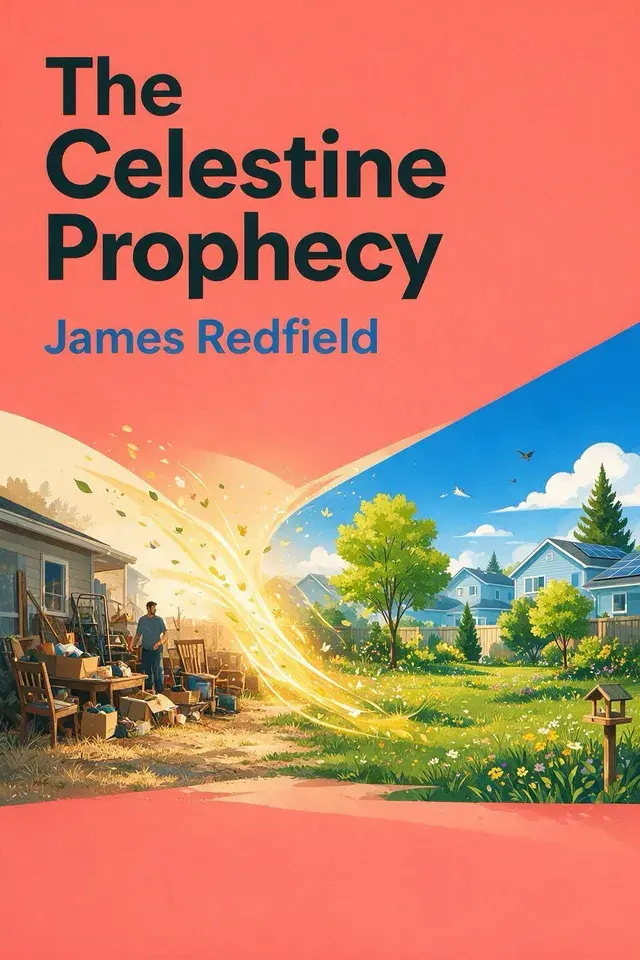
Key ideas from The Celestine Prophecy
These ideas compress the book's argument without treating the author's view as settled fact. Use them as an orientation before reading the full work or listening in Wiseley.
The First Insight frames synchronistic events as possible signals that awaken a search for purpose.
The Third Insight treats matter and living systems as expressions of underlying energy that beauty and attention may help people perceive.
The Fifth Insight replaces energy competition with connection to a higher source, presented as an experiential remedy for human depletion.
The four control dramas secure attention through intimidation, interrogation, aloofness, or appeals to guilt and helplessness.
Conscious appreciation is described as reciprocal energizing that preserves separate growth without attachment or control.
Conscious conversation lets attention move toward the strongest emerging idea through responsive turn-taking and reciprocal energy.
The book frames conscious evolution as a possible synthesis of scientific inquiry, religious experience, and deliberate collective change.
How The Celestine Prophecy builds its case
Follow how the book develops its argument. Each note is a brief orientation, not a replacement for the chapter.
Awakening Through Coincidence
The book opens by treating coincidence as a possible interruption of ordinary life. The First Insight says sudden synchronistic events can become meaningful when a person recognizes and interprets them.
Energy Beneath the Visible
At Viciente, the book turns toward the physical world. The Third Insight predicts that people will perceive an energy underlying and radiating from everything, including themselves.
Connection Beyond Competition
Earlier, the book described human conflict as a struggle for energy: when people feel cut off, they try to draw strength through one another. The Fifth Insight asks what changes when energy can come from somewhere larger.
Control Dramas, Hidden Mission
The Sixth Insight turns the book’s spiritual theory into a method of self-diagnosis. Building on the earlier account of attention and energy, it asks why people keep repeating the same ways of controlling an encounter.
Relationships Without Energy Theft
Within the book’s energy model, the Eighth Insight asks people to stop treating relationships as supplies of vitality. It applies the earlier logic of energy exchange to children, romantic partners, and conflict.
How Groups Generate Insight
After presenting the Eighth Insight as a way to relate to one person without taking that person’s energy, the book asks what happens when several people practice it together. It begins with “thought groups”: people whose interests and development follow similar lines may think and express themselves similarly.
The Future of Conscious Evolution
The Ninth Insight is the book’s forward-looking answer to what the earlier discoveries are for. It presents history as moving from medieval religious certainty, through Renaissance inquiry and scientific materialism, toward conscious cooperation with a spiritual reality.