What you'll learn
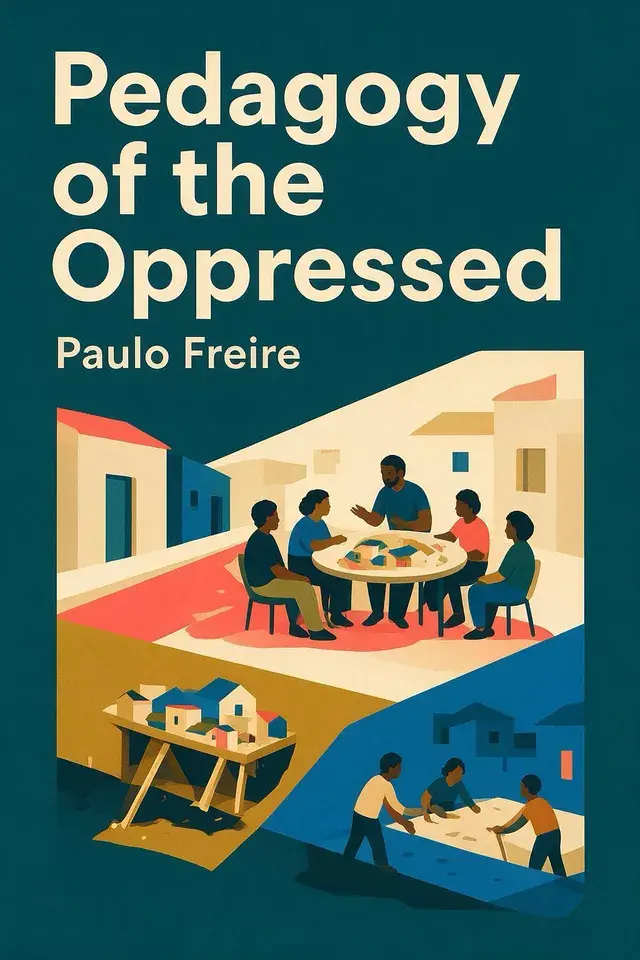
Key ideas from Pedagogy of the Oppressed
These ideas compress the book's argument without treating the author's view as settled fact. Use them as an orientation before reading the full work or listening in Wiseley.
Oppression denies the oppressed full human existence and damages the oppressor through the power used to deny it.
Critical reading moves from lived experience and common sense toward relational and structural understanding.
Democratic teaching preserves teacher–student difference while joining authority to freedom, disclosure, questioning, and respect.
Critical understanding prepares people for change, but organized action is needed to transform perception into collective praxis.
Unity in diversity joins class, race, sex, and culture without making any one category explain the whole social order.
Participatory democracy links material provision, cooperative production, democratic schooling, and self-management under real political limits.
How Pedagogy of the Oppressed builds its case
Follow how the book develops its argument. Each note is a brief orientation, not a replacement for the chapter.
Hope and Reciprocal Humanization
Freire opens with a lesson about the distance between an abstract principle and a lived situation. In a seminar on family discipline, he cited Piaget and argued for dialogue rather than violent punishment.
Internalized Domination and Critical Reading
Domination does not remain outside people. In Freire’s account, a social order can enter consciousness until those who suffer it begin to judge themselves by standards that diminish them.
Dialogue, Authority, and Democratic Teaching
Freire’s educational argument turns on a practical question: how can teaching be rigorous without making knowledge the teacher’s property? He treats educational practice as a whole.
From Critical Insight to Collective Praxis
Critical understanding changes what people can see, but seeing more clearly does not by itself liberate anyone. A revised perception can create a disposition to change reality; it cannot change reality alone.
Pluralism and the Reinvention of Democratic Power
Freire’s final institutional question is not how a liberated movement can seize power once, but how people can make power democratic and keep it open to revision. His answer begins with unity in diversity.