What you'll learn
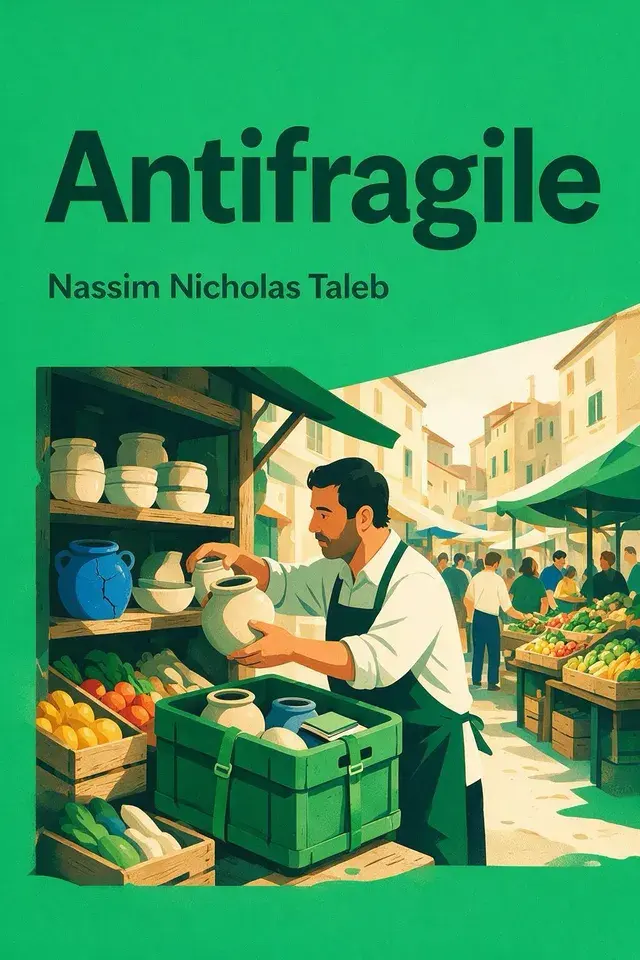
Key ideas from Antifragile
These ideas compress the book's argument without treating the author's view as settled fact. Use them as an orientation before reading the full work or listening in Wiseley.
The Triad distinguishes fragility, robustness, and antifragility by whether disorder causes loss, little change, or improvement.
Bounded stress can act as information, prompting overcompensation, repair, adaptation, or sharper attention.
Errors generate useful selection only when failures are localized, survivable, and informative rather than contagious or system-destroying.
Iatrogenics names harm created when an intervention’s delayed costs exceed its probabilistic benefits.
Path dependence makes survival prior to returns because irreversible damage can leave a system broken after conditions improve.
Optionality preserves the right to benefit from favorable change without imposing equal obligation under unfavorable conditions.
Via negativa treats removing known fragilities as more dependable than adding confident prescriptions under uncertainty.
Ethical fragility appears when decision-makers keep upside while exporting losses to people who cannot see or resist the exposure.
How Antifragile builds its case
Follow how the book develops its argument. Each note is a brief orientation, not a replacement for the chapter.
The Antifragile Triad
The chapter begins with a problem of vocabulary. We already have words for things that break under stress and for things that withstand it.
Stressors Become Information
After naming antifragility, Taleb asks how a disturbance becomes a gain. His answer begins with information.
Layers, Errors, and Survival
An antifragile system is not always a stronger version of the thing we can see. Sometimes its strength appears at a higher layer, paid for by weakness or failure below.
Distributed Risk, Local Variation
Taleb's central distinction here is between visible variation and hidden exposure. He compares identical twins with roughly comparable long-run earnings.
Intervention and the Forecast Trap
Once fragility is visible, the question changes. It is not simply what might happen next, but what our attempt to help could damage.
Seneca, Survival, and the Barbell
Personal antifragility begins with a blunt question: what could ruin me? Fat Tony’s practical nonsuckerness is to detect exposure before admiring expertise.
Optionality, Asymmetry, and Tinkering
Optionality is the mechanism that turns uncertainty from mere danger into possible advantage. For Taleb, an option is a right without an obligation.
Causal Illusions and Retrospective Credit
To explain prosperity, innovation, or professional success, we often treat a visible companion as the cause. A university, research program, or official profession may be present when success appears without producing it.
Ecological Learning and the Tacit Test
Education is often sold as a national growth machine, but the author asks whether schooling causes prosperity or merely accompanies it. At the country level, he treats the arrow from rising literacy to rising income as unproven.
Convexity Reveals Hidden Fragility
Taleb turns the stone-and-pebbles story into an operational rule. A king receives one large stone and an equal weight of pebbles.
Subtract, Endure, and Survive
Once fragility is visible, the practical question changes. Instead of asking what new addition will improve a system, ask what commitment can be removed before it breaks.
Medicine, Fasting, and Mortality
The earlier case for via negativa becomes concrete when Taleb turns to the human body. His rule is not that medicine should do nothing, but that intervention deserves a high threshold when visible benefit is small and hidden downside may be large.
Skin in the Game
At the end of Antifragile, the question is not only how a system responds to stress. It is also who pays when a decision goes wrong.