What you'll learn
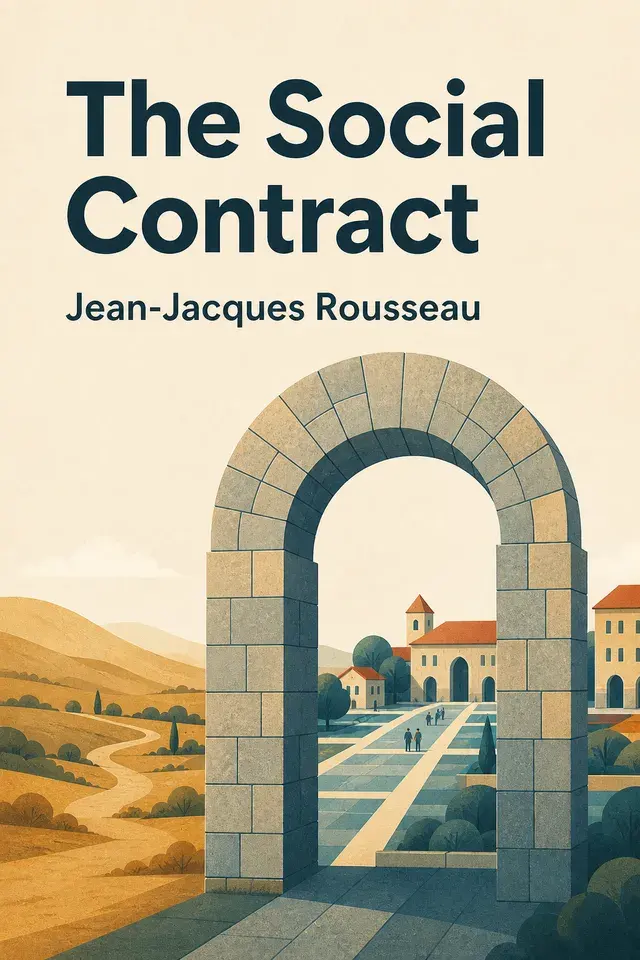
Key ideas from The Social Contract
These ideas compress the book's argument without treating the author's view as settled fact. Use them as an orientation before reading the full work or listening in Wiseley.
Rousseau’s central problem is how people born free can belong to a political community without becoming dependent on another’s private will.
The general will expresses identification with a common good, not simply the preference of a numerical majority or the power of a faction.
Force can compel obedience, but only agreement can create a moral right to rule.
The compact makes each person both a participant in the sovereign and a subject bound by reciprocal obligations.
A law addresses citizens as a body and actions abstractly; a decree addresses a particular person or case.
Government executes the sovereign people's laws as a commissioned intermediary whose authority remains subordinate and revocable.
Legislative sovereignty cannot be represented; deputies may administer existing laws but cannot make unratified laws binding.
Civil faith limits public dogma to moral duty and the sanctity of law while rejecting intolerance and rival sovereignty.
How The Social Contract builds its case
Follow how the book develops its argument. Each note is a brief orientation, not a replacement for the chapter.
The Problem of Political Freedom
Rousseau’s political problem begins with a contradiction. Human beings are born free, yet social life can place them in relations of dependence that resemble slavery.
The Compact Creates Civil Freedom
Rousseau begins with a stark contrast: people are born free, yet everywhere they live under authority. He does not claim to know how freedom was historically lost.
The General Will Becomes Law
Once the social compact has made a people into a political body, Rousseau asks what gives that body movement and direction. His answer is legislation.
Government as a Revocable Instrument
To understand Rousseau's idea of government, begin with a simple distinction. Every free action requires both a determining will and the physical power to carry it out.
How Political Bodies Decay
Rousseau treats government as a necessary but dangerous instrument. The people are sovereign, while government applies general laws through particular acts.
Institutions That Preserve Sovereignty
Once the people have been established as sovereign, a practical question remains: how can their sovereignty stay real in public life? Rousseau answers that participation must be organized according to the issue and the condition of the state.
Civil Religion and Civic Unity
Rousseau completes his political argument by asking what religion can contribute to a state. Religion can strengthen public duties, justice, law, and loyalty to the social contract.